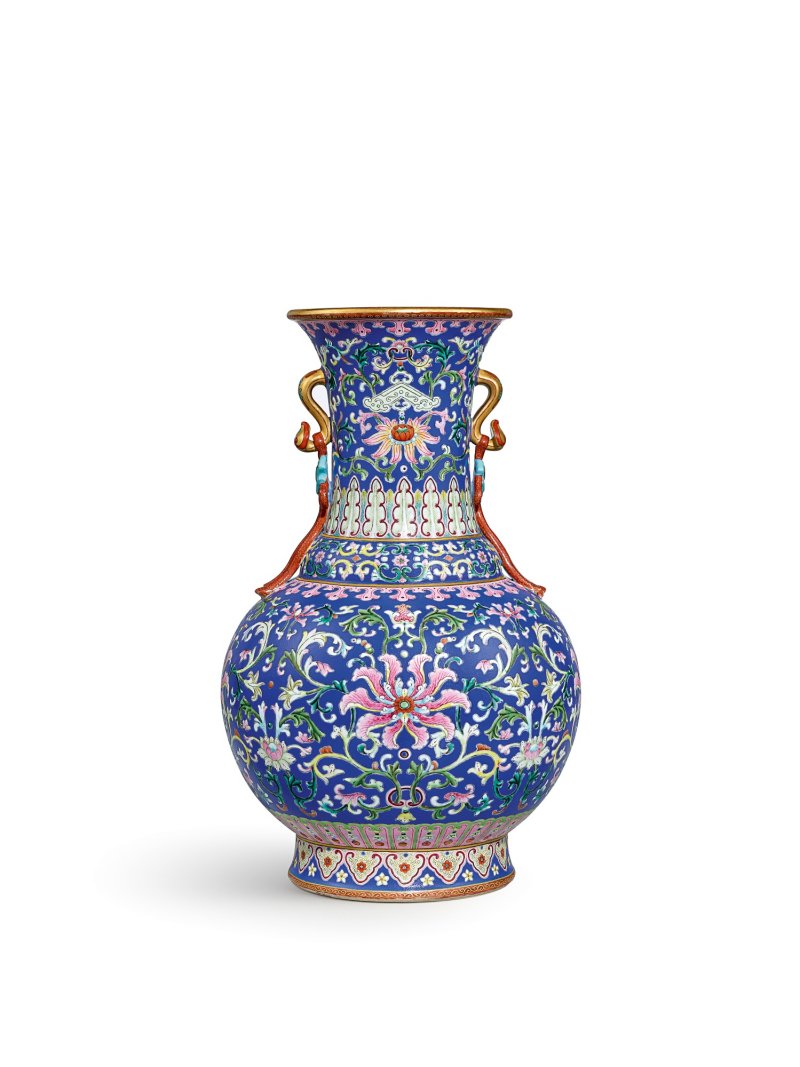

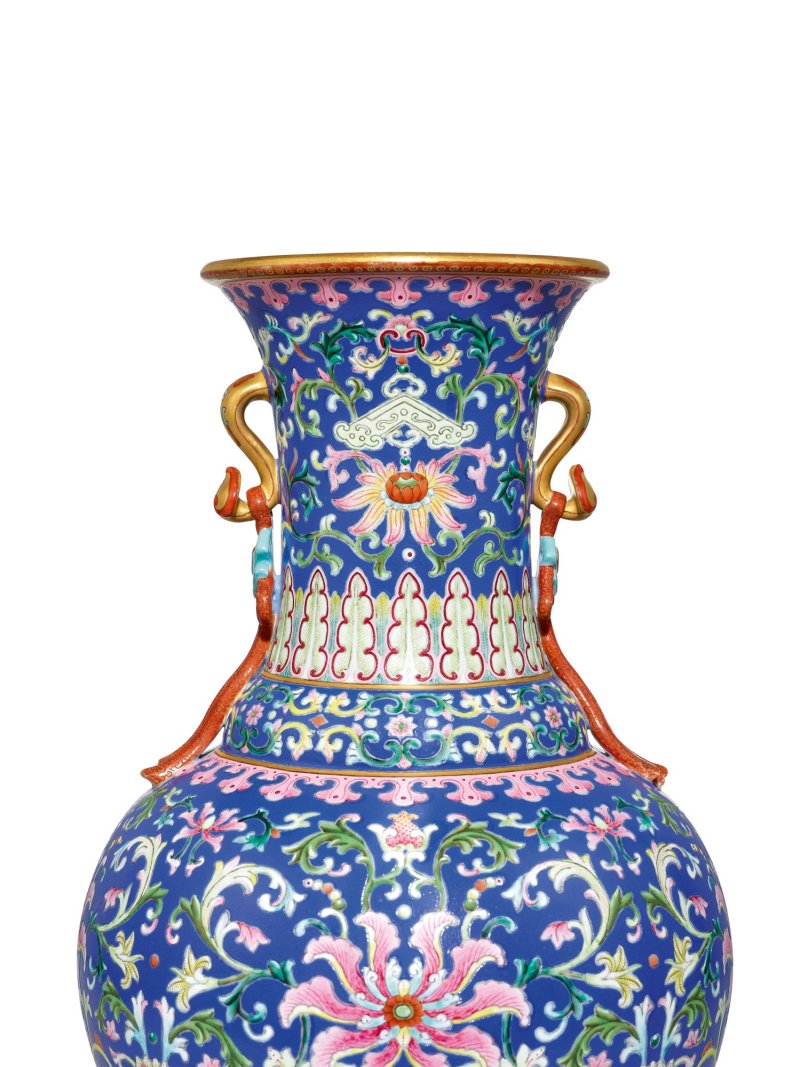
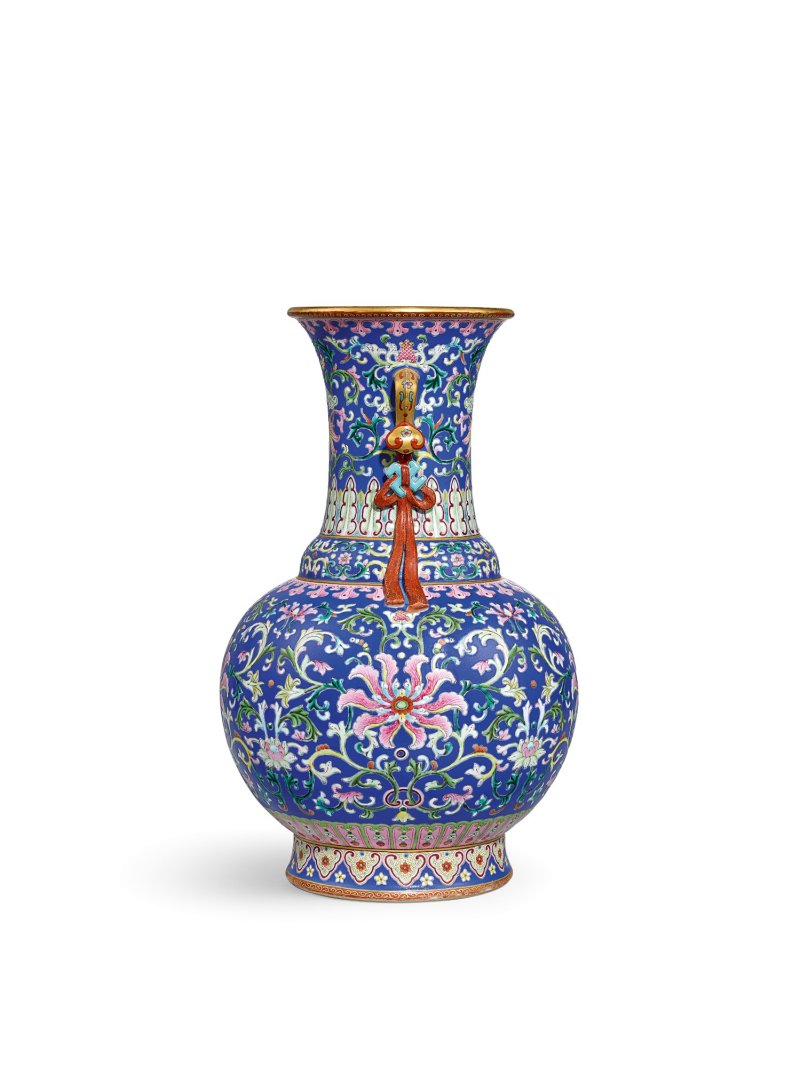
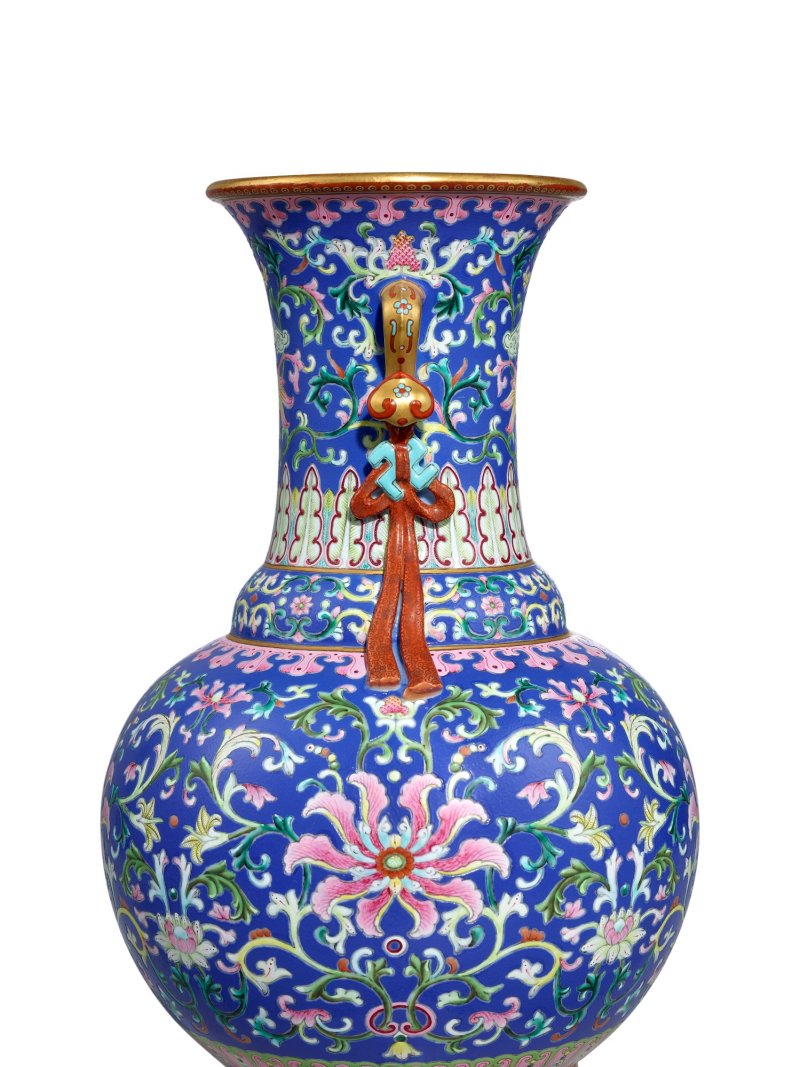
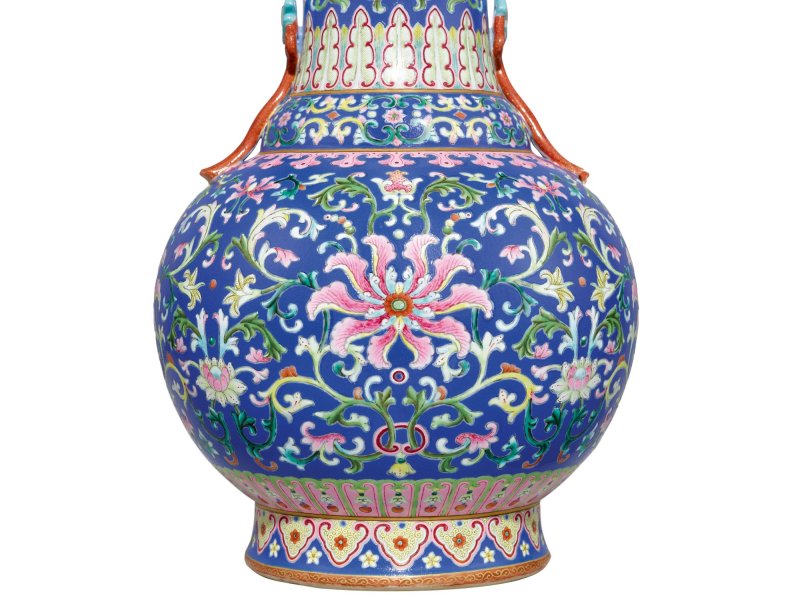
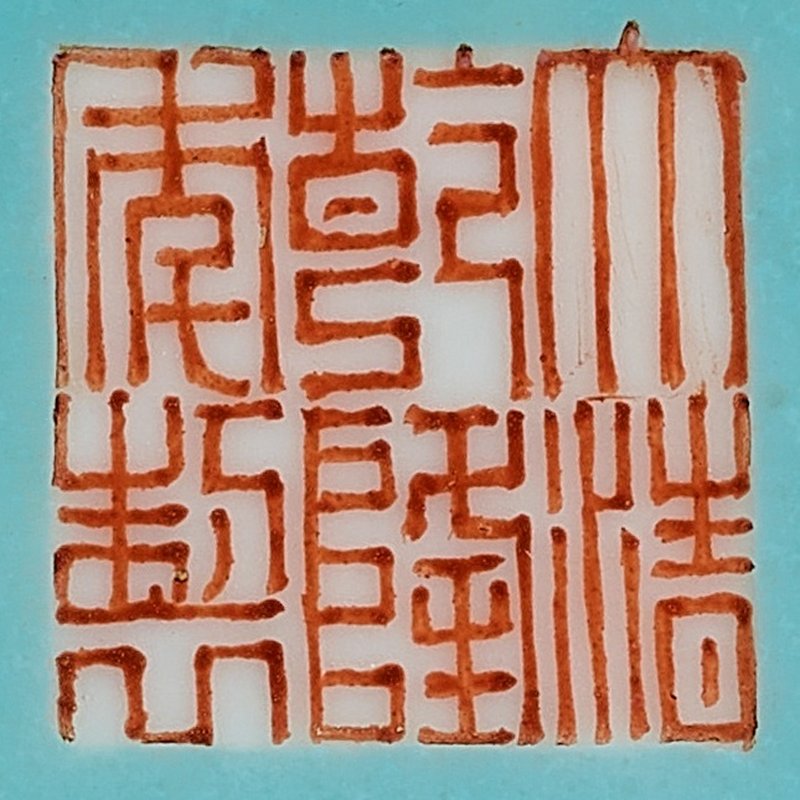
Lot 6032 A magnificent and extremely rare yangcai blue-ground 'lotus’ ruyi-handled vase, Seal mark and period of Qianlong | 清乾隆 洋彩藍地番蓮紋如意耳瓶 《大清乾隆年製》礬紅款
落槌价
预展中
成交价
预展中
| 拍卖公司 | 苏富比 |
|---|---|
| 拍卖时间 | 2026年10月30日 |
拍品信息
拍品名称
A magnificent and extremely rare yangcai blue-ground 'lotus’ ruyi-handled vase, Seal mark and period of Qianlong | 清乾隆 洋彩藍地番蓮紋如意耳瓶 《大清乾隆年製》礬紅款
起拍价
HKD 6,000,000
估值区间
6,000,000 - 18,000,000 HKD
尺寸
未知
品相
如欲了解本拍品狀況的更多資訊,請聯絡 Rubie.Fong@sothebys.com
更多信息
36.7 cm
来源:Collection of Lord Loch of Drylaw (1827-1900).
Collection of Alfred Morrison (1821-1897), Fonthill House, Tisbury, Wiltshire (no. 525).
The Rt. Hon The Lord of Margadale of Islay, T.D.
Christie's London, 9th November 2004, lot 57.
图录
说明:來源
洛赫勛爵(1827-1900年)收藏
英國威爾特郡放山居艾弗瑞.莫里森(1821-1897年)收藏(編號525)
蘇格蘭艾雷島馬格代爾勛爵收藏
倫敦佳士得2004年11月9日,編號57
Yangcai Blue-Ground Lotus Vase
A Harmonious Synthesis of East and West
Hajni Elias
Amongst the porcelains produced by the imperial kilns for the Qianlong Emperor (r. 1736-1795), those decorated in the rich spectrum of the yangcai or ‘foreign colours’ stand out for their superior workmanship and luxurious eye-catching decoration. The present blue-ground, two-handled pear-shaped vase belongs to this special group of wares with the use of the distinctive yangcai technique and palette in combination with an exquisite artistry of painting. Amongst vessels decorated in this fashion, this vase stands out, and thus remains an extremely rare example, for the use of the deep blue enamel for the ground and for the application of a pair of handles in the form of ruyi sceptres with the wan symbols suspended on a red ribbon. Only four yangcai vases with ruyi-shaped handles are known from the Qing court collection: an identical vase, possibly the pair to the present example, sold at Christie’s Hong Kong, 28th April 1997, lot 755; and three are in the Place Museum, Beijing, illustrated in The Complete Collection of Treasures of the Palace Museum. Porcelains with Cloisonne Enamel Decoration and Famille Rose Decoration, Hong Kong, 1999, pl. 118, a green-ground vase with lotus scroll painting (fig. 1); pl. 126, a double-gourd form purple-ground vase with lotus scroll painting; and pl. 127, another purple-ground vase with similar lotus scroll decoration (fig. 2). Deep blue-ground yangcai vases remain extremely rare in any museum and private collections, although they are mentioned in the Qing Imperial Porcelain records which will be discussed later.
The application of the yangcai, initially introduced to the Imperial Workshops at the Qing court by European Jesuit craftsmen, and subsequently embraced by Tang Ying (1682-1756), China’s unsurpassed kiln supervisor at Jingdezhen, confirms the extraordinary advancements made possible in ceramics production when Eastern aesthetics and Western technology were synthesised.
The term yangcai was first mentioned in 1735 by Tang Ying in his work, the Tao wu shu lue beiji [Records of Narrated Summaries of Porcelain Matters], and later included in the ceramics manual by Lan Pu titled, Jingdezhen taolu [Records of the Potteries of Jingdezhen], published in 1815. Tang writes as follows, ‘Yangcai household porcelains [are made with the application of] a new technique borrowed from Western painting methods during this dynasty. [Amongst the paintings of] figures, landscapes, flowers and plumage, there are none that are not fine and enthralling.'1 On the application of the yangcai palette, in 1744, he wrote as follows,
‘Both round wares and vases of white porcelain are painted in enamel colours in a style imitated from Western foreigners, which is consequently called Yang ts’ai or ‘Foreign Coloring’. Clever artists of proved skill are selected to paint the decoration. The different materials of the colour having been previously finely ground and properly combined, the artist first paints with them upon a slab of white porcelain, which is fired to test the properties of the colours and the length of firing they require. He is gradually promoted from coarse work to fine, and acquires skill by constant practice; a good eye, attentive mind, and exact hand being required to attain excellence.’2
Along with new colour tones, western style designs and decorative elements that were fashionable in Europe at the time were also introduced to Chinese artists. For example, the small pearl-like roundels dispersed amongst the lotus scroll decoration seen on the present vase are taken from Western floral decoration found on baroque-style furnishings. On the vase they are skilfully shaded to give them a distinct three-dimensional quality that makes them appear jewel-like. Thus, effective employment of the yangcai allowed Chinese potters to create a much wider range of colours than previously possible and added a new decorative technique to their established repertoire.
The Qianlong Emperor delighted in challenging his artists and artisans in the Imperial Workshops to create innovative designs, often testing their ability to produce pieces that explored the boundary between illusion and reality. The yangcai allowed, for the first time in the history of Chinese ceramics production, the creation of multi coloured brocade-like fields and borders in a variety of floral designs on a sgraffiato or mock-sgraffiato ground. The illusion achieved makes the surface of the vase appear as soft and sumptuous as the finest embroidered silk brocade. Yangcai also helped incorporate Western-style shading on compositions, a technique especially admired by the Qianlong Emperor in the paintings of Giuseppe Castiglione (1688-1766), the Italian Jesuit missionary who served as an artist at the court and who painted in a style that skilfully fused Western and Chinese traditions.
What made yangcai pieces even more prized was their limited number, as they were often produced as unique items or as pairs and never in larger quantities or series. Furthermore, we know from the Qing imperial records that blue-ground yangcai vases were exceptionally rare within this group of wares and were made from the mid-18th century for only a few years. The Qing gong ciqi dang’an quanji [Complete Records on Porcelain from the Qing Court] records that on the 10th day of the first lunar month, in the 13th year of Qianlong’s reign (1748), the Aide and the Chief Commissioner of the Seventh Grade, Samuha, reported that the Eunuch Hu Shijie delivered a pair of blue-ground yangcai vases painted with gilt floral design. These vases were made to be placed in one of the Buddha Halls (fotang) in the grounds of the Forbidden City. On the 19th day of the 10th month of the same year another pair of blue-ground yangcai vases with gilt floral decoration and matching wooden stands were handed to the Eunuch Hu Shijie, for submission to the emperor. Accounts for the 18th day of the 15th year of Qianlong’s reign (1750) record that the Treasurer Da Zi reported that Eunuch Hu Shijie delivered a pair of blue-ground yangcai vases with matching stands for presentation to the emperor (fig. 3).3 From these records it is evident that blue-ground yangcai vases were produced on imperial order during a short period of only a few years, primarily between 1748-1750, and only three pairs of vases appear to be recorded, all submitted by the Eunuch Hu Shijie. While we know little about Hu Shijie, his name appears frequently in the imperial records, suggesting that he was a trusted member of the emperor’s inner circle and played a key role in handing out imperial decrees and supervising and delivering artefacts to the emperor.
While the technique and palate for the present vase may be of Western origin, in its shape and decoration the vase is a Chinese masterpiece. Although we can only speculate on the reasons for its production, nevertheless, the use of the colour blue combined with the painting of the lotus scrollwork as the primary decoration, along with the employment of ruyi-shaped handles and the wan symbol attached by red ribbons all convey an auspicious message. The ‘hidden’ meaning in the decoration celebrates the emperor’s appreciation of qualities of purity and integrity known in Chinese as qinglian, which is a homophone for qinglian meaning ‘blue lotus’. The term appears in the Dongguan Han ji [Han Records of the Eastern Lodge], compiled by a team of historiographers under the guidance of Ban Gu (AD 32-92) in the Eastern Han dynasty (AD 25-220). In the ‘Biography of Zhou Ze (Zhou Ze zhuan)’ we read, ‘[Zhou Ye] paid his [deep] respect to the Minister of Ceremonies, [he was] resolute and daring, and on several [occasions] he spoke bluntly. The court was delighted with his honesty and integrity.’4 The colour blue is also associated with scholars and learning. The ‘Chapter on Learning (Quan xue)’ in the Xunzi, attributed to the Confucian philosopher Xun Kuang (c.310-c.235 BC, alt. c.314-c.217 BC), records the gentleman saying, ‘[The pigment] blue is obtained from the indigo plant, but it is bluer than the plant itself’. This phrase advises that through the act of learning it is possible to elevate oneself and become even better than the master.5 Qianlong would have appreciated an object whose colour and imagery prompted ideas of learning and qualities of purity and integrity as advocated by the teachings of Buddhism (alluded to here by the beautiful lotus flower). The ruyi sceptre and the wan symbol on the handles represent the granting of good wishes. The wan symbol was introduced into China with the spread of Buddhism. The pronunciation of wan is a homophone for the Chinese word of ‘ten thousand’ or ‘infinity’. Combined with the red ribbon (shoudai), the design is a reference to the wish of ‘having ten thousand longevities without boundary’ (wanshou wujiang).
The majority of extant yangcai porcelains may be found in the collection of the Palace Museum, Taipei. They are the focus of Liao Baoxiu’s study titled Huali cai ci: Qianlong yangcai /Stunning Decorative Porcelains from the Ch’ien-lung Reign, Palace Museum, Taipei, 2008. Liao demonstrates the wide variety of wares decorated in the yangcai and confirms how orders for these pieces seem to date from the early 1740s.
The present vase has a distinguished provenance, formerly belonging to Alfred Morrison (1821-1897), one of the wealthiest of Victorian collectors of works of art, paintings, autographs and manuscripts. Second son of James Morrison (1790-1857), who was a businessman and Member of Parliament, Alfred inherited Fonthill House in Wiltshire from his father where he lived most of his life with his wife Mabel and family. According to Caroline Dakers’s study, to him ‘size and quantity mattered just as much as quality. He was an addict, surrounding himself with paintings, engravings, medals and autographs of royalty, aristocrats and distinguished politicians, suggesting his collecting was linked to a desire for status.’6 Dakers further notes that once ‘hooked’ on the work of a particular artist, designer or craftsman his inclination was to buy everything he could lay his hands on. Between 1861-1866 he spent £40,000 on porcelain alone which was undoubtedly a vast sum at the time.7 The collection later became known as the Fonthill Heirlooms after it was inherited by Lord Margadale of Islay. The contents of Fonthill House have been gradually sold at auction, first in 1965, and then in 1971 and 2004.8
1 See Liao Baoxiu, Stunning Decorative Porcelains from the Ch’ien-lung Reign, Taipei, 2008, p. 14.
2 Ibid., p. 14; and for the translation see S.W. Bushell, Oriental Ceramic Art, London, 1981 (1896), p. 234.
3 Qing gong ciqi dang’an quanji [Complete records on porcelain from the Qing court], Beijing, 2008.
4 Dongguan Han ji jiaozhu [Han Records of the Eastern Lodge, annotated], edited by Wu Shuping, Beijing, 2008, 18.804.
5 Xunzi jianzhu [Xunzi, Simply annotated], edited by Zhang Shitong, Shanghai, 1974, 1.1.
6 Caroline Dakers, ‘Size Matters: The Extraordinary Collection of Alfred Morrison, Victorian Maecenas,’ in Picturing the Nineteenth Century, University of Kentucky, Kentucky, 2013.
7 Caroline Dakers, Fonthill Recovered: A Cultural History, London, 2018, pp. 146-147.
8 For more information see Audrey Wang, Chinese Antiques: An Introduction to the Chinese Art Market, London, 2012.
中西融粹
洋彩藍地番蓮紋如意耳瓶
薛好佩
乾隆洋彩瓷,工藝卓絕,釉彩豐美,華麗耀目,乃同朝官窰瓷之佼佼者。此件如意耳瓶屬同類洋彩瓷中特為突出之例,繪技精熟,配色明豔,盡顯官窰瓷人巧能臻藝。瓶身施藍地,如意耳繫紅色授帶綴「卍」字,相類之例極為罕見,鳳毛麟角。存世僅知四例清宮舊藏洋彩如意耳瓶:其一與本品極為相似,或原為一對,1997年4月28日售於香港佳士得,編號755;另三例均藏於北京故宮博物院,刊載於《故宮博物院藏文物珍品全集.琺瑯彩.粉彩》,香港,1999年,圖版118,洋彩綠地勾蓮紋如意耳瓶(圖1);圖版126,紫地勾蓮紋如意耳葫蘆瓶;圖版127,紫地勾蓮紋如意耳瓶(圖2)。清宮舊檔雖曾記載洋彩藍地瓷瓶,存世之例仍極珍罕,下文詳述。
洋彩,由歐洲傳教士傳入清宮造辦處,景德鎮御窰廠督陶官唐英(1682-1756年)將其發揚光大,成果巧奪天工,臻善至美,展現中式美學與西洋技法之完美融合。
「洋彩」一詞,首見於1735年唐英撰《陶務敘略碑記》,藍浦,《景德鎮陶錄》,1815年,亦有述之。唐英敘及「洋彩器皿,本朝新仿西洋法瑯畫法,人物、山水、花卉、翎毛無不精細入神」。1 1744年,唐氏針對洋彩仔細詳述:「圓琢白器,五采繪畫,摹仿西洋,故曰洋彩。須選素習繪事高手,將各種顏料研細調和,以白瓷片畫染燒試,必熟諳顏料、火候之性,始可由粗及細,熟中生巧,總以眼明心細,手準為佳。」2
當時,西洋不僅傳入釉彩新色,亦帶來當時風行歐洲之西洋設計、裝飾元素等,如本品器身纏枝蓮紋間所綴各色圓珠,可見於西洋巴洛克風之花形裝飾,瓔珞珠串巧施光影,強調立體效果,宛若珍寶般耀眼。洋彩之研發,帶給清代御窰更為豐富的色彩選擇,於既有官瓷基礎上,增添了前所未見的新穎風格。
乾隆皇帝重創新,命宮廷畫師、藝匠竭其所能,巧探虛實,推陳出新。洋彩新創「錦上添花」技法,乃中國瓷器發展史上首度得以呈現仿似織錦般繁麗紋飾,效果細緻柔美,富麗尊貴。洋彩運用西洋明暗陰影透視法描繪紋飾,中西繪畫傳統相映交融,如此技法深得乾隆帝喜愛,可見於宮廷畫師郎世寧之繪畫風格。
御窰廠燒製洋彩瓷數量多為單件或成對,無大量燒造,更顯珍稀。據清宮檔案,藍地洋彩瓷僅燒造於十八世紀中期寥寥數年,成品數量極少,《清宮瓷器檔案全集》載錄,乾隆十三年(1748年)一月十日,七品首領薩木哈來說太監胡世傑交洋彩藍花地畫金花瓶一對,皇帝下旨交佛堂。同年十月十九日,司庫白世秀將一對洋彩藍地畫金花瓶交太監胡世傑呈上。乾隆十五年十八日(1750年),庫掌達子來說太監胡世傑交洋彩藍地錦上添花蓍草瓶一對,隨木座(圖3)。3 檔案僅錄此三對洋彩藍地瓶,造於1748至1750年間,均由太監胡世傑上呈。清檔中時見胡氏大名,應為高宗重用人物,負責傳旨、監督並呈交工藝品。
本瓶之技法、配色顯洋風,觀其造形與紋飾,卻屬中式卓絕佳作。當朝製作目的雖未明,藍地搭配纏枝蓮紋、如意耳、紅授帶及卍字紋,均載祥瑞之意,「青蓮」與「清廉」諧音,寓意皇帝重操守德行。清廉首見於《東觀漢記》,乃東漢時期,班固(公元32-92年)等史家修纂而成,其中〈周澤傳〉錄,「拜太常,果敢,數有直言,朝廷嘉其清廉。」4 藍色且與進學相關,儒家學者荀況,《荀子》〈勸學〉述及「青,取之於藍而青於藍」,意指經由學習,可提升自我,甚可超越師輩。5 寄寓清廉、鼓勵精進佛學(蓮紋意涵),此瓶配色與紋飾應深得乾隆帝歡心,如意耳及卍字亦有祝願之意。卍字隨著佛教傳入中國,音同「萬」,與紅授帶相繫,意喻「萬壽無疆」。
存世多數洋彩瓷均藏於台北故宮博物院,廖寶秀,《華麗彩瓷:乾隆洋彩》,台北,2008年,詳細論述此品類研究,並刊載各式多貌之洋彩瓷,其研究確認多數洋彩瓷燒製於1740年代早期。
此件洋彩如意耳瓶來源顯赫,曾為艾弗瑞.莫里森(1821-1897年)所藏,其乃維多利亞時期最為重要之私人收藏家,藏品含括藝術品、繪畫、名人簽名、手稿等。莫氏為商賈暨國會議員詹姆士.莫里森(1790-1857年)次子,繼承威爾特郡大宅放山居,與其夫人 Mabel、家族長居於此。據 Caroline Dakers 研究,莫氏對於藏品之尺寸、數量、品質極為重視,熱愛蒐藏,尤其關於皇室成員、貴族、名人政治家之繪畫、版畫、勳章或簽名手稿等,反映其收藏與權力地位息息相關。6 Dakers 論及,凡是得到莫氏青睞的藝術家或工藝品,必會盡其所能將相關作品全數買下。1861至1866年之間,莫氏花費約四萬英鎊購買瓷器,金額之鉅令人咋舌。7 其珍藏得名放山居,為蘇格蘭艾雷島馬格代爾勛爵繼承。放山居舊藏曾數次售於拍賣會,首次為1965年,後為1971年、2004年。8
1 見廖寶秀,《華麗彩瓷:乾隆洋彩》,台北,2008年,頁14
2 同上,頁14;英譯版本見 S.W. Bushell,《Oriental Ceramic Art》,1981年(1896年初版),頁234
3 《清宮瓷器檔案全集》,北京,2008年
4 吳樹平校注,《東觀漢記校注》,北京,2008年,卷18
5 章詩同編,《荀子簡注》,上海,1974年
6 Caroline Dakers,〈Size Matters: The Extraordinary Collection of Alfred Morrison, Victorian Maecenas〉,《 Picturing the Nineteenth Century》,肯塔基大學,肯塔基,2013年
7 Caroline Dakers,《Fonthill Recovered: A Cultural History》,倫敦,2018年,頁146-147
8 相關資料見 Audrey Wang,《Chinese Antiques: An Introduction to the Chinese Art Market》,倫敦,2012年
常见问题
这件A magnificent and extremely rare yangcai blue-ground 'lotus’ ruyi-handled vase, Seal mark and period of Qianlong | 清乾隆 洋彩藍地番蓮紋如意耳瓶 《大清乾隆年製》礬紅款的成交价是多少?
落槌价为 预展中。 成交价为 预展中。
拍品的品相状况如何?
如欲了解本拍品狀況的更多資訊,請聯絡 Rubie.Fong@sothebys.com
这件拍品的流传来源是什么?
Collection of Lord Loch of Drylaw (1827-1900).
Collection of Alfred Morrison (1821-1897), Fonthill House, Tisbury, Wiltshire (no. 525).
The Rt. Hon The Lord of Margadale of Islay, T.D.
Christie's London, 9th November 2004, lot 57.
图录
Collection of Alfred Morrison (1821-1897), Fonthill House, Tisbury, Wiltshire (no. 525).
The Rt. Hon The Lord of Margadale of Islay, T.D.
Christie's London, 9th November 2004, lot 57.
图录