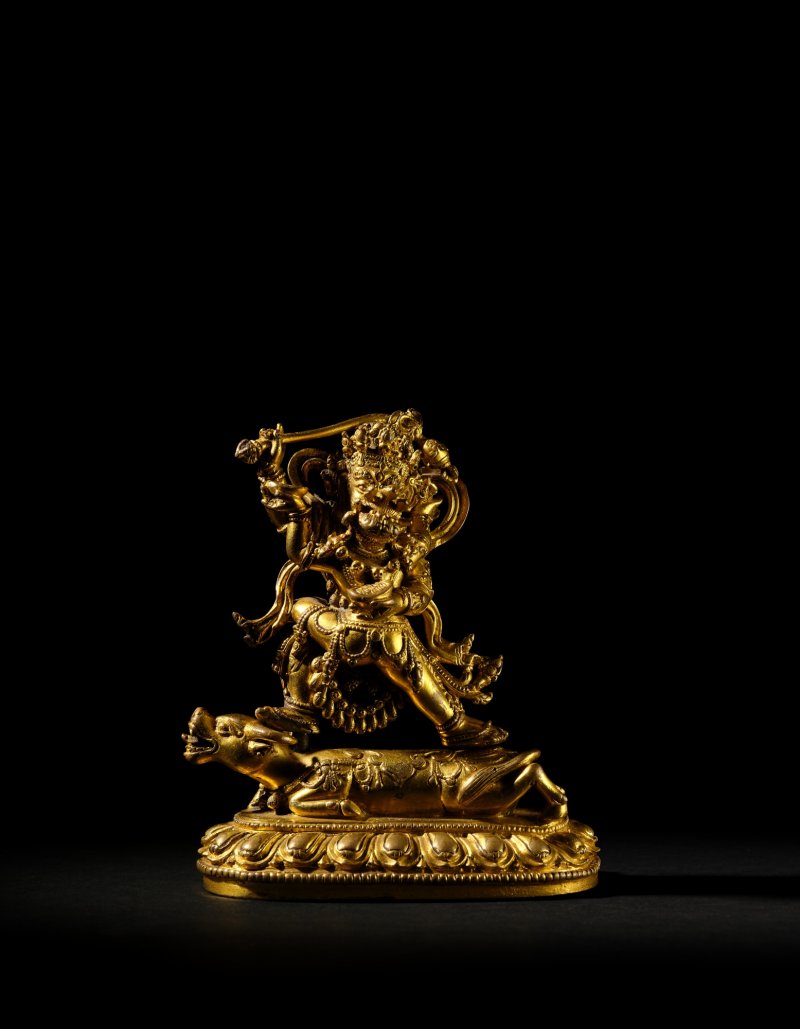

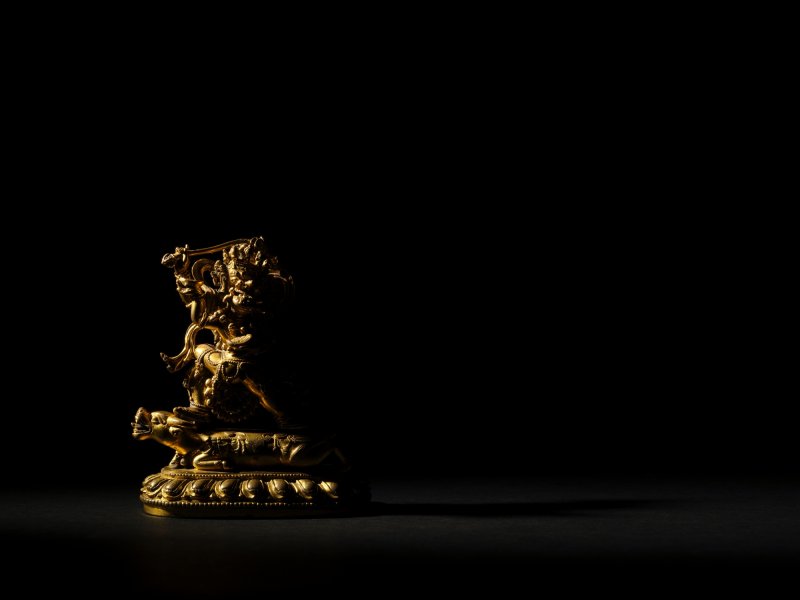
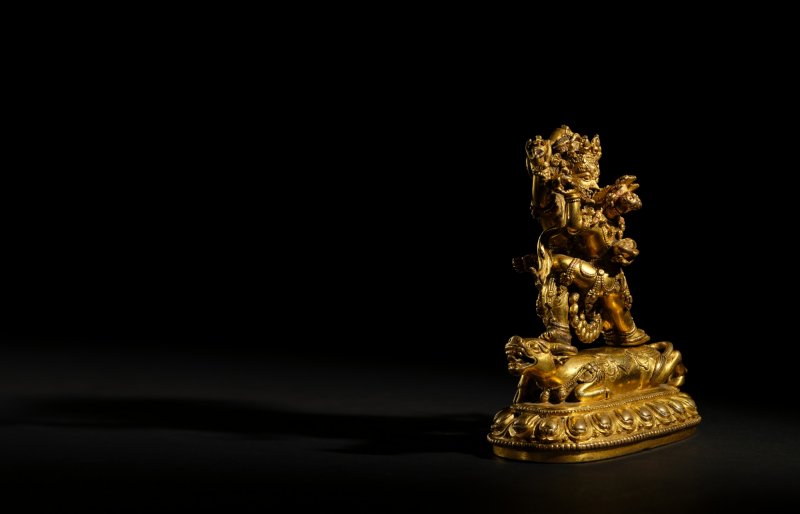
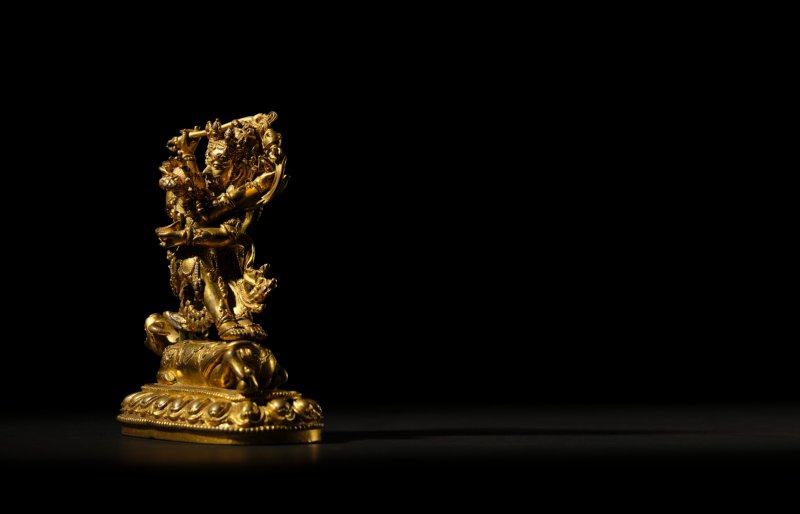
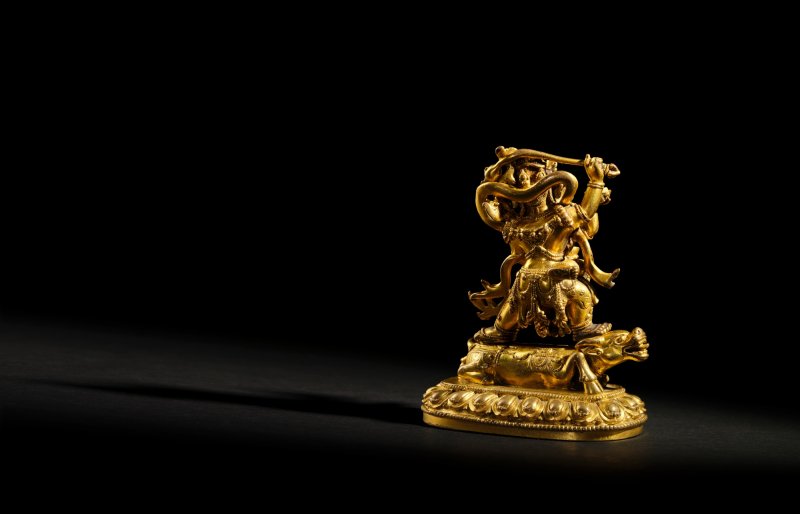
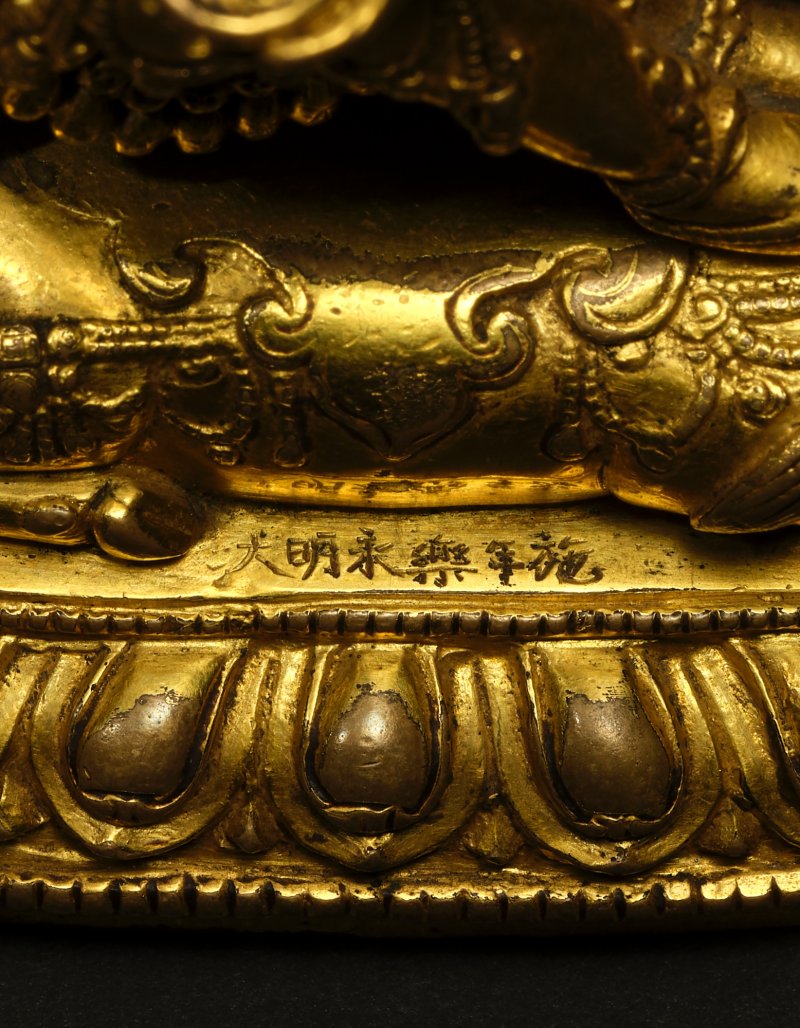
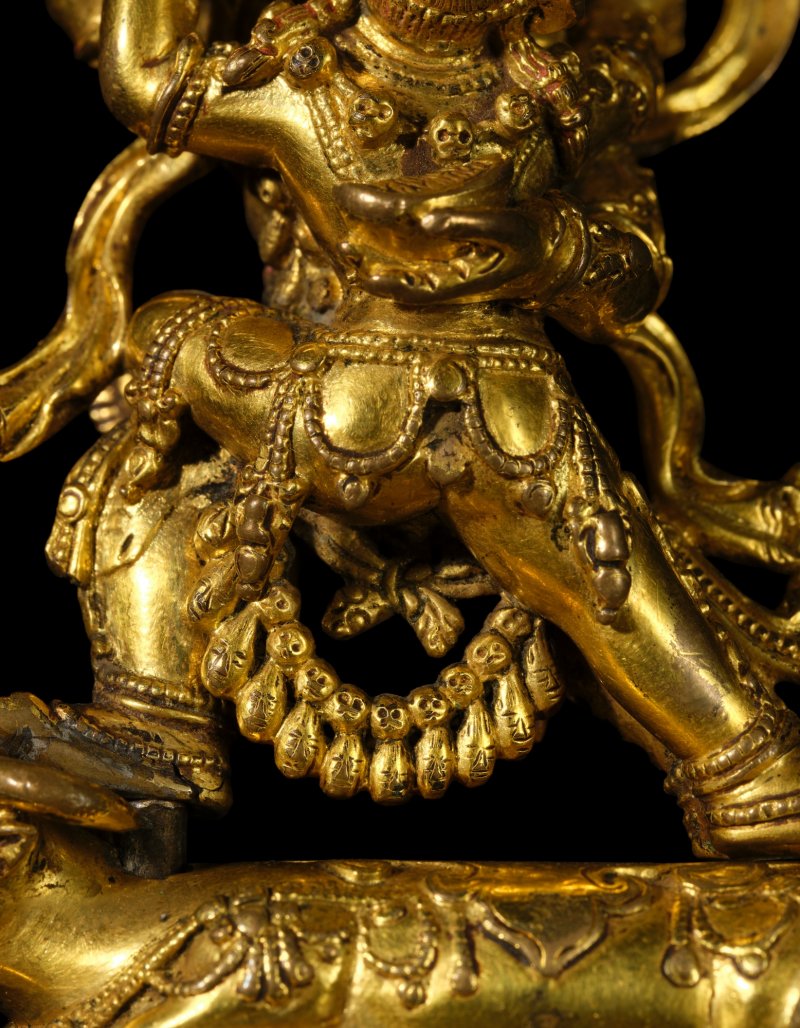
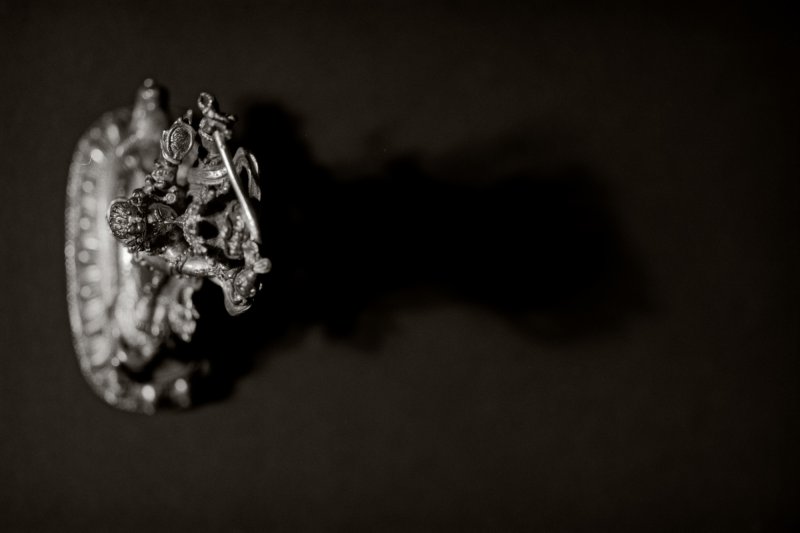
Lot 9502 A gilt-bronze figure of Raktayamari and Vajravetali, Mark and period of Yongle | 明永樂 銅鎏金紅閻摩敵與金剛亥母造像 《大明永樂年施》款
落槌价
预展中
成交价
预展中
| 拍卖公司 | 苏富比 |
|---|---|
| 拍卖时间 | 2026年10月30日 |
拍品信息
拍品名称
A gilt-bronze figure of Raktayamari and Vajravetali, Mark and period of Yongle | 明永樂 銅鎏金紅閻摩敵與金剛亥母造像 《大明永樂年施》款
起拍价
HKD 4,200,000
估值区间
4,200,000 - 6,000,000 HKD
尺寸
未知
品相
The figure is in very good overall condition. Minor typical wear to the gilding. Base plate intact and sealed with two green wax stamps.
整體品相良好。像身見正常輕微磨痕。封底,鈐綠蠟印二方。
If a condition report is provided to assist you with assessing the condition of the lot, it is for guidance purposes only. Such condition report may not refer to all faults, restoration, alterations, or adaptations because Sotheby's is not a professional conservator or restorer but rather a condition report is a statement of subjective, qualified opinion genuinely held by Sotheby's. For these reasons, any such condition report is not an alternative to taking your own professional advice regarding the condition of the lot. Prospective buyers should also refer to the Guide for Buyers at Auction which includes important notices concerning the type of property in this sale.
更多信息
9 cm
Himalayan Art Resources (HAR) item no. 12853
喜馬拉雅藝術資源編號12853
来源:A Midwestern private collection, 1970s.
Sotheby’s New York, 17th September 2014, lot 408.
图录
说明:來源
美國中西部私人收藏,1970年代入藏
紐約蘇富比2014年9月17日,編號408
This exquisite gilt-bronze sculpture, smaller than the more frequently found larger Yongle reign-marked bronzes, is much rarer and ritually more important, for it was created as a personal piece for private meditational use.
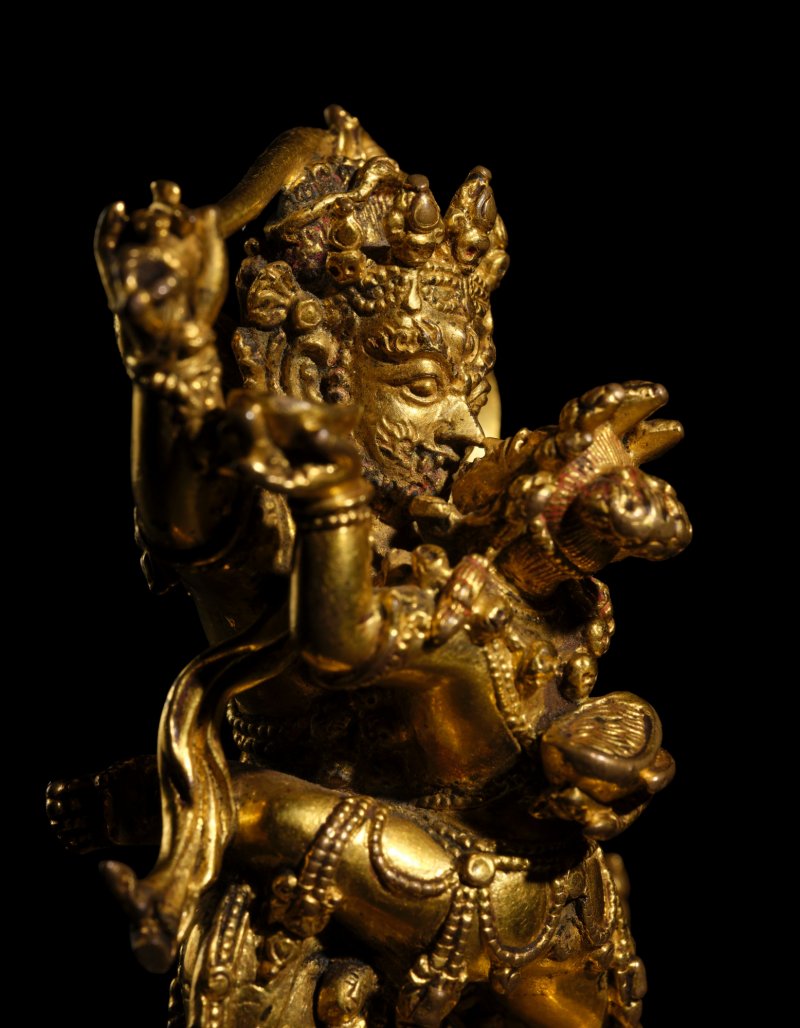
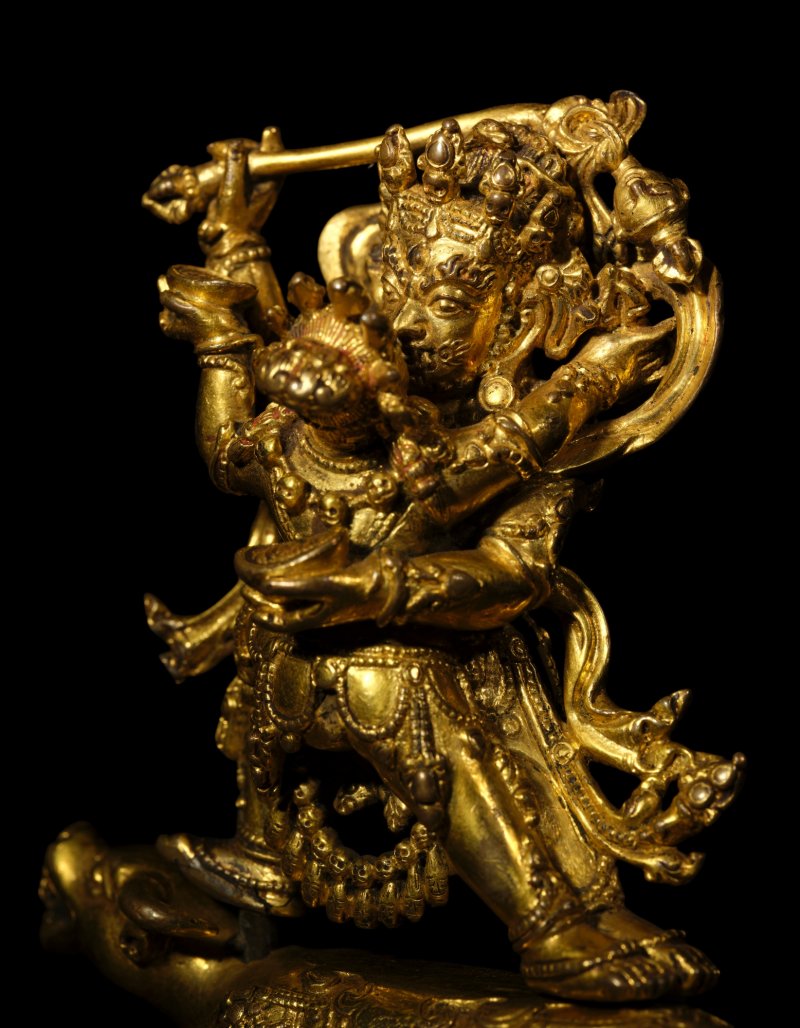
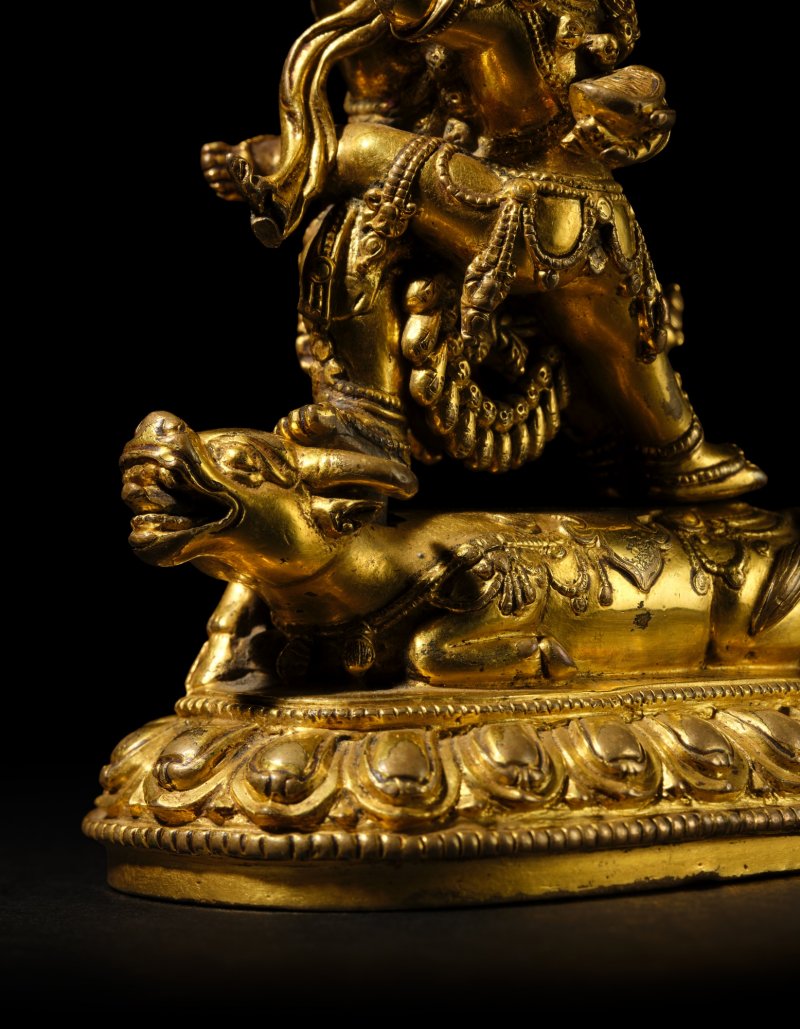
It depicts meditational deity Raktayamari in fierce alidhasana with his consort Vajravetali atop a supine buffalo mount, holding a vajra-hilted sword in his raised right hand and a skullcup filled with blood in the left hand, both deities wearing five-pointed crowns and the six bone ornaments representing the six paramitas. He is a wrathful manifestation of Manjushri, the bodhisattva of discriminating wisdom, as well as a form of Yamantaka, the Lord of Death. The buffalo underfoot the two deities symbolises death overcome through the ecstatic union of male and female energies.
The artists working in the imperial workshops during the Yongle period remain anonymous, but their sculptures have now become recognised as among the most important works of art from the Buddhist world, characterised by faultless casting and rich gilding. Some fifty-four gilt bronzes bearing the inscription “Da Ming Yongle nian shi” (bestowed in the Yongle era of the great Ming) have been documented in Tibetan monastery collections, see von Schroeder, Buddhist Sculptures in Tibet, Hong Kong, 2001, Vol. II, pp. 1237-91. These works have survived in Tibet largely due to imperial patronage lavished on Tibetan hierarchs and monasteries during the reign of the Yongle Emperor, who pursued a bountiful relationship with Tibetan religious leaders.
Compare the dynamic posture and superlative casting of the present work to another larger Yongle mark and period copper and gold figure of Raktayamari from the State Hermitage Collection in Leningrad, illustrated in Robert A.F. Thurman and Marylin M. Rhie, Wisdom and Compassion: The Sacred Art of Tibet, New York, 1991, cat. no. 76; and another Yongle reign-marked gilt-bronze depicting Mahakala, illustrated in Heather Karmay, Early Sino-Tibetan Art, Warminster, 1975, pls 60 and 61.
The practice of Raktayamari meditation was popularised at the Mongolian court of Kublai Khan during the Yuan period by Chogyal Pagpa Lodro Gyaltsen (1235–80), a student of Sakya Pandita. The initiation was transmitted down through several masters to Tsongkhapa and his student Shakya Yeshe, who arrived at the court of the Yongle Emperor in 1414, where he bestowed many types of Tantric initiations. An important depiction of Raktayamari in embroidered silk, bestowed as a gift to a Tibetan hierarch by the Yongle Emperor, emerged from the collection of the Chogyal of Sikkim in the 1940s, and has sold several times, most recently at Christie’s Hong Kong, 26th November 2014, lot 3001, and is now in the collection of the Long Museum, Shanghai.
此尊紅閻摩敵與金剛亥母鎏金銅造像,工藝精妙卓絕,體量小於存世較為多見的永樂年款大型造像,可見其珍罕且非凡的儀軌意義,原為私人禪修供奉之隨身本尊。
本像主尊為紅閻摩敵,呈忿怒左展立姿,與明妃金剛亥母相擁,雙尊踏於仰臥水牛之上。主尊右手高舉,執金剛劍;左手持盈血嘎巴拉盌。雙尊均戴五葉寶冠,身配六骨飾,象徵六波羅蜜。紅閻摩敵為文殊菩薩的忿怒化現,亦屬降伏死主閻摩的大威德金剛之化身。雙尊足下水牛,象徵藉由男女雙運的喜樂智慧,調伏死亡。
永樂朝宮廷造辦處工匠名諱無考,但其所鑄佛造像,現已被公認為佛教藝術史上的重要典範,以精工鑄造及鎏金豐厚著稱。據西藏寺院舊藏文獻著錄,共計五十四件帶有「大明永樂年施」銘文的鎏金銅造,載於烏爾里希.馮.施羅德,《西藏佛教造像》,香港,2001年,卷2,頁1237–1291。永樂帝對西藏宗教領袖與寺院多有厚賜,此類禦賜造像亦因此得以在西藏保存至今。
本品姿態生動,鑄造工藝臻於至善,可比聖彼得堡冬宮博物館(State Heritage Collection)所藏一例尺寸更大的施永樂年款紅閻摩敵鎏金銅造像,載於 Robert A.F. Thurman 及 Marylin M. Rhie,《慈悲與智慧:藏傳佛教藝術大展》,紐約,1991年,編號76;可另比一施永樂年款銅鎏金大黑天造像,載於 Heather Karmay,《早期漢藏藝術》,沃明斯特,1975年,圖版60及61。
紅閻摩敵修法,薩迦班智達弟子八思巴.洛哲堅贊(1235–1280年)於元代傳入忽必烈宮廷,廣為弘傳。該灌頂法脈歷經多位上師傳承,傳至宗喀巴及其弟子釋迦也失。釋迦也失於1414年赴永樂宮廷,為宮廷傳授多種密宗灌頂。另比一例紅閻摩敵的重要唐卡作品,由永樂帝禦賜西藏高僧,於1940年代出自錫金法王舊藏,曾多次上拍,最近一次為香港佳士得2014年11月26日,編號3001,現藏於上海龍美術館。
常见问题
这件A gilt-bronze figure of Raktayamari and Vajravetali, Mark and period of Yongle | 明永樂 銅鎏金紅閻摩敵與金剛亥母造像 《大明永樂年施》款的成交价是多少?
落槌价为 预展中。 成交价为 预展中。
拍品的品相状况如何?
The figure is in very good overall condition. Minor typical wear to the gilding. Base plate intact and sealed with two green wax stamps.
整體品相良好。像身見正常輕微磨痕。封底,鈐綠蠟印二方。
If a condition report is provided to assist you with assessing the condition of the lot, it is for guidance purposes only. Such condition report may not refer to all faults, restoration, alterations, or adaptations because Sotheby's is not a professional conservator or restorer but rather a condition report is a statement of subjective, qualified opinion genuinely held by Sotheby's. For these reasons, any such condition report is not an alternative to taking your own professional advice regarding the condition of the lot. Prospective buyers should also refer to the Guide for Buyers at Auction which includes important notices concerning the type of property in this sale.
整體品相良好。像身見正常輕微磨痕。封底,鈐綠蠟印二方。
If a condition report is provided to assist you with assessing the condition of the lot, it is for guidance purposes only. Such condition report may not refer to all faults, restoration, alterations, or adaptations because Sotheby's is not a professional conservator or restorer but rather a condition report is a statement of subjective, qualified opinion genuinely held by Sotheby's. For these reasons, any such condition report is not an alternative to taking your own professional advice regarding the condition of the lot. Prospective buyers should also refer to the Guide for Buyers at Auction which includes important notices concerning the type of property in this sale.
这件拍品的流传来源是什么?
A Midwestern private collection, 1970s.
Sotheby’s New York, 17th September 2014, lot 408.
图录
Sotheby’s New York, 17th September 2014, lot 408.
图录