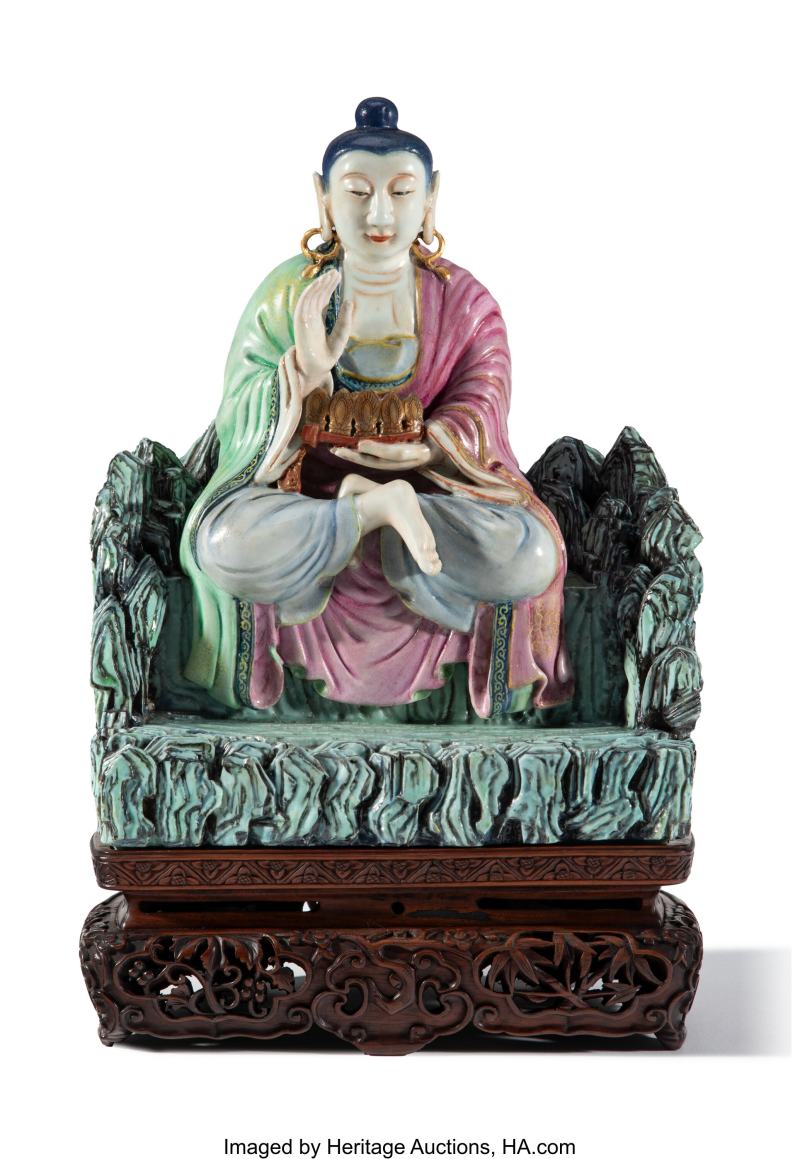

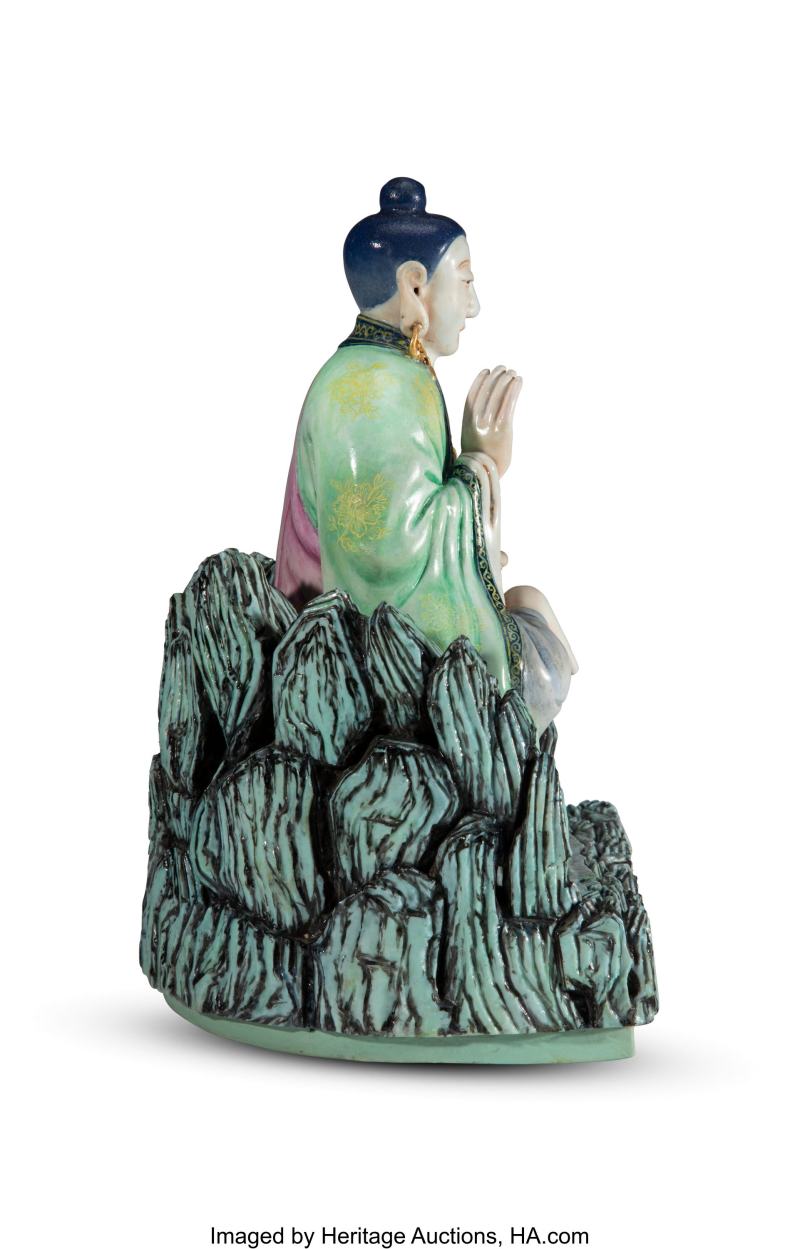
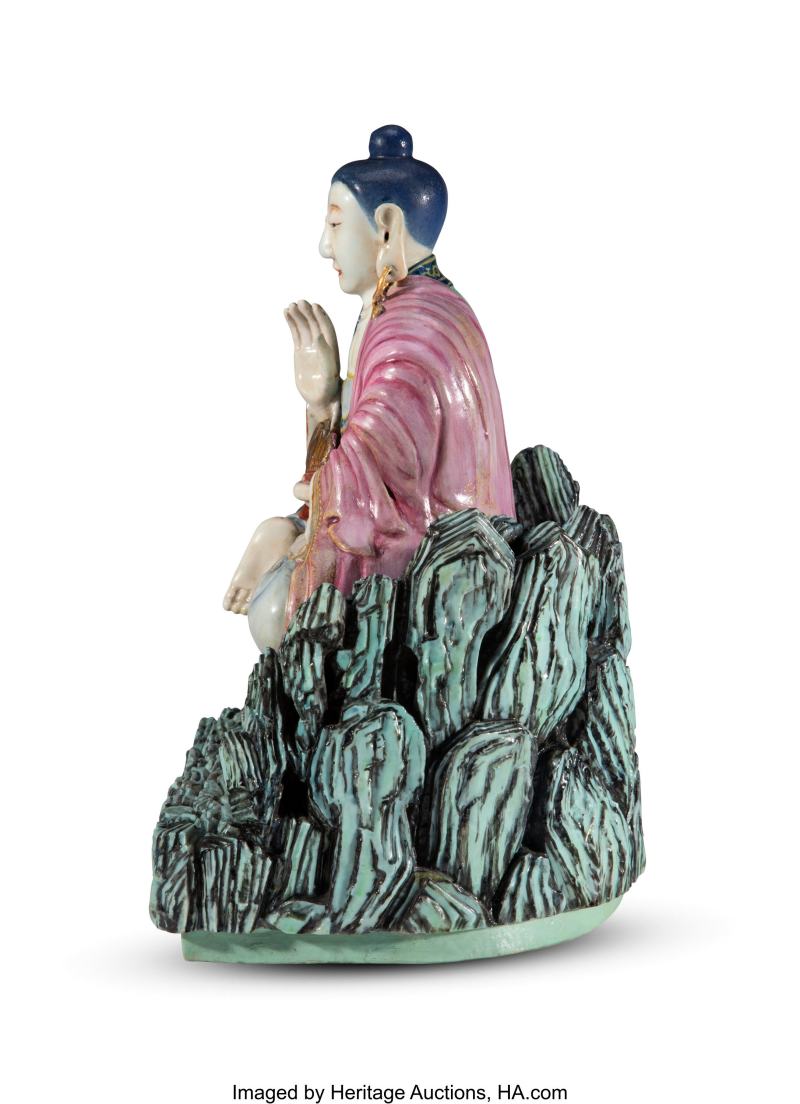
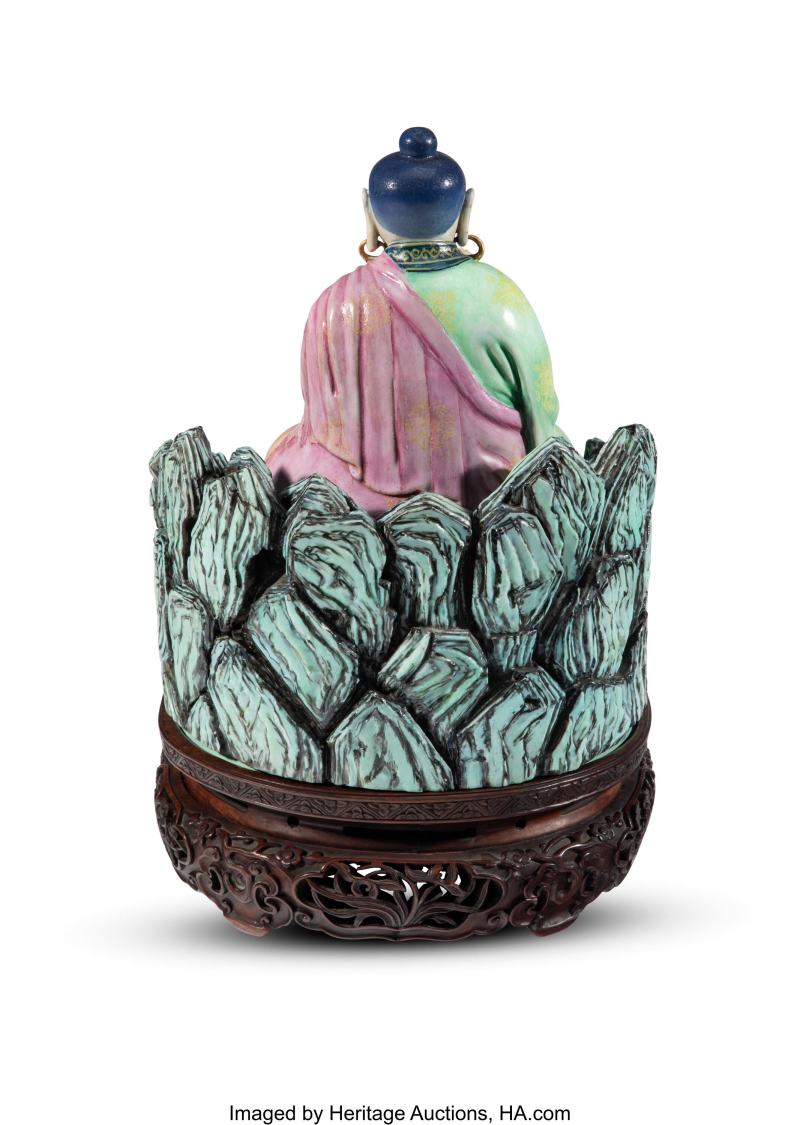
Lot 78079 A Rare and Exceptional Chinese Molded Famille Rose Figure of the Arhat
落槌价
****
成交价
****
拍品信息
拍品名称
A Rare and Exceptional Chinese Molded Famille Rose Figure of the Arhat
年代
(Luohan) Rahula, 18th century
起拍价
未知
估值区间
$40,000 - $60,000
尺寸
10-1/2 x 8-1/2 x 6-1/4 inches (26.7 x 21.6 x 15.9 cm) (work) 13 x 8-1/2 x 6-1/4 inches (overall)
品相
Condition report available upon request.
更多信息
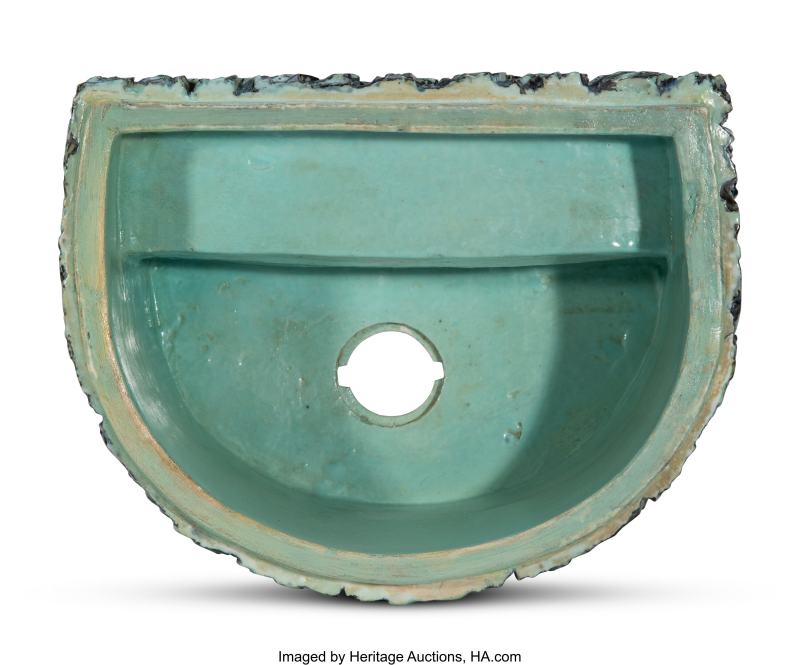
Marks: dong wu (East Five) to underside of the figure
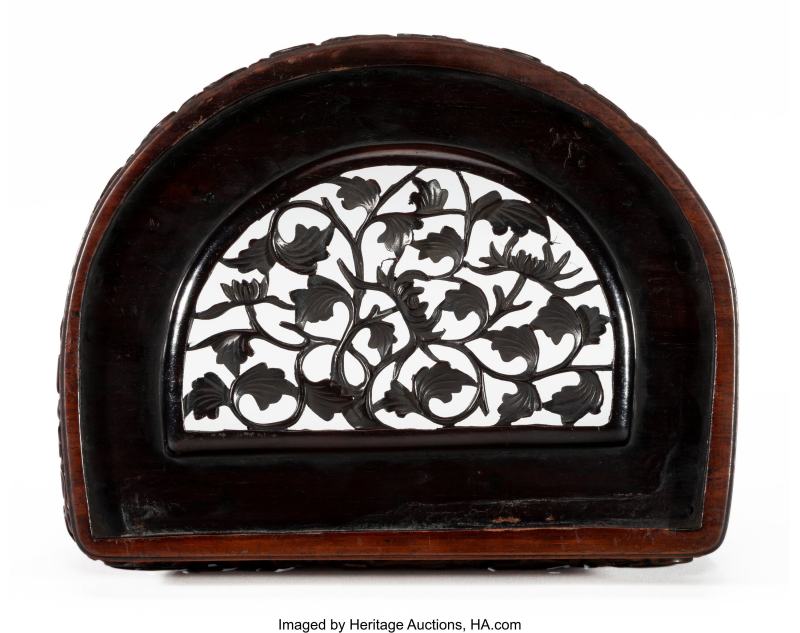
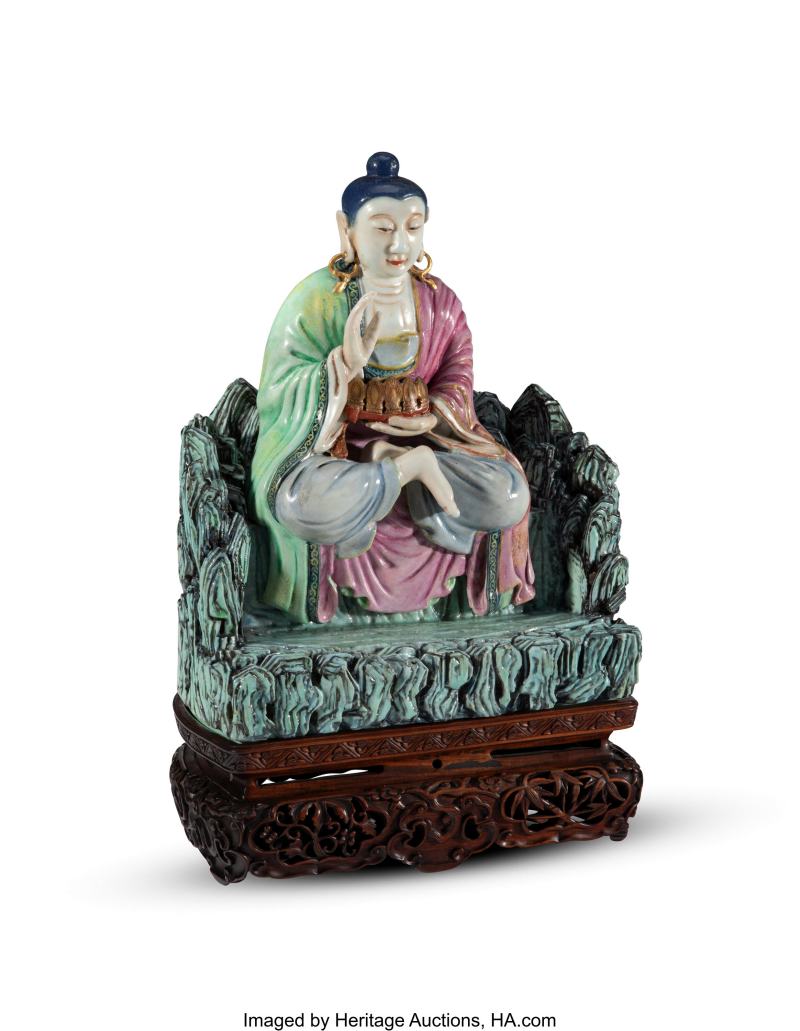
modeled seated in dhyanasana on a rock throne wearing long turquoise and pink enameled robe with blue enameled borders decorated with yellow enameled scrolling foliage, the robe slightly parted revealing the blue inner garment, his right hand raised in abhaya mudra and left hand holding the buddha crown, his face in serene expression with slight smile and downcast eyes, the throne exquisitely molded in the form of jagged rockwork picked out in turquoise and blue enamel with black edges, accompanied by an original fitted wood stand
Among the most remarkable expressions of Buddhist devotion at the Qianlong court is an exceptionally rare group of famille-rose porcelain figures representing the Arhats, or Luohans. The present figure, identifiable as the Arhat Rāhula, belonged to this remarkable series and is most likely associated with the ceramic Luohans documented in the Buddhist hall of Ningshou Palace (寧壽宮), the complex created by the emperor in anticipation of his retirement.
The Arhat and the Eighteen Luohans Arhatship originally referred to the highest attainment in the Buddhist tradition. One who has attained this state is known as an Arhat in Sanskrit and is forever liberated from the suffering of the cycle of birth and death. The earliest Buddhist tradition recognized a group of sixteen Arhats rather than eighteen. Their identities became particularly influential in China, and over the following centuries they developed into one of the most enduring subjects of East Asian Buddhist art. The phonetic transcription of Arhat in Chinese is Luohan (羅漢), an abbreviated form of Aluohan (阿羅漢).
By the Five Dynasties period (907-960), the celebrated monk-painter Guanxiu (832-912) had established an influential pictorial conception of the Arhats. His sixteen strange, intensely individualized holy men, often characterized by exaggerated physiognomies and foreign features, exerted a profound influence on subsequent representations. By the Northern Song dynasty (960-1127), the concept of eighteen Arhats had entered Chinese literary and artistic culture.
The distinction between sixteen and eighteen remained by no means straightforward, however, and the question fascinated the Qianlong Emperor (1711-1799) himself. Court documents demonstrate that Qianlong repeatedly investigated the names, identities and sequence of the Arhats, consulting his Tibetan Buddhist preceptor, the Changkya Khutukhtu, and comparing Chinese and Tibetan traditions. In 1756, he ordered Ding Guanpeng to paint the Sixteen Arhats and standardized their names according to the system associated with Changkya Rölpé Dorjé, his primary Tibetan Buddhist teacher. Qianlong continued to revisit these questions and, around 1787, again revised aspects of their names and sequence and affirmed the group of eighteen.
Rāhula, Son of the Buddha The present figure of Rāhula is one of the most personally compelling members of the group. Rāhula was the son of the Buddha, Siddhārtha Gautama, conceived shortly before his father abandoned the secular aspects of his life. Rāhula later studied under his father and eventually attained Arhatship. Unlike the other Arhats, he has an ushnisha, the domed protuberance on his head, in the likeness of the Buddha. Within the Tibetan-derived iconographic tradition embraced at the Qianlong court, Rāhula is characteristically represented holding a jeweled crown with both hands. The same iconography appears in a painting by Yao Wenhan in the National Palace Museum Collection (see no. 故畫00278300000).
Porcelain Luohans in Ningshou Palace The strongest documentary evidence for this extraordinary group occurs in the records of the Qing court's Comprehensive Records of Zaobanchu Workshops. In 1780, an imperial command concerned four zitan altar tables in the Yanghe Jingshe (Chamber for Cultivating Harmony) in Ningshou Palace, on which ceramic Luohans were displayed. The command ordered adjustments to the dimensions of the altar tables. This archival reference is important: it establishes that ceramic Luohan figures formed part of the Buddhist furnishings of Ningshou Palace during Qianlong's lifetime. The use of four altar tables to display them also suggests an ensemble rather than a single figure.
The Ningshou Palace complex was reconstructed as the residence in which Qianlong intended to spend his later years after relinquishing the throne and assuming the title of Emperor Emeritus, where he would live a more private life while also receiving visitors. Within it, the complex now generally known as the Qianlong Garden constituted an intensely private environment of architecture, rockwork, paintings, books, antiquities and Buddhist spaces.
Yanghe Jingshe, an L-shaped, two-storey building, was reconstructed in 1772 in the fourth and most private courtyard of the garden. Built into an elaborate landscape of rockeries and linked by bridges and covered corridors to adjacent structures, it housed a Buddhist chapel in its eastern section bearing the inscription Xifang Jile Shijie Anyang Daochang (西方極樂世界安養道場, "Sanctuary of Peace and Repose in the Western Pure Land"). The rockwork pedestals of these Luohans visually echo the scenery of the garden, situating the figures within a designed landscape similarly characterized by abundant rockeries.
Reconstructing a Lost Imperial Ensemble Porcelain Luohans of this series remained unrecognized as a group until individual examples began to emerge from private collections. An early published example appeared in Chao Tsong-yea's Ch'ing Porcelain from the Wah Kwong Collection, Hong Kong, 1974, no. 119, where a figure was catalogued simply as a "Figure of an old man seated in a chair of rock in famille rose," dated to the Qianlong period or later. With the benefit of iconographic comparison, it can possibly be identified as Arhat number 15, Gopaka.
Another figure appeared at Sotheby's Hong Kong on 29 October 1991, lot 267. Further examples subsequently emerged, including two offered at Christie's Hong Kong on 3 June 2015, lot 3020; two at Christie's London on 10 November 2015, lot 304; and another at Christie's New York on 25 September 2020, lot 1617. Christie's has likewise connected this group with the Ningshou Palace archival record and noted the exceptional rarity of porcelain Luohans of this type.
More revealing still is their construction. The figure and rock throne were modeled separately but were designed to lock together with a tongue-and-groove system. On the present example, recessed channels beneath the figure correspond to raised tongues on the throne, allowing the figure to slide securely into its prescribed position. Several known figures bear incised directional and numerical designations on otherwise concealed joining surfaces. The present Rāhula is inscribed dong wu (East Five) on both grooves. Other members of the group are known with such designations as dong si (East Four) and dong ba (East Eight). These inscriptions appear to be directional, suggesting the installation instructions governing the arrangement of the ensemble. A figure sold at Christie's New York in 2020 bears xi jiu (West Nine) on one of the grooves. The survival of "West Nine" is particularly suggestive that nine positions on the west would naturally correspond to nine on the east. "East Five" therefore most plausibly indicates the central, fifth position in an eastern sequence of nine, yielding a complete ensemble of eighteen figures. The same arrangement of eighteen Luohans can also be seen in the Yonghegong Hall in Yonghe Temple in Beijing, formerly the personal palace of the Yongzheng Emperor and later converted into a Tibetan Buddhist temple under the Qianlong Emperor.
Further comparison among the known examples allows the sequence of display to be reconstructed: the first Arhat, Aṅgaja, occupies "West One"; the second, "East One"; the third, "West Two"; the fourth, "East Two"; and so forth, culminating with the eighteenth at "East Nine."
An Imperial Object Without an Imperial Mark Equally significant is the absence of conventional imperial reign marks on these figures. Unlike imperial tablewares, ritual vessels and decorative porcelains produced at Jingdezhen, which often bear reign marks, these Luohans were created for the emperor's private devotional use and formed part of a carefully ordered palace installation. Their concealed surfaces instead bear practical inscriptions indicating position and orientation, suggesting that the primary concern was not to identify the reign of manufacture, but to ensure that each sacred figure occupied its prescribed place within the ensemble. Later Qing and Republic period imitations of this particular set, by contrast, sometimes bear apocryphal Qianlong marks, explicitly asserting an imperial association that the original series had no need to proclaim.
A Lost Imperial Ensemble Reconsidered The present Rāhula represents more than an exceptionally rare famille-rose figure. Its identity, intended location for display, concealed numbering and relationship to the handful of surviving companion figures offer evidence for the reconstruction of a virtually lost imperial Buddhist ensemble. The 1780 palace record places ceramic Luohans within Qianlong's Ningshou Palace; the surviving objects reveal how carefully such an ensemble was conceived and arranged; and the emperor's own sustained investigation of the Arhats explains why questions of identity and sequence assumed such importance.
Property from the Estate of Gail Grissom King
以下内容由AI翻译:
【名称】
十八世纪粉彩罗汉像(罗睺罗)
【年代】
十八世纪
【描述】
款识:东五 (East Five) 在塑像底部
塑像呈禅定坐姿,坐在岩石宝座上,身着长袍,长袍以绿松石色和粉红色珐琅釉装饰,边缘为蓝色珐琅釉,并饰有黄色珐琅釉卷草纹。长袍微微分开,露出蓝色内衫。右手作无畏印,左手持佛冠。面容宁静,略带微笑,目光下垂。宝座精巧地塑造成锯齿状的岩石,用绿松石色和蓝色珐琅釉点缀,边缘为黑色。配有原装木底座。
在乾隆宫廷中,最引人注目的佛教敬拜表达之一是一组极为罕见的粉彩瓷罗汉像。这件塑像可辨认为罗汉罗睺罗,属于这一系列,并很可能与宁寿宫(寧寿宮)佛教殿堂中记录的陶瓷罗汉有关,该宫殿是皇帝为退休而建造的。
阿罗汉和十八罗汉 阿罗汉最初是指佛教传统中的最高成就。达到这种状态的人被称为阿罗汉,在梵文中表示永远从生死轮回的苦难中解脱。最早的佛教传统认可的是十六位阿罗汉而不是十八位。他们的身份在中国特别有影响力,并在随后的几个世纪里发展成为东亚佛教艺术中最持久的主题之一。阿罗汉在中国的音译是罗汉(羅漢),是阿罗汉(阿羅漢)的缩写形式。
到了五代时期(907-960),著名的僧侣画家贯休(832-912)建立了一种有影响力的罗汉画像概念。他的十六位奇特、个性化的圣人,通常具有夸张的面部特征和异国特征,对后来的表现产生了深远影响。到北宋时期(960-1127),十八罗汉的概念进入了中国的文学和艺术文化。
然而,十六和十八之间的区别并不简单,这个问题也引起了乾隆皇帝(1711-1799)的兴趣。宫廷文献显示,乾隆多次调查了罗汉的名字、身份和顺序,咨询了他的藏传佛教导师章嘉呼图克图,并比较了汉藏传统。1756年,他命令丁观鹏绘制十六罗汉,并根据与章嘉若必多吉相关的系统标准化了他们的名字。乾隆继续重新审视这些问题,并在大约1787年再次修订了他们的名字和顺序,确认了十八罗汉的群体。
佛陀之子罗睺罗 这件罗睺罗塑像是该群体中最具个人魅力的成员之一。罗睺罗是佛陀释迦牟尼的儿子,在其父亲放弃世俗生活之前不久受孕。罗睺罗后来跟随父亲学习,最终达到了阿罗汉的境界。与其他罗汉不同,他头顶有一个类似佛陀的顶髻。在乾隆宫廷所接受的藏传佛教图像传统中,罗睺罗通常双手持珠宝冠。同样的图像出现在国立故宫博物院收藏的一幅姚文瀚画作中(见编号 故画00278300000)。
宁寿宫中的瓷器罗汉 关于这一非凡群体的最强有力的文献证据出现在清廷造办处的综合记录中。1780年,一条关于宁寿宫养和精舍(Chamber for Cultivating Harmony)四张紫檀供桌的皇命,要求调整供桌的尺寸,上面摆放着瓷器罗汉。这条档案参考非常重要:它确立了在乾隆生前,瓷器罗汉是宁寿宫佛教陈设的一部分。使用四张供桌来展示它们也表明这是一个整体,而不仅仅是一个单独的塑像。
宁寿宫建筑群被重建为乾隆退位后作为太上皇居住的地方,在那里他将过一种更私密的生活,同时也会接待访客。其中,现在通常称为乾隆花园的建筑群构成了一个由建筑、假山、绘画、书籍、古董和佛教空间组成的极其私密的环境。
养和精舍是一座L形的两层建筑,于1772年在花园的第四个也是最私密的庭院中重建。它建在一个复杂的假山景观中,并通过桥梁和走廊与相邻的结构相连。它的东部部分设有一个佛教礼拜堂,题有“西方极乐世界安养道场”(西方極樂世界安養道場)的铭文。这些罗汉的岩石底座在视觉上呼应了花园的景色,将塑像置于同样以丰富假山为特征的设计景观中。
重构失落的皇家组合 直到个别例子开始从私人收藏中出现,这一系列的瓷器罗汉才作为一个群体被认出。早期发表的一个例子出现在赵从衍(Chao Tsong-yea)的《Ch'ing Porcelain from the Wah Kwong Collection》中,香港,1974年,编号119,其中一件塑像被简单地编目为“粉彩岩石椅上的老人坐像”,日期为乾隆时期或之后。通过图像比较,它可以被识别为第15位阿罗汉,Gopaka。
另一件塑像出现在1991年10月29日苏富比香港拍卖会上,编号267。随后出现了更多例子,包括2015年6月3日在佳士得香港拍卖会上的两件,编号3020;2015年11月10日在佳士得伦敦拍卖会上的两件,编号304;以及2020年9月25日在佳士得纽约拍卖会上的一件,编号1617。佳士得也将这一群体与宁寿宫档案记录联系起来,并指出这种类型的瓷器罗汉极为罕见。
更为揭示的是它们的构造。塑像和岩石宝座是分别塑造的,但设计成通过榫卯系统锁定在一起。在这件塑像上,塑像底部的凹槽对应宝座上的凸起,使塑像能够牢固地滑入预定位置。已知的一些塑像在隐藏的连接面上刻有方向和数字标记。这件罗睺罗在两个凹槽上都刻有“东五”。其他成员则标有如“东四”和“东八”等标记。这些标记似乎是方向性的,表明了安装指示,指导整个组合的排列。2020年在佳士得纽约出售的一件塑像在其中一个凹槽上刻有“西九”。“西九”的存在特别暗示了西侧九个位置自然对应东侧九个位置。“东五”因此最有可能表示东侧序列中的第五个中心位置,从而形成完整的十八个塑像组合。在北京雍和宫的大殿中也可以看到同样的十八罗汉排列,这里曾是雍正皇帝的私人宫殿,后来在乾隆皇帝时期被改建为藏传佛教寺庙。
进一步比较已知的例子,可以重建展示顺序:第一位阿罗汉Aṅgaja占据“西一”;第二位,“东一”;第三位,“西二”;第四位,“东二”;以此类推,最后一位在“东九”。
没有常规皇室款识的重要意义 同样重要的是,这些塑像上没有常规的皇室款识。与景德镇生产的带有年号款识的御用餐具、礼器和装饰瓷器不同,这些罗汉是为了皇帝私人敬拜而制作的,并构成一个精心安排的宫殿装置的一部分。它们隐藏的表面上刻有实用的标记,指示位置和方向,这表明主要关注的不是标识制造年代,而是确保每个神圣的塑像在其组合中占据预定的位置。相比之下,后来的清代和民国时期的仿制品有时带有伪托的乾隆款识,明确宣称其皇室关联,而原始系列无需声明这一点。
重新考虑失落的皇家组合 这件罗睺罗不仅是一件极为罕见的粉彩塑像。它的身份、预期展示地点、隐藏的编号及其与少数幸存同伴的关系提供了重构几乎失落的皇家佛教组合的证据。1780年的宫殿记录将瓷器罗汉置于乾隆的宁寿宫中;现存的物品揭示了这样一个组合是如何精心构思和排列的;而皇帝本人对罗汉的持续研究解释了为什么身份和顺序的问题变得如此重要。
来自盖尔·格里索姆·金遗产
【品相】
状况报告可应要求提供。
modeled seated in dhyanasana on a rock throne wearing long turquoise and pink enameled robe with blue enameled borders decorated with yellow enameled scrolling foliage, the robe slightly parted revealing the blue inner garment, his right hand raised in abhaya mudra and left hand holding the buddha crown, his face in serene expression with slight smile and downcast eyes, the throne exquisitely molded in the form of jagged rockwork picked out in turquoise and blue enamel with black edges, accompanied by an original fitted wood stand
Among the most remarkable expressions of Buddhist devotion at the Qianlong court is an exceptionally rare group of famille-rose porcelain figures representing the Arhats, or Luohans. The present figure, identifiable as the Arhat Rāhula, belonged to this remarkable series and is most likely associated with the ceramic Luohans documented in the Buddhist hall of Ningshou Palace (寧壽宮), the complex created by the emperor in anticipation of his retirement.
The Arhat and the Eighteen Luohans Arhatship originally referred to the highest attainment in the Buddhist tradition. One who has attained this state is known as an Arhat in Sanskrit and is forever liberated from the suffering of the cycle of birth and death. The earliest Buddhist tradition recognized a group of sixteen Arhats rather than eighteen. Their identities became particularly influential in China, and over the following centuries they developed into one of the most enduring subjects of East Asian Buddhist art. The phonetic transcription of Arhat in Chinese is Luohan (羅漢), an abbreviated form of Aluohan (阿羅漢).
By the Five Dynasties period (907-960), the celebrated monk-painter Guanxiu (832-912) had established an influential pictorial conception of the Arhats. His sixteen strange, intensely individualized holy men, often characterized by exaggerated physiognomies and foreign features, exerted a profound influence on subsequent representations. By the Northern Song dynasty (960-1127), the concept of eighteen Arhats had entered Chinese literary and artistic culture.
The distinction between sixteen and eighteen remained by no means straightforward, however, and the question fascinated the Qianlong Emperor (1711-1799) himself. Court documents demonstrate that Qianlong repeatedly investigated the names, identities and sequence of the Arhats, consulting his Tibetan Buddhist preceptor, the Changkya Khutukhtu, and comparing Chinese and Tibetan traditions. In 1756, he ordered Ding Guanpeng to paint the Sixteen Arhats and standardized their names according to the system associated with Changkya Rölpé Dorjé, his primary Tibetan Buddhist teacher. Qianlong continued to revisit these questions and, around 1787, again revised aspects of their names and sequence and affirmed the group of eighteen.
Rāhula, Son of the Buddha The present figure of Rāhula is one of the most personally compelling members of the group. Rāhula was the son of the Buddha, Siddhārtha Gautama, conceived shortly before his father abandoned the secular aspects of his life. Rāhula later studied under his father and eventually attained Arhatship. Unlike the other Arhats, he has an ushnisha, the domed protuberance on his head, in the likeness of the Buddha. Within the Tibetan-derived iconographic tradition embraced at the Qianlong court, Rāhula is characteristically represented holding a jeweled crown with both hands. The same iconography appears in a painting by Yao Wenhan in the National Palace Museum Collection (see no. 故畫00278300000).
Porcelain Luohans in Ningshou Palace The strongest documentary evidence for this extraordinary group occurs in the records of the Qing court's Comprehensive Records of Zaobanchu Workshops. In 1780, an imperial command concerned four zitan altar tables in the Yanghe Jingshe (Chamber for Cultivating Harmony) in Ningshou Palace, on which ceramic Luohans were displayed. The command ordered adjustments to the dimensions of the altar tables. This archival reference is important: it establishes that ceramic Luohan figures formed part of the Buddhist furnishings of Ningshou Palace during Qianlong's lifetime. The use of four altar tables to display them also suggests an ensemble rather than a single figure.
The Ningshou Palace complex was reconstructed as the residence in which Qianlong intended to spend his later years after relinquishing the throne and assuming the title of Emperor Emeritus, where he would live a more private life while also receiving visitors. Within it, the complex now generally known as the Qianlong Garden constituted an intensely private environment of architecture, rockwork, paintings, books, antiquities and Buddhist spaces.
Yanghe Jingshe, an L-shaped, two-storey building, was reconstructed in 1772 in the fourth and most private courtyard of the garden. Built into an elaborate landscape of rockeries and linked by bridges and covered corridors to adjacent structures, it housed a Buddhist chapel in its eastern section bearing the inscription Xifang Jile Shijie Anyang Daochang (西方極樂世界安養道場, "Sanctuary of Peace and Repose in the Western Pure Land"). The rockwork pedestals of these Luohans visually echo the scenery of the garden, situating the figures within a designed landscape similarly characterized by abundant rockeries.
Reconstructing a Lost Imperial Ensemble Porcelain Luohans of this series remained unrecognized as a group until individual examples began to emerge from private collections. An early published example appeared in Chao Tsong-yea's Ch'ing Porcelain from the Wah Kwong Collection, Hong Kong, 1974, no. 119, where a figure was catalogued simply as a "Figure of an old man seated in a chair of rock in famille rose," dated to the Qianlong period or later. With the benefit of iconographic comparison, it can possibly be identified as Arhat number 15, Gopaka.
Another figure appeared at Sotheby's Hong Kong on 29 October 1991, lot 267. Further examples subsequently emerged, including two offered at Christie's Hong Kong on 3 June 2015, lot 3020; two at Christie's London on 10 November 2015, lot 304; and another at Christie's New York on 25 September 2020, lot 1617. Christie's has likewise connected this group with the Ningshou Palace archival record and noted the exceptional rarity of porcelain Luohans of this type.
More revealing still is their construction. The figure and rock throne were modeled separately but were designed to lock together with a tongue-and-groove system. On the present example, recessed channels beneath the figure correspond to raised tongues on the throne, allowing the figure to slide securely into its prescribed position. Several known figures bear incised directional and numerical designations on otherwise concealed joining surfaces. The present Rāhula is inscribed dong wu (East Five) on both grooves. Other members of the group are known with such designations as dong si (East Four) and dong ba (East Eight). These inscriptions appear to be directional, suggesting the installation instructions governing the arrangement of the ensemble. A figure sold at Christie's New York in 2020 bears xi jiu (West Nine) on one of the grooves. The survival of "West Nine" is particularly suggestive that nine positions on the west would naturally correspond to nine on the east. "East Five" therefore most plausibly indicates the central, fifth position in an eastern sequence of nine, yielding a complete ensemble of eighteen figures. The same arrangement of eighteen Luohans can also be seen in the Yonghegong Hall in Yonghe Temple in Beijing, formerly the personal palace of the Yongzheng Emperor and later converted into a Tibetan Buddhist temple under the Qianlong Emperor.
Further comparison among the known examples allows the sequence of display to be reconstructed: the first Arhat, Aṅgaja, occupies "West One"; the second, "East One"; the third, "West Two"; the fourth, "East Two"; and so forth, culminating with the eighteenth at "East Nine."
An Imperial Object Without an Imperial Mark Equally significant is the absence of conventional imperial reign marks on these figures. Unlike imperial tablewares, ritual vessels and decorative porcelains produced at Jingdezhen, which often bear reign marks, these Luohans were created for the emperor's private devotional use and formed part of a carefully ordered palace installation. Their concealed surfaces instead bear practical inscriptions indicating position and orientation, suggesting that the primary concern was not to identify the reign of manufacture, but to ensure that each sacred figure occupied its prescribed place within the ensemble. Later Qing and Republic period imitations of this particular set, by contrast, sometimes bear apocryphal Qianlong marks, explicitly asserting an imperial association that the original series had no need to proclaim.
A Lost Imperial Ensemble Reconsidered The present Rāhula represents more than an exceptionally rare famille-rose figure. Its identity, intended location for display, concealed numbering and relationship to the handful of surviving companion figures offer evidence for the reconstruction of a virtually lost imperial Buddhist ensemble. The 1780 palace record places ceramic Luohans within Qianlong's Ningshou Palace; the surviving objects reveal how carefully such an ensemble was conceived and arranged; and the emperor's own sustained investigation of the Arhats explains why questions of identity and sequence assumed such importance.
Property from the Estate of Gail Grissom King
以下内容由AI翻译:
【名称】
十八世纪粉彩罗汉像(罗睺罗)
【年代】
十八世纪
【描述】
款识:东五 (East Five) 在塑像底部
塑像呈禅定坐姿,坐在岩石宝座上,身着长袍,长袍以绿松石色和粉红色珐琅釉装饰,边缘为蓝色珐琅釉,并饰有黄色珐琅釉卷草纹。长袍微微分开,露出蓝色内衫。右手作无畏印,左手持佛冠。面容宁静,略带微笑,目光下垂。宝座精巧地塑造成锯齿状的岩石,用绿松石色和蓝色珐琅釉点缀,边缘为黑色。配有原装木底座。
在乾隆宫廷中,最引人注目的佛教敬拜表达之一是一组极为罕见的粉彩瓷罗汉像。这件塑像可辨认为罗汉罗睺罗,属于这一系列,并很可能与宁寿宫(寧寿宮)佛教殿堂中记录的陶瓷罗汉有关,该宫殿是皇帝为退休而建造的。
阿罗汉和十八罗汉 阿罗汉最初是指佛教传统中的最高成就。达到这种状态的人被称为阿罗汉,在梵文中表示永远从生死轮回的苦难中解脱。最早的佛教传统认可的是十六位阿罗汉而不是十八位。他们的身份在中国特别有影响力,并在随后的几个世纪里发展成为东亚佛教艺术中最持久的主题之一。阿罗汉在中国的音译是罗汉(羅漢),是阿罗汉(阿羅漢)的缩写形式。
到了五代时期(907-960),著名的僧侣画家贯休(832-912)建立了一种有影响力的罗汉画像概念。他的十六位奇特、个性化的圣人,通常具有夸张的面部特征和异国特征,对后来的表现产生了深远影响。到北宋时期(960-1127),十八罗汉的概念进入了中国的文学和艺术文化。
然而,十六和十八之间的区别并不简单,这个问题也引起了乾隆皇帝(1711-1799)的兴趣。宫廷文献显示,乾隆多次调查了罗汉的名字、身份和顺序,咨询了他的藏传佛教导师章嘉呼图克图,并比较了汉藏传统。1756年,他命令丁观鹏绘制十六罗汉,并根据与章嘉若必多吉相关的系统标准化了他们的名字。乾隆继续重新审视这些问题,并在大约1787年再次修订了他们的名字和顺序,确认了十八罗汉的群体。
佛陀之子罗睺罗 这件罗睺罗塑像是该群体中最具个人魅力的成员之一。罗睺罗是佛陀释迦牟尼的儿子,在其父亲放弃世俗生活之前不久受孕。罗睺罗后来跟随父亲学习,最终达到了阿罗汉的境界。与其他罗汉不同,他头顶有一个类似佛陀的顶髻。在乾隆宫廷所接受的藏传佛教图像传统中,罗睺罗通常双手持珠宝冠。同样的图像出现在国立故宫博物院收藏的一幅姚文瀚画作中(见编号 故画00278300000)。
宁寿宫中的瓷器罗汉 关于这一非凡群体的最强有力的文献证据出现在清廷造办处的综合记录中。1780年,一条关于宁寿宫养和精舍(Chamber for Cultivating Harmony)四张紫檀供桌的皇命,要求调整供桌的尺寸,上面摆放着瓷器罗汉。这条档案参考非常重要:它确立了在乾隆生前,瓷器罗汉是宁寿宫佛教陈设的一部分。使用四张供桌来展示它们也表明这是一个整体,而不仅仅是一个单独的塑像。
宁寿宫建筑群被重建为乾隆退位后作为太上皇居住的地方,在那里他将过一种更私密的生活,同时也会接待访客。其中,现在通常称为乾隆花园的建筑群构成了一个由建筑、假山、绘画、书籍、古董和佛教空间组成的极其私密的环境。
养和精舍是一座L形的两层建筑,于1772年在花园的第四个也是最私密的庭院中重建。它建在一个复杂的假山景观中,并通过桥梁和走廊与相邻的结构相连。它的东部部分设有一个佛教礼拜堂,题有“西方极乐世界安养道场”(西方極樂世界安養道場)的铭文。这些罗汉的岩石底座在视觉上呼应了花园的景色,将塑像置于同样以丰富假山为特征的设计景观中。
重构失落的皇家组合 直到个别例子开始从私人收藏中出现,这一系列的瓷器罗汉才作为一个群体被认出。早期发表的一个例子出现在赵从衍(Chao Tsong-yea)的《Ch'ing Porcelain from the Wah Kwong Collection》中,香港,1974年,编号119,其中一件塑像被简单地编目为“粉彩岩石椅上的老人坐像”,日期为乾隆时期或之后。通过图像比较,它可以被识别为第15位阿罗汉,Gopaka。
另一件塑像出现在1991年10月29日苏富比香港拍卖会上,编号267。随后出现了更多例子,包括2015年6月3日在佳士得香港拍卖会上的两件,编号3020;2015年11月10日在佳士得伦敦拍卖会上的两件,编号304;以及2020年9月25日在佳士得纽约拍卖会上的一件,编号1617。佳士得也将这一群体与宁寿宫档案记录联系起来,并指出这种类型的瓷器罗汉极为罕见。
更为揭示的是它们的构造。塑像和岩石宝座是分别塑造的,但设计成通过榫卯系统锁定在一起。在这件塑像上,塑像底部的凹槽对应宝座上的凸起,使塑像能够牢固地滑入预定位置。已知的一些塑像在隐藏的连接面上刻有方向和数字标记。这件罗睺罗在两个凹槽上都刻有“东五”。其他成员则标有如“东四”和“东八”等标记。这些标记似乎是方向性的,表明了安装指示,指导整个组合的排列。2020年在佳士得纽约出售的一件塑像在其中一个凹槽上刻有“西九”。“西九”的存在特别暗示了西侧九个位置自然对应东侧九个位置。“东五”因此最有可能表示东侧序列中的第五个中心位置,从而形成完整的十八个塑像组合。在北京雍和宫的大殿中也可以看到同样的十八罗汉排列,这里曾是雍正皇帝的私人宫殿,后来在乾隆皇帝时期被改建为藏传佛教寺庙。
进一步比较已知的例子,可以重建展示顺序:第一位阿罗汉Aṅgaja占据“西一”;第二位,“东一”;第三位,“西二”;第四位,“东二”;以此类推,最后一位在“东九”。
没有常规皇室款识的重要意义 同样重要的是,这些塑像上没有常规的皇室款识。与景德镇生产的带有年号款识的御用餐具、礼器和装饰瓷器不同,这些罗汉是为了皇帝私人敬拜而制作的,并构成一个精心安排的宫殿装置的一部分。它们隐藏的表面上刻有实用的标记,指示位置和方向,这表明主要关注的不是标识制造年代,而是确保每个神圣的塑像在其组合中占据预定的位置。相比之下,后来的清代和民国时期的仿制品有时带有伪托的乾隆款识,明确宣称其皇室关联,而原始系列无需声明这一点。
重新考虑失落的皇家组合 这件罗睺罗不仅是一件极为罕见的粉彩塑像。它的身份、预期展示地点、隐藏的编号及其与少数幸存同伴的关系提供了重构几乎失落的皇家佛教组合的证据。1780年的宫殿记录将瓷器罗汉置于乾隆的宁寿宫中;现存的物品揭示了这样一个组合是如何精心构思和排列的;而皇帝本人对罗汉的持续研究解释了为什么身份和顺序的问题变得如此重要。
来自盖尔·格里索姆·金遗产
【品相】
状况报告可应要求提供。
常见问题
拍品的品相状况如何?
Condition report available upon request.
拍品的尺寸是多少?
10-1/2 x 8-1/2 x 6-1/4 inches (26.7 x 21.6 x 15.9 cm) (work) 13 x 8-1/2 x 6-1/4 inches (overall)