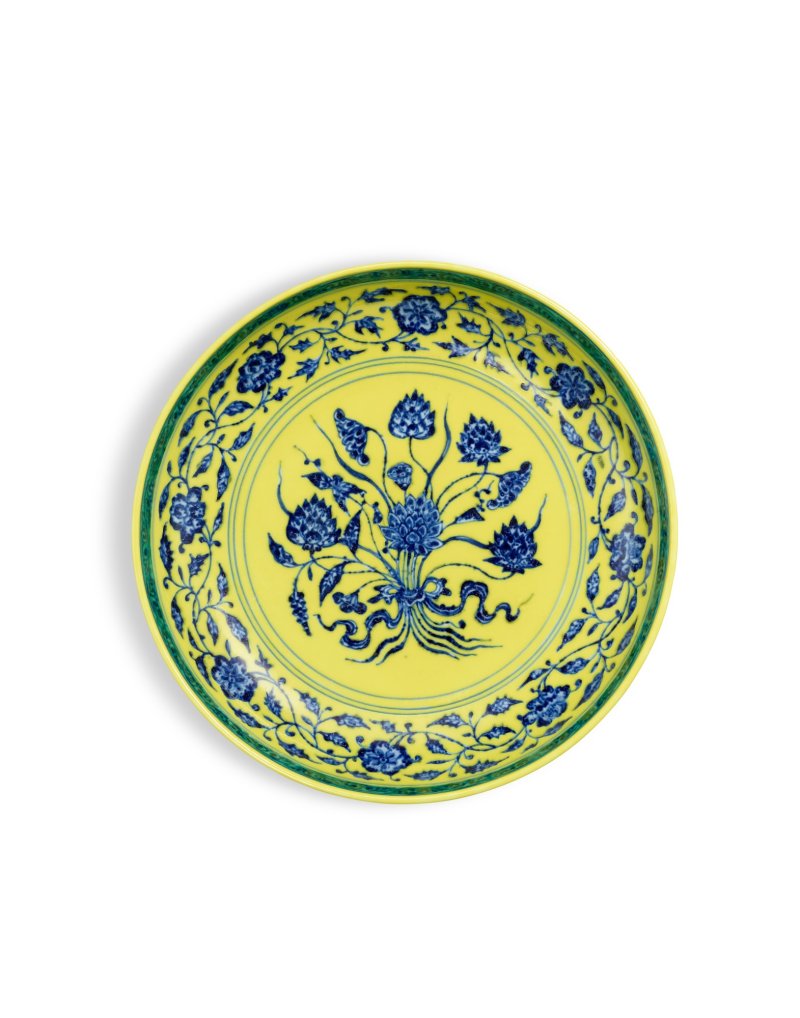

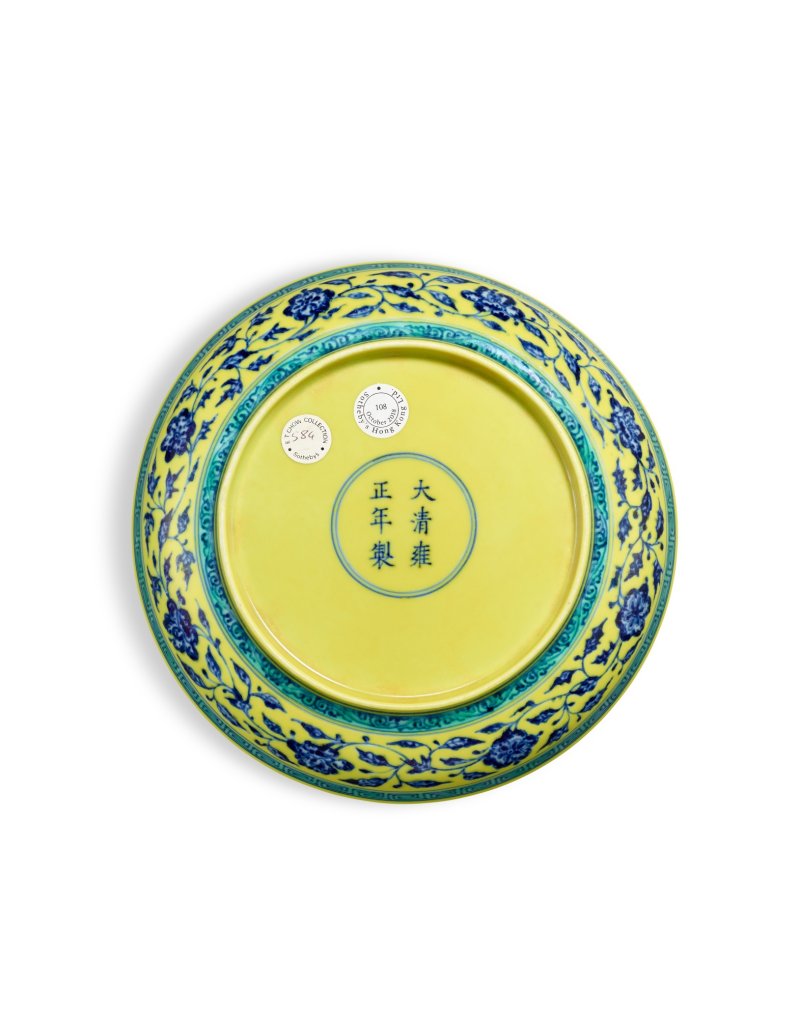
Lot 6051 A rare underglaze-blue and yellow-enamelled 'lotus bouquet' dish, Mark and period of Yongzheng | 清雍正 黃地青花一把蓮紋盤 《大清雍正年製》款
落槌价
预展中
成交价
预展中
| 拍卖公司 | 苏富比 |
|---|---|
| 拍卖时间 | 2026年10月30日 |
拍品信息
拍品名称
A rare underglaze-blue and yellow-enamelled 'lotus bouquet' dish, Mark and period of Yongzheng | 清雍正 黃地青花一把蓮紋盤 《大清雍正年製》款
起拍价
HKD 1,600,000
估值区间
1,600,000 - 2,800,000 HKD
尺寸
未知
品相
如欲了解本拍品狀況的更多資訊,請聯絡 Rubie.Fong@sothebys.com
更多信息
21.5 cm
来源:Collection of Edward T. Chow (1910-1980).
Sotheby's Hong Kong, 19th May 1981, lot 584.
Collection of Sir Quo-Wei Lee (1918-2013).
Sotheby's Hong Kong, 3rd October 2018, lot 108.
图录
说明:來源
仇焱之(1910-1980年)收藏
香港蘇富比1981年5月19日,編號584
利國偉爵士(1918-2013年)收藏
香港蘇富比2018年10月3日,編號108
Both the design and colour palette of the dish are rooted in the Yongle and Xuande period prototypes that were developed at the Jingdezhen kilns in the early Ming dynasty. The lotus bouquet, with its beribboned cluster of lotus blooms, leaves and water weeds, is borrowed from a popular motif that was first employed in the Yongle period and an example from the Meiyintang collection, illustrated in Regina Krahl, Chinese Ceramics from the Meiyintang Collection, vol. 2, London, 1994, pl. 665, was sold in these rooms, 4th April 2012, lot 37. This design was revived in the Yongzheng period and two such examples are in the Palace Museum, Beijing, illustrated in Geng Baochang, ed., Gugong bowuyuan cang Ming chu qinghua ci [Early Ming blue-and-white porcelain in the Palace Museum], vol. 2, Beijing, 2002, pls 195 and 199.
In addition to the emulation of the past, this dish is also notable for the level of artistic innovation in the Yongzheng period and this is reflected in the pale green bands bordering the inner and outer rims of the dish. The cobalt-blue decoration and the application of the yellow enamel undoubtedly required the craftsmen's meticulous precision, however, a masterful control of the kilns was also of vital importance in the production of this dish, which is arguably an exemplar model of its type. No related example, however, with a yellow-ground reign mark appears to be recorded. The companion piece to the current dish, also from the collection of Edward T. Chow, bears a white-ground reign mark, and was sold in these rooms, 19th May 1981, lot 583. See also a related example, albeit fired to a less brilliant tone, sold in our London rooms, 11th May 2011, lot 213.
In the Yongzheng reign alone, this design was also produced in various dimensions. Compare one of the largest sizes, sold in these rooms 7th April 2011, lot 74, from the Meiyintang collection; and a smaller one, illustrated in John Ayers, Chinese Ceramics. The Koger Collection, London, 1985, pl. 122.
本盤紋飾及配色仿自明初永樂、宣德年間景德鎮製御瓷。蓮花、蓮葉及水藻以飄帶綁束,始見於永樂一朝,見玫茵堂舊藏例,載於康蕊君,《玫茵堂中國陶瓷》,卷2,倫敦,1994年,圖版665,售於香港蘇富比2012年4月4日,編號37。此紋樣於雍正時期復現,北京故宮博物院藏兩例,錄於耿寶昌編,《故宮博物院明初青花瓷》,卷2,北京,2002年,圖版159及199。
本盤口沿內外巧飾一圈淡綠卷草,足見雍正年間瓷匠慕古求新的心思。本品以鈷青繪飾、黃釉為地,講求匠人手巧、謹控窰溫方成,本品堪稱為黃地青花典範。此盤署以黃地青花年款,目前未見有他例。仇焱之舊藏一近例,白釉底署年款,售於香港蘇富比1981年5月19日,編號583。另見一類例,釉色不及本品明艷,售於倫敦蘇富比2011年5月11日,編號213。
單是雍正年間,已有不同大小的黃地青花一把蓮紋盤。玫茵堂有相近之例,尺寸屬最大的一類,售於香港蘇富比2011年4月7日,編號74。另一例尺寸較小,圖見 John Ayers,《Chinese Ceramics. The Koger Collection》,倫敦,1985年,圖版122。
常见问题
这件A rare underglaze-blue and yellow-enamelled 'lotus bouquet' dish, Mark and period of Yongzheng | 清雍正 黃地青花一把蓮紋盤 《大清雍正年製》款的成交价是多少?
落槌价为 预展中。 成交价为 预展中。
拍品的品相状况如何?
如欲了解本拍品狀況的更多資訊,請聯絡 Rubie.Fong@sothebys.com
这件拍品的流传来源是什么?
Collection of Edward T. Chow (1910-1980).
Sotheby's Hong Kong, 19th May 1981, lot 584.
Collection of Sir Quo-Wei Lee (1918-2013).
Sotheby's Hong Kong, 3rd October 2018, lot 108.
图录
Sotheby's Hong Kong, 19th May 1981, lot 584.
Collection of Sir Quo-Wei Lee (1918-2013).
Sotheby's Hong Kong, 3rd October 2018, lot 108.
图录