
拍品信息
拍品名称
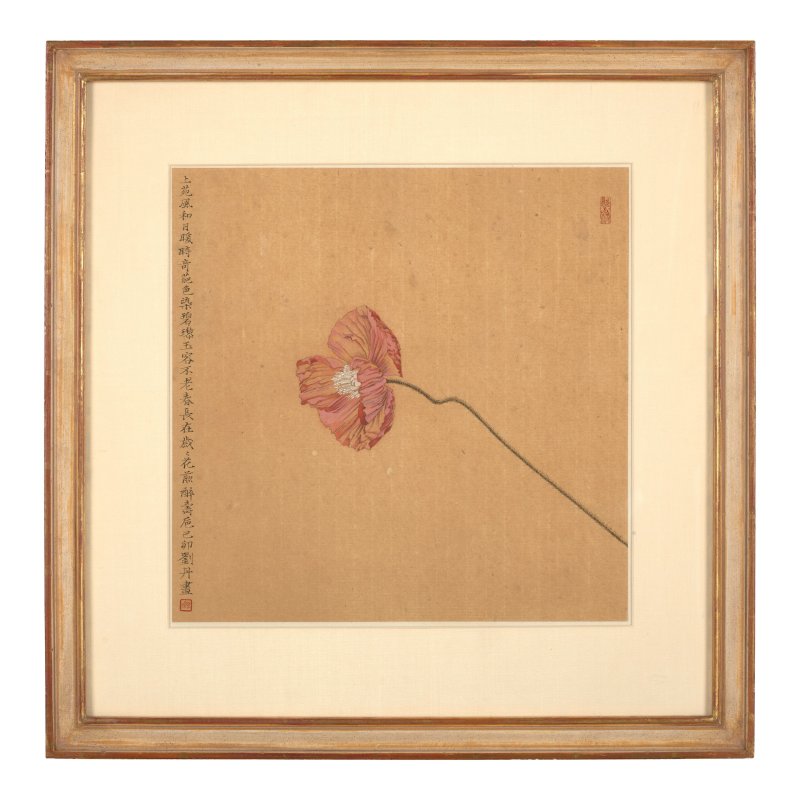
劉丹(1953年生) 上苑壽春 設色紙本 鏡框 一九九九年作 | LIU DAN (BORN 1953)
年代
Single Pinwheel, 1999
起拍价
USD 45,000
估值区间
未知
尺寸
未知
品相
未知
更多信息
Single Pinwheel, 1999
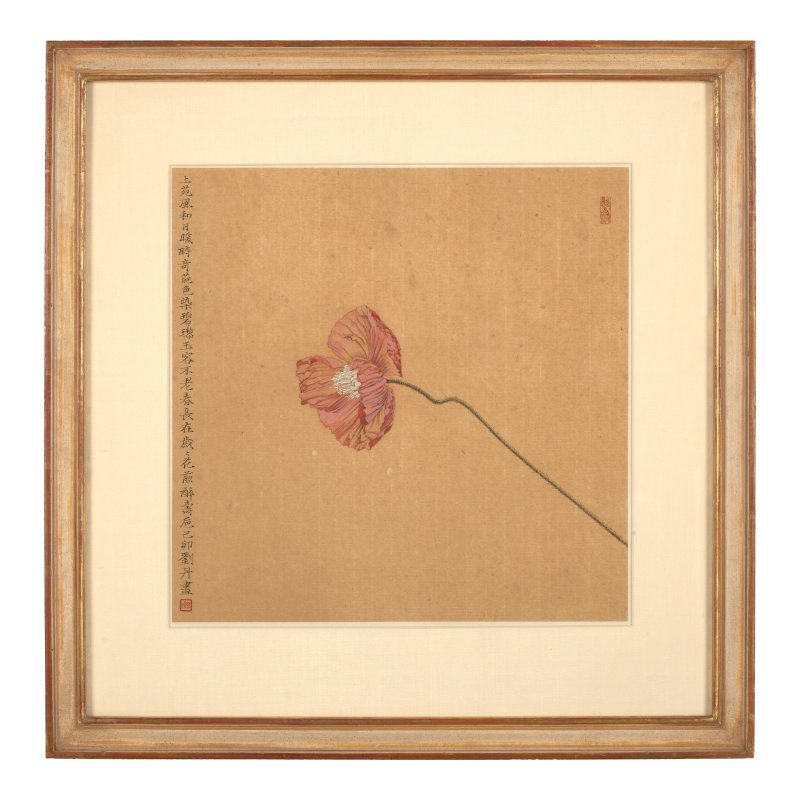
Matted, framed and glazed, ink and color on paper, inscribed by the artist and dated jimao, and signed Liu Dan with two artist's seals.
14 3/8 x 14 1/2in (36.4 x 36.8cm)
Footnotes
Provenance:
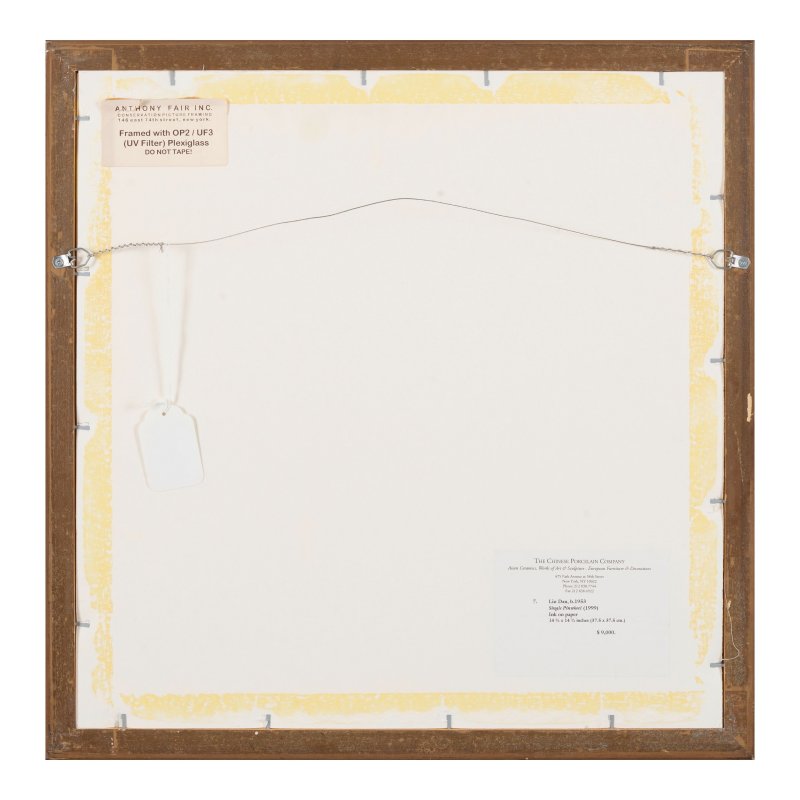
The Chinese Porcelain Company, New York, 29 October 2000
Published:
Still Expression: Recent Flower Paintings by Liu Dan, New York: The Chinese Porcelain Company, 2000, pl. 7, pp. 22-23. (fig. 1)
Exhibited:
"Still Expression: Recent Flower Paintings by Liu Dan," The Chinese Porcelain Company, New York, 20 March - 1 April, 2000. (fig. 2)
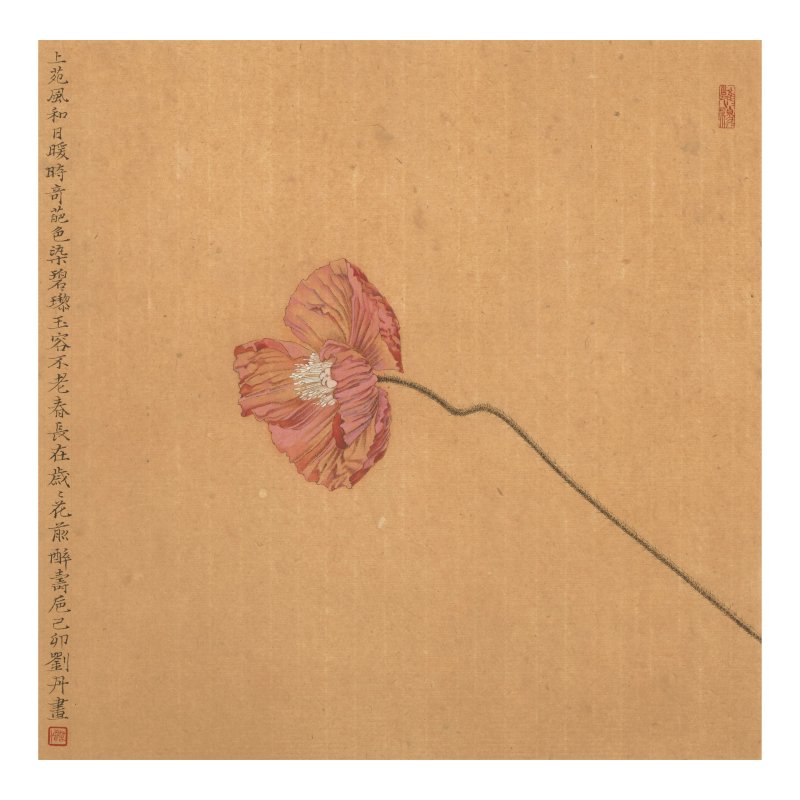
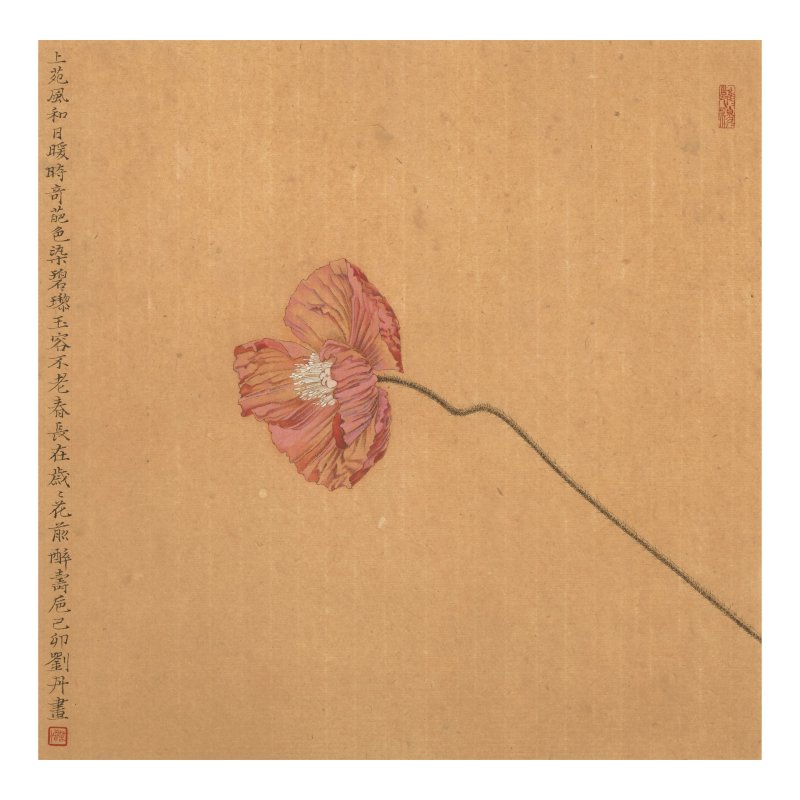
The present work depicts a single poppy of vivid red color in bloom, standing gracefully on its own. Its slender, upright stem is covered with fine hairs, while the petals and stamens turn toward the left edge of the composition, where a vertical line of inscription in meticulous regular script descends from above. Although the flower depicted is a poppy, the inscription is taken from the verse accompanying the "flower of everlasting spring" () in the opening section of the handscroll (), traditionally attributed to Yang Jieyu from the Southern Song dynasty. The poppy was a subject Liu Dan began exploring after relocating to New York in 1993. His accompanying inscriptions on poppy paintings sometimes draw upon poetry or ancient texts explicitly related to the flower, while in other instances, as in the present work, the textual source bears no direct connection to poppy.
Executed in 1999, the present lot was exhibited the following year in an exhibition of Liu Dan's recent flower paintings organized by The Chinese Porcelain Company in New York. The exhibition centered primarily on poppies, alongside depictions of narcissus, including in the present sale, and orchids. As a pictorial subject, the poppy has is rooted in the tradition of Chinese painting while simultaneously possessing a distinctly contemporary resonance, drawing upon both Chinese and Western cultural associations. An album preserved in the National Palace Museum, Taipei, (Collected Paintings of the Song and Yuan Dynasties), , includes a leaf entitled "Xiesheng Yingsu" (Poppy Painted from Life; ) by the Southern Song painter Ai Xuan of Jinling (present day Nanjing). Liu Dan was likewise born in Nanjing and frequently signs himself "Liu Dan of Jinling," lending this historical connection particular resonance. Yet in Liu's hands, the poppy incorporates the painting techniques and visual vocabulary of the contemporary world, subjecting the Song-dynasty tradition of painting flowers from life to a process of microscopic deconstruction and conceptual reconstruction.
Liu Dan's painting features an extraordinary degree of realism, while his compositions are often radically minimal. At first glance, his depictions of flowers might almost be mistaken for photographic close-ups. Yet the carefully positioned calligraphic inscription disrupts the beholder's direct engagement with the pictorial space. The viewer's eye and mind are compelled to oscillate between the intensely lifelike, three-dimensional presence of the flower and the two-dimensional interplay of text and image on the pictorial surface, creating a seductive tension between illusion and reality. Particularly striking here is the combined vertical extent of the inscription together with the artist's seal corresponds exactly to the height of the sheet, further drawing the viewer's attention to the edge of the paper itself, namely the physical boundary of the pictorial world.
At the same time, the content of the verse carries the imagination beyond that boundary and into the imperial gardens of the Song dynasty, where "the jade-like countenance (of the flower) never ages" and spring endures eternally. The exquisite blossom once beheld by Song-dynasty eyes "when the breeze was gentle and the sun warm" seems here to have been suspended in time, transformed into the immortal flower before our modern eyes. Its beauty preserved across a thousand years, its fragrance enduring through the ages. As Liu Dan himself has observed of the flowers he paints: "their shapes are formed initially in order 'not to forget.' Now what has been painted has become the 'remembered.' Just like flowers in a book, they are flat and have very little to do with the poems and the ancient verse next to them.
劉丹(1953年生) 上苑壽春 設色紙本 鏡框 一九九九年作
款識:上苑風和日暖時,奇葩色染碧(玻)瓈。玉容不老春長在,歲歲花前醉壽卮。己卯劉丹畫。
鈐印:雝雝穆穆、若僧
紐約中國瓷業公司,2000年10月29日
《劉丹花卉作品近作展》(Still Expression: Recent Flower Paintings by Liu Dan)展覽圖錄,紐約:中國瓷業公司,2000年,圖錄編號7,頁22-23()
"劉丹花卉作品近作展"(Still Expression: Recent Flower Paintings by Liu Dan),中國瓷業公司,紐約,2000年3月20日至4月1日()
此幅單繪一枝鮮妍欲滴的虞美人,玲瓏獨立。花莖纖細挺拔,上覆茸毛,花瓣及花蕊朝向畫幅左側邊緣處自上而下一行工緻的簪花小楷,仿有春風不解意,欲言固又止之姿。畫中所繪雖為虞美人,款識所錄則出自傳為楊婕妤所作《百花圖》卷上第一段「壽春花」之題詠。虞美人又名罌粟,或麗春花、望仙花,是劉丹自一九九三年遷居紐約後始作探索的主題,畫上所配題詠或取與罌粟相關之詩詞舊敘,亦有如此幅般未必直接關聯者。
本拍品作于一九九九年,次年便參與由紐約中國瓷業公司為劉丹舉辦的花卉近作個展。該展畫作以罌粟為主,兼有水仙(如本場)、蘭花。罌粟此一母體,宜今宜古,貫通中西。現存臺北故宮《宋元集繪》冊,便有南宋金陵畫家艾宣所作〈寫生罌粟〉一頁()。劉丹亦生于南京,常自署「金陵劉丹」,此為淵源有自。然其筆下罌粟,則融入了當代繪畫技法與視覺語匯,對宋代寫生花卉這一題材進行了一次冷靜的微觀解構及精神重構。
劉丹的畫風近乎極緻寫實,構圖亦異常簡約,乍觀宛若花卉特寫攝影。然巧妙置入畫幅中的楷書題詠,卻打斷了觀者與所繪空間的直接連結,使視覺思維于極度逼真的三維花體及全然平面的圖文互映之間往復游移,如幻似真。尤其此幅的題詠並畫家鈐印所佔縱長適與紙幅等高,更是提醒了觀者紙張邊緣,亦即畫中世界的物理界綫之所在。而詩文内容又將觀者思緒牽引至宋代宮苑;「玉容不老」,春光長在,宋人于「風和日暖時」所見的那一盞上苑仙葩,仿佛就此定格成了觀者眼前這朵永生之花,千年風華,亙古流芳。誠如劉丹自言,其筆下所畫之花:是爲了不被忘記。被畫下,即被銘記。正好似夾入書頁中的鮮花,被按壓成了扁平的圖像,與書中的遠古詩文別無關涉。
Matted, framed and glazed, ink and color on paper, inscribed by the artist and dated jimao, and signed Liu Dan with two artist's seals.
14 3/8 x 14 1/2in (36.4 x 36.8cm)
Footnotes
Provenance:
The Chinese Porcelain Company, New York, 29 October 2000
Published:
Still Expression: Recent Flower Paintings by Liu Dan, New York: The Chinese Porcelain Company, 2000, pl. 7, pp. 22-23. (fig. 1)
Exhibited:
"Still Expression: Recent Flower Paintings by Liu Dan," The Chinese Porcelain Company, New York, 20 March - 1 April, 2000. (fig. 2)
The present work depicts a single poppy of vivid red color in bloom, standing gracefully on its own. Its slender, upright stem is covered with fine hairs, while the petals and stamens turn toward the left edge of the composition, where a vertical line of inscription in meticulous regular script descends from above. Although the flower depicted is a poppy, the inscription is taken from the verse accompanying the "flower of everlasting spring" () in the opening section of the handscroll (), traditionally attributed to Yang Jieyu from the Southern Song dynasty. The poppy was a subject Liu Dan began exploring after relocating to New York in 1993. His accompanying inscriptions on poppy paintings sometimes draw upon poetry or ancient texts explicitly related to the flower, while in other instances, as in the present work, the textual source bears no direct connection to poppy.
Executed in 1999, the present lot was exhibited the following year in an exhibition of Liu Dan's recent flower paintings organized by The Chinese Porcelain Company in New York. The exhibition centered primarily on poppies, alongside depictions of narcissus, including in the present sale, and orchids. As a pictorial subject, the poppy has is rooted in the tradition of Chinese painting while simultaneously possessing a distinctly contemporary resonance, drawing upon both Chinese and Western cultural associations. An album preserved in the National Palace Museum, Taipei, (Collected Paintings of the Song and Yuan Dynasties), , includes a leaf entitled "Xiesheng Yingsu" (Poppy Painted from Life; ) by the Southern Song painter Ai Xuan of Jinling (present day Nanjing). Liu Dan was likewise born in Nanjing and frequently signs himself "Liu Dan of Jinling," lending this historical connection particular resonance. Yet in Liu's hands, the poppy incorporates the painting techniques and visual vocabulary of the contemporary world, subjecting the Song-dynasty tradition of painting flowers from life to a process of microscopic deconstruction and conceptual reconstruction.
Liu Dan's painting features an extraordinary degree of realism, while his compositions are often radically minimal. At first glance, his depictions of flowers might almost be mistaken for photographic close-ups. Yet the carefully positioned calligraphic inscription disrupts the beholder's direct engagement with the pictorial space. The viewer's eye and mind are compelled to oscillate between the intensely lifelike, three-dimensional presence of the flower and the two-dimensional interplay of text and image on the pictorial surface, creating a seductive tension between illusion and reality. Particularly striking here is the combined vertical extent of the inscription together with the artist's seal corresponds exactly to the height of the sheet, further drawing the viewer's attention to the edge of the paper itself, namely the physical boundary of the pictorial world.
At the same time, the content of the verse carries the imagination beyond that boundary and into the imperial gardens of the Song dynasty, where "the jade-like countenance (of the flower) never ages" and spring endures eternally. The exquisite blossom once beheld by Song-dynasty eyes "when the breeze was gentle and the sun warm" seems here to have been suspended in time, transformed into the immortal flower before our modern eyes. Its beauty preserved across a thousand years, its fragrance enduring through the ages. As Liu Dan himself has observed of the flowers he paints: "their shapes are formed initially in order 'not to forget.' Now what has been painted has become the 'remembered.' Just like flowers in a book, they are flat and have very little to do with the poems and the ancient verse next to them.
劉丹(1953年生) 上苑壽春 設色紙本 鏡框 一九九九年作
款識:上苑風和日暖時,奇葩色染碧(玻)瓈。玉容不老春長在,歲歲花前醉壽卮。己卯劉丹畫。
鈐印:雝雝穆穆、若僧
紐約中國瓷業公司,2000年10月29日
《劉丹花卉作品近作展》(Still Expression: Recent Flower Paintings by Liu Dan)展覽圖錄,紐約:中國瓷業公司,2000年,圖錄編號7,頁22-23()
"劉丹花卉作品近作展"(Still Expression: Recent Flower Paintings by Liu Dan),中國瓷業公司,紐約,2000年3月20日至4月1日()
此幅單繪一枝鮮妍欲滴的虞美人,玲瓏獨立。花莖纖細挺拔,上覆茸毛,花瓣及花蕊朝向畫幅左側邊緣處自上而下一行工緻的簪花小楷,仿有春風不解意,欲言固又止之姿。畫中所繪雖為虞美人,款識所錄則出自傳為楊婕妤所作《百花圖》卷上第一段「壽春花」之題詠。虞美人又名罌粟,或麗春花、望仙花,是劉丹自一九九三年遷居紐約後始作探索的主題,畫上所配題詠或取與罌粟相關之詩詞舊敘,亦有如此幅般未必直接關聯者。
本拍品作于一九九九年,次年便參與由紐約中國瓷業公司為劉丹舉辦的花卉近作個展。該展畫作以罌粟為主,兼有水仙(如本場)、蘭花。罌粟此一母體,宜今宜古,貫通中西。現存臺北故宮《宋元集繪》冊,便有南宋金陵畫家艾宣所作〈寫生罌粟〉一頁()。劉丹亦生于南京,常自署「金陵劉丹」,此為淵源有自。然其筆下罌粟,則融入了當代繪畫技法與視覺語匯,對宋代寫生花卉這一題材進行了一次冷靜的微觀解構及精神重構。
劉丹的畫風近乎極緻寫實,構圖亦異常簡約,乍觀宛若花卉特寫攝影。然巧妙置入畫幅中的楷書題詠,卻打斷了觀者與所繪空間的直接連結,使視覺思維于極度逼真的三維花體及全然平面的圖文互映之間往復游移,如幻似真。尤其此幅的題詠並畫家鈐印所佔縱長適與紙幅等高,更是提醒了觀者紙張邊緣,亦即畫中世界的物理界綫之所在。而詩文内容又將觀者思緒牽引至宋代宮苑;「玉容不老」,春光長在,宋人于「風和日暖時」所見的那一盞上苑仙葩,仿佛就此定格成了觀者眼前這朵永生之花,千年風華,亙古流芳。誠如劉丹自言,其筆下所畫之花:是爲了不被忘記。被畫下,即被銘記。正好似夾入書頁中的鮮花,被按壓成了扁平的圖像,與書中的遠古詩文別無關涉。