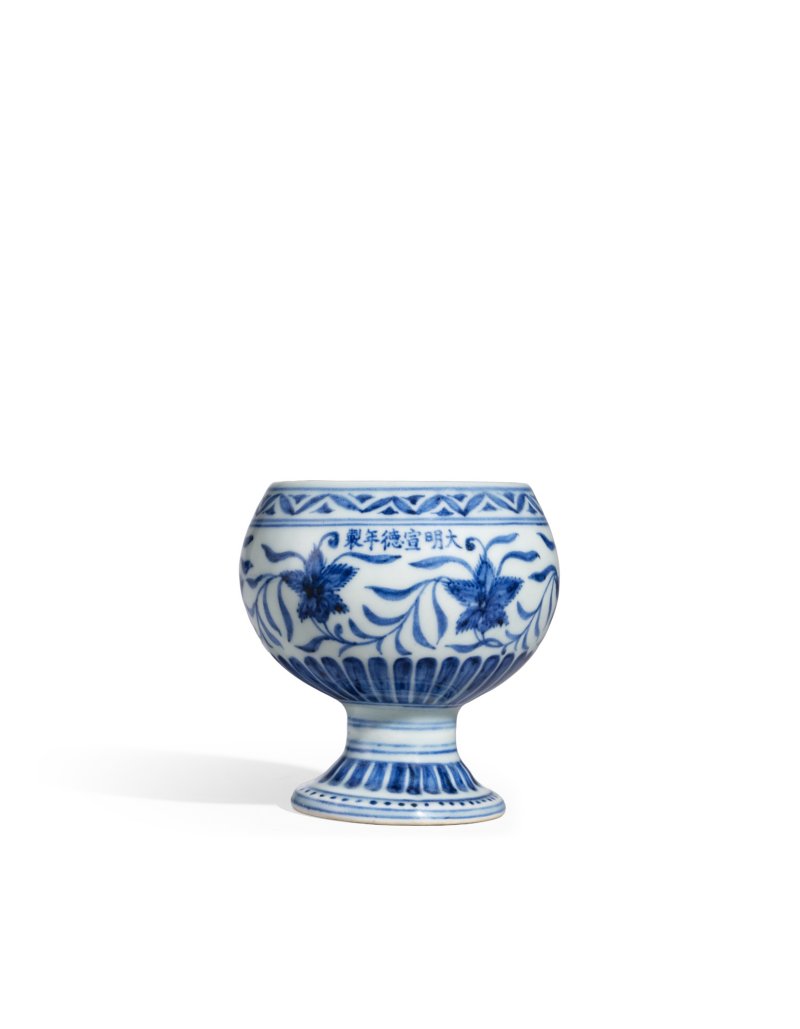

Lot 6009 A fine and rare blue and white ‘floral’ stem cup, dou, Mark and period of Xuande | 明宣德 青花纏枝花卉紋豆 《大明宣德年製》款
落槌价
预展中
成交价
预展中
| 拍卖公司 | 苏富比 |
|---|---|
| 拍卖时间 | 2026年10月30日 |
拍品信息
拍品名称
A fine and rare blue and white ‘floral’ stem cup, dou, Mark and period of Xuande | 明宣德 青花纏枝花卉紋豆 《大明宣德年製》款
起拍价
HKD 1,200,000
估值区间
1,200,000 - 1,800,000 HKD
尺寸
未知
品相
Very good overall condition, with only very minor firing imperfections, such as a slightly slanted mouth, and a few pinholes to the interior.
整體品相良好。見正常燒造瑕疵,如口沿稍斜,盌心見數點小棕眼。
If a condition report is provided to assist you with assessing the condition of the lot, it is for guidance purposes only. Such condition report may not refer to all faults, restoration, alterations, or adaptations because Sotheby's is not a professional conservator or restorer but rather a condition report is a statement of subjective, qualified opinion genuinely held by Sotheby's. For these reasons, any such condition report is not an alternative to taking your own professional advice regarding the condition of the lot. Prospective buyers should also refer to the Guide for Buyers at Auction which includes important notices concerning the type of property in this sale.
更多信息
h. 10.1 cm
图录
说明:Stem cups of this globular form, with an inward curved rather than the flared rim, probably belong to the wide range of Yongle and Xuande porcelain shapes that derive their inspiration from Middle Eastern metalwork, and the petal borders above and below the waist of the stem seem to imitate gadrooning of the metal examples. Stem cups have a long tradition in Iran and were introduced to China prior to the Tang dynasty. Compare several Iranian stem cups of the 13th and 14th centuries, but without gadroons, in Assadullah Souren Melikian-Chirvani, Islamic Metalwork from the Iranian World. 8th-18th Centuries, London, 1982, p. 147, fig. 53, and cat. nos 71, 72, 84 and 85.
The elegant carnation design was rarely used in the Ming dynasty, but was similarly found on blue-and-white tankards of Xuande mark and period, which equally follow a Middle Eastern form; see an example in the Taipei Palace Museum, illustrated in Catalogue of the Special Exhibition of Selected Hsüan-te Imperial Porcelains of the Ming Dynasty, Palace Museum, Taipei, 1998, cat. no. 12.
Fragments of a porcelain prototype in monochrome white, with a more accentuated, stepped foot, were recovered from the Yongle stratum of the imperial kiln sites in Jingdezhen; see Imperial Porcelain of the Yongle and Xuande Periods Excavated from the Site of the Ming Imperial Factory at Jingdezhen, Hong Kong Museum of Art, Hong Kong, 1989, cat. no. 12.
A similar stem cup in the British Museum, London, is published in Jessica Harrison-Hall, Ming Ceramics in the British Museum, London, 2001, pl. 4: 21; one in the Museum of Fine Arts, Boston, is illustrated in Oriental Ceramics. The World's Great Collections, Tokyo, New York, San Francisco, 1980-82, vol. 10, pl. 219; one from the Sir Percival David Collection in the British Museum, London, ibid., vol. 6, pl. 90; one in the Capital Museum, Beijing, in Shoudu Bowuguan cang ci xuan [Selection of porcelains from the Capital Museum], Beijing, 1991, pl. 96; and one in the National Museum of China, Beijing, in Zhongguo Guojia Bowuguan guancang wenwu yanjiu congshu, Ciqi juan: Mingdai, Shanghai, 2007, pl. 34. See also an example formerly in the collections of Mr & Mrs R.H.R. Palmer, Eskenazi and Meiyintang, sold in these rooms, 5th October 2011, lot 27; and another from the the Yin Xue Tang Collection, sold in these rooms, 8th April 2023, lot 20.
Stem cups of this form are also known with covers, all of them surprisingly poorly fitted to the opening of the cups; see two examples in the Taipei Palace Museum, in the exhibition catalogues Mingdai Xuande guanyao jinghua tezhan tulu, op. cit., cat. no. 8, and Catalogue of a Special Exhibition of Hsuan-te Period Porcelain, Taipei, 1980, cat. no. 25; one in the Beijing Palace Museum, from the Qing court collection, included in Geng Baochang, ed., Gugong Bowuyuan cang Ming chu qinghua ci, Beijing, 2002, vol. 2, pl. 105; another in the Shanghai Museum, see Lu Minghua, Shanghai Studies of the Shanghai Museum Collections: A Series of Monographs. Mingdai guanyao ciqi, Shanghai, 2007, pl. 3-29; or the example in the Freer Gallery of Art, Washington, D.C., published in Oriental Ceramics, op. cit., vol. 9, pl. 101. A fragmentary blue-and-white stem cup and cover of this design were also excavated from the waste heaps of the Ming imperial kiln site at Zhushan, Jingdezhen, see Jingdezhen chutu Ming Xuande guanyao ciqi/Xuande Imperial Porcelain Excavated at Jingdezhen, Chang Foundation, Taipei, 1998, cat. no. 27.
此類豆形器,鼓腹斂口,應屬永宣時期,仿中東金屬器造型。腰部上下所飾蓮瓣紋,似仿金屬器之模雕紋樣。高足器形制在伊朗歷史久遠,唐代以前傳入中國。比較十三至十四世紀伊朗高足杯例,無圓模雕飾,載於 Assadullah Souren Melikian-Chirvani,《Islamic Metalwork from the Iranian World. 8th-18th Centuries》, 倫敦,1982年,頁147,圖53,編號71、72、84、85。
此豆所繪纏枝花卉紋,明代鮮見,相若圖案同見於明宣德青花花澆,其形亦屬仿中東樣式。比較一件宣德款青花纏枝花卉紋花澆,見於《明代宣德官窰菁華特展圖錄》,故宮博物院,台北,1998年,編號12。
同類的白釉豆形器殘件,底足呈明顯台階狀,見有景德鎮御窰廠永樂地層出土物,參考《景德鎮珠山出土永樂宣德官窰瓷器展覽》, 香港藝術館, 香港,1989年,編號12。
相近豆形器,見有:倫敦大英博物館藏品,載於霍吉淑,《Ming Ceramics in the British Museum》,倫敦,2001年,圖版4:21;波士頓美術館藏例,載於《東洋陶磁大觀》,東京、紐約、三藩市,1980–82年,卷10,圖版219;倫敦大英博物館大維德爵士藏品,出處同上,卷6,圖版90;北京首都博物館藏品,載於《首都博物館藏瓷選》,北京,1991年,圖版96;北京中國國家博物館藏品,載《中國國家博物館館藏文物研究叢書》,瓷器卷:明代,上海,2007年,圖版34。另可參考一拍賣例,為 R.H.R. Palmer、埃斯卡納齊及玫茵堂遞藏,後售於香港蘇富比,2011年10月5日,編號27。胤雪堂藏一例,釋於香港蘇富比2023年4月8日,編號20。
造型相同的豆形器,亦見有蓋者,其器蓋扣合卻全都出現偏差,讓人意外;參考兩例,屬台北故宮博物院藏品,載《明代宣德官窰菁華特展圖錄》,台北,1998年,編號8,也見於《明宣德瓷器特展目錄》,台北,1980年,編號25;另有一件北京故宮藏例,屬清宮舊藏。收錄於耿寶昌,《故宮博物院藏明初青花瓷》,北京,2002年,卷2,圖版105;上海博物館藏例,載於陸明華,《上海博物館藏品研究大系.明代官窰瓷器》,上海,2007年,圖版3–29;或見華盛頓弗利爾美術館藏品,載於《東洋陶磁大觀》,見上註,卷9,圖版101。一件青花花卉紋帶蓋豆殘器,出土於景德鎮珠山明代御窰廠遺址,見於《景德鎮出土明宣德官窰瓷器》,鴻禧美術館,台北,1998年,編號27。
常见问题
这件A fine and rare blue and white ‘floral’ stem cup, dou, Mark and period of Xuande | 明宣德 青花纏枝花卉紋豆 《大明宣德年製》款的成交价是多少?
落槌价为 预展中。 成交价为 预展中。
拍品的品相状况如何?
Very good overall condition, with only very minor firing imperfections, such as a slightly slanted mouth, and a few pinholes to the interior.
整體品相良好。見正常燒造瑕疵,如口沿稍斜,盌心見數點小棕眼。
If a condition report is provided to assist you with assessing the condition of the lot, it is for guidance purposes only. Such condition report may not refer to all faults, restoration, alterations, or adaptations because Sotheby's is not a professional conservator or restorer but rather a condition report is a statement of subjective, qualified opinion genuinely held by Sotheby's. For these reasons, any such condition report is not an alternative to taking your own professional advice regarding the condition of the lot. Prospective buyers should also refer to the Guide for Buyers at Auction which includes important notices concerning the type of property in this sale.
整體品相良好。見正常燒造瑕疵,如口沿稍斜,盌心見數點小棕眼。
If a condition report is provided to assist you with assessing the condition of the lot, it is for guidance purposes only. Such condition report may not refer to all faults, restoration, alterations, or adaptations because Sotheby's is not a professional conservator or restorer but rather a condition report is a statement of subjective, qualified opinion genuinely held by Sotheby's. For these reasons, any such condition report is not an alternative to taking your own professional advice regarding the condition of the lot. Prospective buyers should also refer to the Guide for Buyers at Auction which includes important notices concerning the type of property in this sale.