
拍品信息
拍品名称
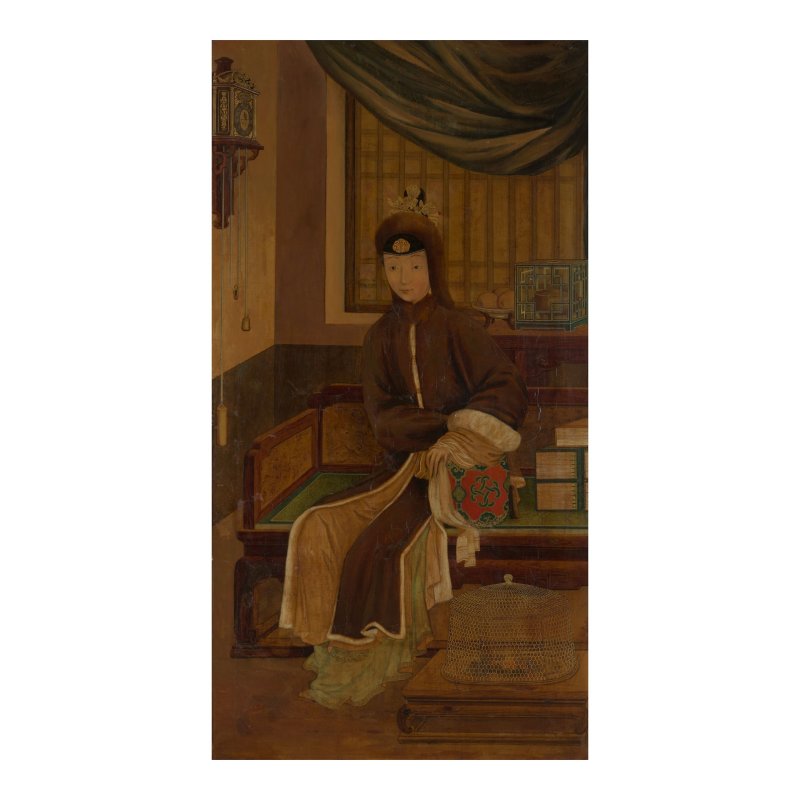
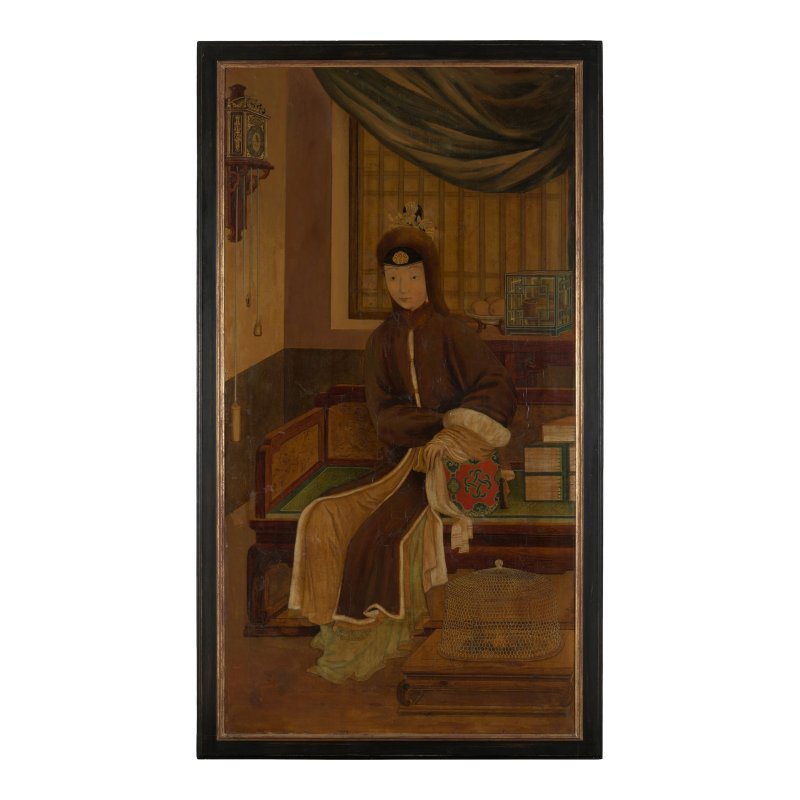
王致誠(1702-1768)畫派 裘裝美人像 | SCHOOL OF JEAN DENIS ATTIRET (WANG ZHICHENG, 1702-1768)
年代
Portrait of a Court Lady in Winter Robe, Qianlong Period, mid-18th century
起拍价
USD 40,000
估值区间
未知
尺寸
未知
品相
未知
更多信息
Portrait of a Court Lady in Winter Robe, Qianlong Period, mid-18th century
Framed, oil on Korean paper, backed with cloth, unsigned and without artist's seals.
68 1/4 x 36in (173.3 x 91.5cm)
Footnotes
Provenance:
Formerly in a private Texas collection
Both the material culture represented in this portrait and its medium strongly indicate that it is a work of the Qing court painting academy. The painting depicts an elegant and dignified young lady wearing a fur hat over a forehead band adorned with a gilt phoenix motif. Before her high coiffure are elaborate gold filigree hairpins in the form of a peacock flanked by butterflies, inset with red and green gemstones and dazzling in its intricacy. Dressed in fur, she sits at a slight angle in a relaxed pose, resting both hands lightly upon a yingshou 迎手 (elbow cushion) embroidered in green and gold thread against red satin (fig. 1). Also known as yingzhen 迎枕 (elbow pillow), this type of bolster was commonly found on beds and couches in the Qing imperial court and wealthy households. Often richly decorated, examples were made in a variety of materials, including embroidered textiles, ceramics, woven bamboo, and even gilt metal. Numerous examples of court elbow cushion remain in the collection of the Chengde Mountain Resort Museum (fig. 2). The lady is seated on a huanghuali luohan bed inset with burlwood, the grain of the timber rendered with remarkable verisimilitude. Its hoof feet rest on base stretchers, and restrained cloud motifs are carved on its feet and aprons. A green cushion patterned with scrolling flowers covers the seat, upon which are placed five cases of thread-bound books, suggesting that the sitter possesses intellectual refinement and literary accomplishment.
A brazier stand with base stretchers is placed in front of the bed (). The charcoal brazier is covered by a gilt-bronze cover formed of an interlinked mesh of metal rings, through which glowing embers can just be discerned. Brazier stands constitute an exceptionally rare category among surviving Ming and Qing furniture, and examples crafted from precious hardwoods are rarer still. The stand depicted here resembles a low table, but with a circular brazier recessed into its center. Grace Wu illustrates a comparable "rectangular low brazier stand" in (). As Wu observes, "since brazier stands were utilitarian objects and, in use, were exposed to the risk of scorching from burning charcoal, they would ordinarily have been made of common timber." The example represented in the present painting, however, from its 'ice-plate' edge and beaded aprons to its pronouncedly incurved legs, displays a refinement characteristic of furnishings made for imperial and upper-class use. Similar metalwork covers are also represented in other Qing court paintings, confirming their use within the palace. In the eleventh leaf, "Weilu Bogu" (Gathering around the Brazier and Appreciating Antiquities) from Chen Mei (ca. 1694-1745)'s 1738 album , a pair of three-legged bronze censers fitted with similarly worked covers stands in the hall where the court ladies examine paintings (). A comparable brazier stand also appears before a bed in the inner room (), although that example is finished in red lacquer rather than natural wood.
Against the wall behind the bed stands a recessed-leg table with -shaped cloud spandrels and openwork panels set into wide shoe feet (). Tables of this type survive in somewhat greater numbers and frequently have upturned flanges at either end; a comparable example is preserved in the Palace Museum, Beijing (). On the table are a porcelain basin on a stand filled with fragrant fruit and a bronze incense burner enclosed beneath a glass cover, with incense ash visible inside. The interior is orderly and restrained. A curtain above the lattice window is rolled up, while on the wall at left hangs a splendid European-style clock with a wooden architectural case and gilt-bronze mounts (), introducing an unmistakable note of imperial luxury into an otherwise scholarly setting. The hands indicate 11:45, presumably shortly before noon. Mechanical clocks had entered China with European missionaries as early as the Ming dynasty, and during the Qing, the Kangxi, Yongzheng, and Qianlong emperors all prized them as ingenious marvels. In addition to imported clocks, the Qing court established its own imperial clockmaking workshops. Wooden clock cases were commonly fashioned from ebony, , or , while lacquered examples often employed softwood such as fir as a structural core. Several clocks comparable to the one depicted here survive in the Palace Museum, Beijing, and the Chengde Mountain Resort Museum, including a lacquered clock with gilt-bronze mounts produced by the imperial clockmaking workshop through the adaptation of a European clock case (). Similar timepieces also appear in Qing court paintings of beauties. In "Nian Zhu Guan Mao" (Lady with Prayer Beads Watching a Cat) from the celebrated series , a European-style clock with an architectural wooden case, enamel decoration, and gilt-bronze mounts appears in the interior (); its hands indicate 1:40 in the afternoon.
The extraordinary precision with which the textures and surfaces of the various objects are rendered in the present painting owes much to the possibilities of oil painting. Oil-painting materials remained rare in China during the Qing dynasty and would not have been readily available to ordinary painters. An artist capable of mastering the medium and producing a work of such monumental scale and extraordinary illusionism was therefore most likely among the European painters serving in the imperial painting academy during the Yongzheng and Qianlong periods. The facial features of the woman in the present lot provide a particularly intriguing point of comparison. Her pale, oval face is framed by delicately arched brows; her long, narrow eyes convey a restrained gentleness, while her nose is finely formed and her lips small and cherry-like. A single earring hangs from each ear. Her features bear a notable resemblance to the female figure in Jean-Denis Attiret (Wang Zhicheng, 1702-1768)'s (Portrait of a Consort of Qianlong Emperor; ). That painting originally served as an affixed hanging () above a doorway in the eastern room of the Kuoran Dagong (Perfect Brightness Garden) complex, also known as Shuanghe Zhai (Double Crane Studio), at the Yuanming Yuan (Summer Palace). An entry dated the twelfth day of the tenth month of the thirteenth year of Qianlong (1748) records: "Ruyiguan (Office of Wish Fulfillment): ... On the seventh day of the eighth month of the thirteenth year, the eunuch Hu Shijie conveyed the imperial order that Wang Zhicheng was to paint a beauty for the west doorway on the north wall in the eastern side room of the rear hall of the Double Crane Studio." The painting remained in situ until the second month of the sixth year of Jiaqing (1801), when it was removed and placed in storage.
Jean-Denis Attiret, also known as Wang Zhicheng, was a French Catholic missionary and painter. He arrived in Macao in 1738 and entered imperial service the following year. Together with Giuseppe Castiglione (Lang Shining, 1688-1766) and Ignatius Sichelbart (Ai Qimeng, 1708-1780), he became one of the most important European artists at the Qing court and participated in the design and construction of the European-style pavilions at the Summer Palace. In 1754, he accompanied the Qianlong Emperor to Jehol, where he produced more than twenty oil portraits on paper of tribal leaders, as well as the monumental oil painting on paper (The Qianlong Emperor Practicing Archery), now in the Palace Museum, Beijing. Attiret passed away in Beijing in 1768. Of intriguing relevance are two exceedingly rare preparatory drawings of court ladies by Attiret, dated 1759 and preserved in the Bibliothèque Nationale de France (). The female figures in these drawings bear a resemblance to the sitter in the present painting as well. Both sheets retain the imperial yellow labels identifying them explicitly as designs for the east and west walls of the eastern side room of Chengguan Ge (Clear View Pavilion), was a Chinese-style building in the Changchun Yuan (Eternal Spring Garden) of the Summer Palace, used for the storage and display of Buddhist statues. Although the building itself was destroyed during the military devastation of the Summer Palace, these two drawings fortunately survive.
Archival records from Zaobanchu (Imperial Household Department Workshops) further document Attiret's production of "oil paintings of beauties" for the Qing court. An entry dated the seventeenth day of the tenth month of the twenty-third year of Qianlong (1758) records: "Ruyiguan: On the seventeenth day, a memorandum endorsed by Yuanwailang Lang Zhengpei was received, stating that on the fifteenth day of this month the eunuch Hu Shijie brought a paper template and conveyed the following: 'In the eastern side room of the main hall of Zelan Tang (Pavilion for Nurturing Orchids), behind Aishan Lou (Building for Loving Mountains), a glass mirror is to be installed in the center of the partition. To its north, facing east, a new false doorway has been added, with a clear height of five , six and three , and a width of two , six and eight . By imperial command, Wang Zhicheng is to paint an oil painting of a beauty for this location. He is first to prepare a draft for imperial inspection. Respect this.'" Another entry, dated the twelfth day of the second month of the twenty-fourth year of Qianlong (1759), records: "Ruyiguan: On the twelfth day, a memorandum endorsed by Yuanwailang Lang Zhengpei and storekeeper Dekui was received, stating that on this day an imperial order was issued: 'Wang Zhicheng's large nocturnal painting and oil painting of a beauty are both to be mounted and pasted in place. Respect this.'" Pavilion for Nurturing Orchids was located within the Eternal Spring Garden at the Summer Palace as well and served as a place for the storage of books, relaxation, and enjoyment of the surrounding scenery. Although itself a Chinese-style garden building, it adjoined the European-style pavilions and the Dashuifa site (Great Fountain) complex to the north, making the installation of an oil-painted beauty there entirely consistent with its architectural context. Although executed in the Western medium of oil, the present painting remains predominantly Chinese in both the appearance of the sitter and the furnishings surrounding her. Moreover, its dimensions are broadly comparable to the one for the Pavilion for Nurturing Orchids five , six and three by two , six and eight , or approximately 180 x 86 cm. It is therefore highly plausible that the present painting was likewise originally commissioned for installation within a comparable palace interior.
A life-size portrait of a beauty painted with Western techniques of illusionistic realism would inherently have possessed a effect. "The spatial depth and tactile quality of the objects transform the pictorial space into an extension of the actual space, investing the image with a powerful sense of visual credibility. We may imagine that certain elements represented within the painting could also have been present among the furnishings of the physical interior." (Yang) Among Qing court works conceived according to this principle, the most eminent is undoubtedly the twelve-panel series . Painted between 1709 and 1723, the panels originally formed a screen in the Shenliu Dushu Tang (Deep Willows Reading Hall) at Double Crane Studio, Summer Palace, a study used by the future Yongzheng Emperor while he was still a prince. The panels were removed and placed in the imperial collection in the tenth year of Yongzheng (1732) and are now preserved in the Palace Museum, Beijing. Each panel measures approximately 184 x 98 cm, dimensions remarkably close to those of the present lot. Moreover, the seated poses of the ladies in "Guanshu Chenyin" (Lady Lost in Thought over a Book; ) and "Chi Biao Dui Ju" (Lady Holding a Watch beside Chrysanthemums; ) closely resemble that of the present sitter. Both compositions also incorporate suspended curtains above the figure. These correspondences suggest that the earlier series may have provided an important pictorial inspiration for the present lot.
Large-scale oil paintings on paper depicting court beauties are exceedingly rare. The National Palace Museum, Taipei, preserves a somewhat smaller (Portrait of the Fragrant Concubine in Western Dress), measuring 147 x 71 cm. Another comparable painting of a lady in Western dress, attributed to the school of Giuseppe Castiglione, was offered at Sotheby's New York in its sale of on 31 March 2005, lot 268. Measuring 130.8 x 69.3 cm, it is smaller still, while its treatment of the sitter's face displays an even more pronounced degree of Western naturalism.
References
Cahill, James. Pictures for Use and Pleasure: Vernacular Painting in High Qing China. BLos Angeles: University of California Press, 2010.
Kleutghen, Kristina. Imperial Illusions: Crossing Pictorial Boundaries in the Qing Palaces. Seattle: University of Washington Press, 2015.
(Comprehensive Archives of the Workshops of the Imperial Household Department in the Qing Palace), Guanzhen Yunjian Database.
Tang, Kaijian. "Qinggong Huajia Faguo Yesuhuishi Wang Zhicheng zai Hua Huodong Kaoshu" (A Study of the Activities in China of the French Jesuit and Qing Court Painter Jean-Denis Attiret). In , 2011 (4), pp. 190–201.
Wu, Grace. . Beijing: Forbidden City Press, 2010.
Xu, Xin. "Mystery behind Fragrant Concubine's Portraits in Chinese History." In , 2012 (03), no. 206, pp. 24–31.
Yang, Dan. "Body, Space, and Imagination: Visual Context of Leng Mei's and the Early Qing Dynasty Boudoir Beauties Painting." In , 2023 (05), pp. 64-71.
王致誠(1702-1768)畫派 裘裝美人像
油彩高麗紙 托布裝框 清乾隆 十八世紀中期
德克薩斯州私人舊藏
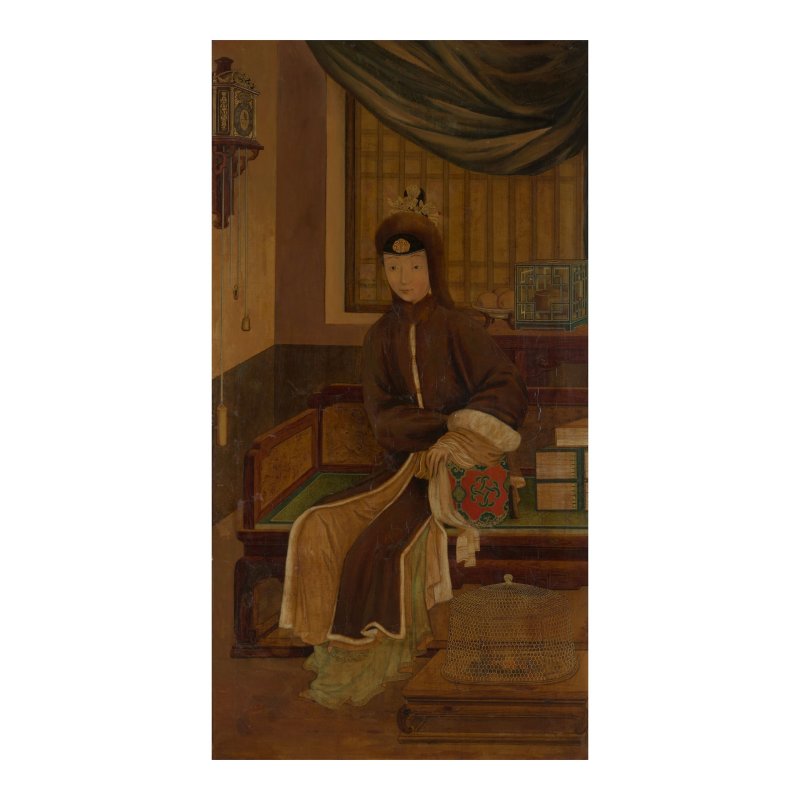
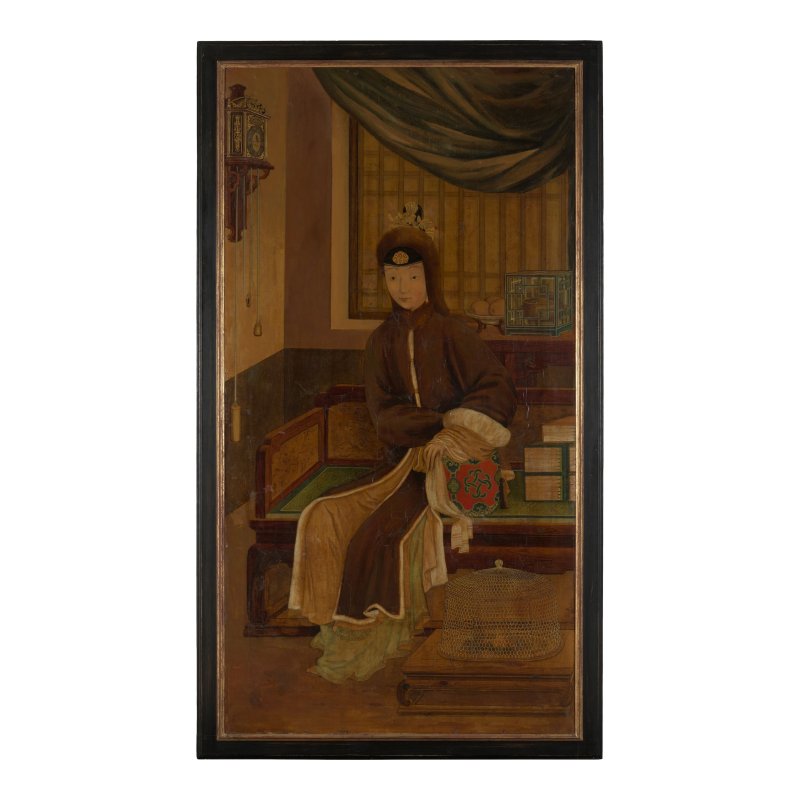
此幅美人像無論就畫面所呈現的物質文化,抑或作品媒材而言,皆可判定為清代宮廷繪畫。畫中繪一端嚴娟秀的女子,頭戴鑲金鳳鳥紋的抹額及裘帽,高聳髮髻前飾以金累絲嵌紅綠寶石孔雀蝴蝶簪,煥爛奪目。身著裘裝,微側閒坐,雙手輕倚紅緞地綠花錯金線繡出的迎手()。迎手,或稱迎枕,常見於清代宮廷及富貴人家,置於床榻之上,文縷繁縟,材質有織繡、陶瓷、竹篾乃至鎏金,承德避暑山莊便有大量宮廷遺存迎手()。美人所坐黃花梨嵌癭木羅漢床,木紋刻繪幾可亂真,馬蹄足下帶托泥,腿足與牙板上雕簡潔雲紋,坐板上鋪翠綠色西番蓮紋坐墊,上置五函線裝書籍,顯見女子秀外慧中,才情不俗。
床前置帶托泥的黃花梨火盆架(),炭盆上覆鏤空鎏金銅罩,罩內隱約可見炭火正熾。火盆架為現存明清家具中極為罕見的門類,以珍貴木材所製則尤為珍罕。畫中此件形製如炕桌,只中央嵌入圓形火盆。伍嘉恩著《明式家具二十年經眼錄》中載有一例「黃花梨長方矮火盆架」()與本拍品所繪相仿。伍氏亦指出,「火盆架既為日常用品,而使用時又近火源易被炭火燒灼,理當用一般柴木製作。」然畫中所繪者,無論冰盤沿、牙板及腿足綫脚,抑或鼓腿彭牙之造型,皆可見宮廷器用之考究。架上銅絲罩於其它宮廷繪畫中亦有見,可知為宮内曾見之物,如陳枚於乾隆三年(1738)所繪《月曼清游》圖冊中第十一開「圍爐博古」,仕女們賞畫的廳堂内置三足銅爐一對,配以做工類似的罩子(),且裡間羅漢塌前亦見類似的火盆架(),惟材質為朱漆而非木製。
羅漢床後倚墻設黃花梨夾頭榫如意雲頭牙子帶擋板供案(),此類案子存世相對較多,兩端多帶翹頭,北京故宮博物院便有一件()。案上置帶架瓷盆盛香果,另有帶玻璃罩盒的銅香爐,爐内見香灰。室內陳設整潔素凈,木欞窗上簾帷半卷,左側壁間懸掛一座綺麗堂皇的木樓嵌銅活西洋鐘(),於書卷氣中又見皇家富貴。鐘面指針顯示此時為十一點四十五分,當為晝日近正午。自鳴鐘自明代已隨傳教士進入中土,至清,康、雍、乾三帝皆目為奇巧之製,除進口鐘外,宮廷亦已有做鐘處,木製鐘多用烏木、紫檀及紅木,髹漆則以杉木為襯。與本拍品所繪近似的自鳴鐘,在北京故宮博物院及承德避暑山莊博物院中均有多件,如做鐘處以歐洲鐘殼改造的「彩漆嵌銅活鼓字盤鐘」()。其它宮廷美人圖中亦有描繪,如《雍親王題書堂深居圖屏》中〈捻珠觀貓〉一軸便有一座木樓嵌琺琅銅活鐘(),指針顯示為中午一點四十分。
本幅作品對各類器物質感的描摹細緻入微,實得益於油畫這種材質。油畫材料至清代猶屬罕見,非一般畫師所能得。能嫻習此種技法,且製作出如此巧侔天工的鉅制者,當屬供奉於雍乾畫院的西洋畫師。觀此作女子開臉,素白的鵝蛋臉上,柳煙眉輕挂,雙目細長,内斂溫柔,鼻若玉葱,唇似櫻桃,一耳一鉗,伶仃作響,與王致誠所作〈乾隆皇帝主位喜容像〉()中女子形貌相類。該圖曾為圓明園「廓然大公」(又稱雙鶴齋)殿東間門上貼落:「乾隆十三年(1748)十月十二日,如意館:......十三年八月初七日,太監胡世傑傳旨,雙鶴齋後殿東次間北向西門上著王致誠畫美人一張。」,此畫至嘉慶六年(1801)二月方被揭下保藏。
王致誠,又名巴德尼,法國天主教傳教士,乾隆三年(1738)抵澳門來華,次年入内廷供奉,與郎世寧、艾啓蒙等同為宮廷重要西洋畫家,曾參與圓明園西洋樓的設計及修建。乾隆十九年(1754)隨高宗赴熱河,為部落首領繪紙本油畫肖像二十餘幅,並作大型紙本油畫《乾隆射箭圖屏》(現藏北京故宮),乾隆三十三年(1768)病逝于京。法國國家圖書館藏有極罕見的王致誠仕女素描手稿兩幀,作於乾隆二十四年(1759)(),其上女子形象與本拍品極為相似,可資參照。二稿猶存黃籤,明確標示為澄觀閣東稍間東西二墻所作。澄觀閣原為圓明園長春園之中式建築,用以貯藏及陳設佛造像,惜於鴉片戰爭期間毀於兵燹,幸此二稿得存於世。
而關於王致誠在清宮作「油畫美人」一事,在《造辦初活計庫》中亦有記載。如「乾隆二十三年(1758)十月十七日,如意館:十七日接得員外郎郎正培押帖一件,内開,本月十五日太監胡世傑持來紙樣一張來說 「愛山樓後澤蘭堂大殿東次間隔斷板中間安玻璃鏡,北邊向東新添假門口一座,净高五尺六寸三分,寬二尺六寸八分,傳時著王致誠畫油畫美人一張,先起稿呈覽,欽此。」及「乾隆二十四年(1759)二月十二日,如意館:十二日接得員外郎郎正培庫掌德魁押帖一件,内開,本日奉,時王致誠得夜景大畫並油畫美人,俱著托貼,欽此」。澤蘭堂位於圓明園長春園内,為藏書處及休憩觀景用,雖其本身為中式園林建築,但北接西洋樓大水法,於此處有「油畫美人」貼落,亦甚為合理。本拍品雖為油畫,然畫中美人及陳設用具,仍以中式風格為主,且作品尺幅與澤蘭堂貼落(高五尺六寸三分,寬二尺六寸八分即高約一米八,寬約八十六厘米)參差相似,可以想見本拍品原亦極可能為類似的殿堂所作。
Framed, oil on Korean paper, backed with cloth, unsigned and without artist's seals.
68 1/4 x 36in (173.3 x 91.5cm)
Footnotes
Provenance:
Formerly in a private Texas collection
Both the material culture represented in this portrait and its medium strongly indicate that it is a work of the Qing court painting academy. The painting depicts an elegant and dignified young lady wearing a fur hat over a forehead band adorned with a gilt phoenix motif. Before her high coiffure are elaborate gold filigree hairpins in the form of a peacock flanked by butterflies, inset with red and green gemstones and dazzling in its intricacy. Dressed in fur, she sits at a slight angle in a relaxed pose, resting both hands lightly upon a yingshou 迎手 (elbow cushion) embroidered in green and gold thread against red satin (fig. 1). Also known as yingzhen 迎枕 (elbow pillow), this type of bolster was commonly found on beds and couches in the Qing imperial court and wealthy households. Often richly decorated, examples were made in a variety of materials, including embroidered textiles, ceramics, woven bamboo, and even gilt metal. Numerous examples of court elbow cushion remain in the collection of the Chengde Mountain Resort Museum (fig. 2). The lady is seated on a huanghuali luohan bed inset with burlwood, the grain of the timber rendered with remarkable verisimilitude. Its hoof feet rest on base stretchers, and restrained cloud motifs are carved on its feet and aprons. A green cushion patterned with scrolling flowers covers the seat, upon which are placed five cases of thread-bound books, suggesting that the sitter possesses intellectual refinement and literary accomplishment.
A brazier stand with base stretchers is placed in front of the bed (). The charcoal brazier is covered by a gilt-bronze cover formed of an interlinked mesh of metal rings, through which glowing embers can just be discerned. Brazier stands constitute an exceptionally rare category among surviving Ming and Qing furniture, and examples crafted from precious hardwoods are rarer still. The stand depicted here resembles a low table, but with a circular brazier recessed into its center. Grace Wu illustrates a comparable "rectangular low brazier stand" in (). As Wu observes, "since brazier stands were utilitarian objects and, in use, were exposed to the risk of scorching from burning charcoal, they would ordinarily have been made of common timber." The example represented in the present painting, however, from its 'ice-plate' edge and beaded aprons to its pronouncedly incurved legs, displays a refinement characteristic of furnishings made for imperial and upper-class use. Similar metalwork covers are also represented in other Qing court paintings, confirming their use within the palace. In the eleventh leaf, "Weilu Bogu" (Gathering around the Brazier and Appreciating Antiquities) from Chen Mei (ca. 1694-1745)'s 1738 album , a pair of three-legged bronze censers fitted with similarly worked covers stands in the hall where the court ladies examine paintings (). A comparable brazier stand also appears before a bed in the inner room (), although that example is finished in red lacquer rather than natural wood.
Against the wall behind the bed stands a recessed-leg table with -shaped cloud spandrels and openwork panels set into wide shoe feet (). Tables of this type survive in somewhat greater numbers and frequently have upturned flanges at either end; a comparable example is preserved in the Palace Museum, Beijing (). On the table are a porcelain basin on a stand filled with fragrant fruit and a bronze incense burner enclosed beneath a glass cover, with incense ash visible inside. The interior is orderly and restrained. A curtain above the lattice window is rolled up, while on the wall at left hangs a splendid European-style clock with a wooden architectural case and gilt-bronze mounts (), introducing an unmistakable note of imperial luxury into an otherwise scholarly setting. The hands indicate 11:45, presumably shortly before noon. Mechanical clocks had entered China with European missionaries as early as the Ming dynasty, and during the Qing, the Kangxi, Yongzheng, and Qianlong emperors all prized them as ingenious marvels. In addition to imported clocks, the Qing court established its own imperial clockmaking workshops. Wooden clock cases were commonly fashioned from ebony, , or , while lacquered examples often employed softwood such as fir as a structural core. Several clocks comparable to the one depicted here survive in the Palace Museum, Beijing, and the Chengde Mountain Resort Museum, including a lacquered clock with gilt-bronze mounts produced by the imperial clockmaking workshop through the adaptation of a European clock case (). Similar timepieces also appear in Qing court paintings of beauties. In "Nian Zhu Guan Mao" (Lady with Prayer Beads Watching a Cat) from the celebrated series , a European-style clock with an architectural wooden case, enamel decoration, and gilt-bronze mounts appears in the interior (); its hands indicate 1:40 in the afternoon.
The extraordinary precision with which the textures and surfaces of the various objects are rendered in the present painting owes much to the possibilities of oil painting. Oil-painting materials remained rare in China during the Qing dynasty and would not have been readily available to ordinary painters. An artist capable of mastering the medium and producing a work of such monumental scale and extraordinary illusionism was therefore most likely among the European painters serving in the imperial painting academy during the Yongzheng and Qianlong periods. The facial features of the woman in the present lot provide a particularly intriguing point of comparison. Her pale, oval face is framed by delicately arched brows; her long, narrow eyes convey a restrained gentleness, while her nose is finely formed and her lips small and cherry-like. A single earring hangs from each ear. Her features bear a notable resemblance to the female figure in Jean-Denis Attiret (Wang Zhicheng, 1702-1768)'s (Portrait of a Consort of Qianlong Emperor; ). That painting originally served as an affixed hanging () above a doorway in the eastern room of the Kuoran Dagong (Perfect Brightness Garden) complex, also known as Shuanghe Zhai (Double Crane Studio), at the Yuanming Yuan (Summer Palace). An entry dated the twelfth day of the tenth month of the thirteenth year of Qianlong (1748) records: "Ruyiguan (Office of Wish Fulfillment): ... On the seventh day of the eighth month of the thirteenth year, the eunuch Hu Shijie conveyed the imperial order that Wang Zhicheng was to paint a beauty for the west doorway on the north wall in the eastern side room of the rear hall of the Double Crane Studio." The painting remained in situ until the second month of the sixth year of Jiaqing (1801), when it was removed and placed in storage.
Jean-Denis Attiret, also known as Wang Zhicheng, was a French Catholic missionary and painter. He arrived in Macao in 1738 and entered imperial service the following year. Together with Giuseppe Castiglione (Lang Shining, 1688-1766) and Ignatius Sichelbart (Ai Qimeng, 1708-1780), he became one of the most important European artists at the Qing court and participated in the design and construction of the European-style pavilions at the Summer Palace. In 1754, he accompanied the Qianlong Emperor to Jehol, where he produced more than twenty oil portraits on paper of tribal leaders, as well as the monumental oil painting on paper (The Qianlong Emperor Practicing Archery), now in the Palace Museum, Beijing. Attiret passed away in Beijing in 1768. Of intriguing relevance are two exceedingly rare preparatory drawings of court ladies by Attiret, dated 1759 and preserved in the Bibliothèque Nationale de France (). The female figures in these drawings bear a resemblance to the sitter in the present painting as well. Both sheets retain the imperial yellow labels identifying them explicitly as designs for the east and west walls of the eastern side room of Chengguan Ge (Clear View Pavilion), was a Chinese-style building in the Changchun Yuan (Eternal Spring Garden) of the Summer Palace, used for the storage and display of Buddhist statues. Although the building itself was destroyed during the military devastation of the Summer Palace, these two drawings fortunately survive.
Archival records from Zaobanchu (Imperial Household Department Workshops) further document Attiret's production of "oil paintings of beauties" for the Qing court. An entry dated the seventeenth day of the tenth month of the twenty-third year of Qianlong (1758) records: "Ruyiguan: On the seventeenth day, a memorandum endorsed by Yuanwailang Lang Zhengpei was received, stating that on the fifteenth day of this month the eunuch Hu Shijie brought a paper template and conveyed the following: 'In the eastern side room of the main hall of Zelan Tang (Pavilion for Nurturing Orchids), behind Aishan Lou (Building for Loving Mountains), a glass mirror is to be installed in the center of the partition. To its north, facing east, a new false doorway has been added, with a clear height of five , six and three , and a width of two , six and eight . By imperial command, Wang Zhicheng is to paint an oil painting of a beauty for this location. He is first to prepare a draft for imperial inspection. Respect this.'" Another entry, dated the twelfth day of the second month of the twenty-fourth year of Qianlong (1759), records: "Ruyiguan: On the twelfth day, a memorandum endorsed by Yuanwailang Lang Zhengpei and storekeeper Dekui was received, stating that on this day an imperial order was issued: 'Wang Zhicheng's large nocturnal painting and oil painting of a beauty are both to be mounted and pasted in place. Respect this.'" Pavilion for Nurturing Orchids was located within the Eternal Spring Garden at the Summer Palace as well and served as a place for the storage of books, relaxation, and enjoyment of the surrounding scenery. Although itself a Chinese-style garden building, it adjoined the European-style pavilions and the Dashuifa site (Great Fountain) complex to the north, making the installation of an oil-painted beauty there entirely consistent with its architectural context. Although executed in the Western medium of oil, the present painting remains predominantly Chinese in both the appearance of the sitter and the furnishings surrounding her. Moreover, its dimensions are broadly comparable to the one for the Pavilion for Nurturing Orchids five , six and three by two , six and eight , or approximately 180 x 86 cm. It is therefore highly plausible that the present painting was likewise originally commissioned for installation within a comparable palace interior.
A life-size portrait of a beauty painted with Western techniques of illusionistic realism would inherently have possessed a effect. "The spatial depth and tactile quality of the objects transform the pictorial space into an extension of the actual space, investing the image with a powerful sense of visual credibility. We may imagine that certain elements represented within the painting could also have been present among the furnishings of the physical interior." (Yang) Among Qing court works conceived according to this principle, the most eminent is undoubtedly the twelve-panel series . Painted between 1709 and 1723, the panels originally formed a screen in the Shenliu Dushu Tang (Deep Willows Reading Hall) at Double Crane Studio, Summer Palace, a study used by the future Yongzheng Emperor while he was still a prince. The panels were removed and placed in the imperial collection in the tenth year of Yongzheng (1732) and are now preserved in the Palace Museum, Beijing. Each panel measures approximately 184 x 98 cm, dimensions remarkably close to those of the present lot. Moreover, the seated poses of the ladies in "Guanshu Chenyin" (Lady Lost in Thought over a Book; ) and "Chi Biao Dui Ju" (Lady Holding a Watch beside Chrysanthemums; ) closely resemble that of the present sitter. Both compositions also incorporate suspended curtains above the figure. These correspondences suggest that the earlier series may have provided an important pictorial inspiration for the present lot.
Large-scale oil paintings on paper depicting court beauties are exceedingly rare. The National Palace Museum, Taipei, preserves a somewhat smaller (Portrait of the Fragrant Concubine in Western Dress), measuring 147 x 71 cm. Another comparable painting of a lady in Western dress, attributed to the school of Giuseppe Castiglione, was offered at Sotheby's New York in its sale of on 31 March 2005, lot 268. Measuring 130.8 x 69.3 cm, it is smaller still, while its treatment of the sitter's face displays an even more pronounced degree of Western naturalism.
References
Cahill, James. Pictures for Use and Pleasure: Vernacular Painting in High Qing China. BLos Angeles: University of California Press, 2010.
Kleutghen, Kristina. Imperial Illusions: Crossing Pictorial Boundaries in the Qing Palaces. Seattle: University of Washington Press, 2015.
(Comprehensive Archives of the Workshops of the Imperial Household Department in the Qing Palace), Guanzhen Yunjian Database.
Tang, Kaijian. "Qinggong Huajia Faguo Yesuhuishi Wang Zhicheng zai Hua Huodong Kaoshu" (A Study of the Activities in China of the French Jesuit and Qing Court Painter Jean-Denis Attiret). In , 2011 (4), pp. 190–201.
Wu, Grace. . Beijing: Forbidden City Press, 2010.
Xu, Xin. "Mystery behind Fragrant Concubine's Portraits in Chinese History." In , 2012 (03), no. 206, pp. 24–31.
Yang, Dan. "Body, Space, and Imagination: Visual Context of Leng Mei's and the Early Qing Dynasty Boudoir Beauties Painting." In , 2023 (05), pp. 64-71.
王致誠(1702-1768)畫派 裘裝美人像
油彩高麗紙 托布裝框 清乾隆 十八世紀中期
德克薩斯州私人舊藏
此幅美人像無論就畫面所呈現的物質文化,抑或作品媒材而言,皆可判定為清代宮廷繪畫。畫中繪一端嚴娟秀的女子,頭戴鑲金鳳鳥紋的抹額及裘帽,高聳髮髻前飾以金累絲嵌紅綠寶石孔雀蝴蝶簪,煥爛奪目。身著裘裝,微側閒坐,雙手輕倚紅緞地綠花錯金線繡出的迎手()。迎手,或稱迎枕,常見於清代宮廷及富貴人家,置於床榻之上,文縷繁縟,材質有織繡、陶瓷、竹篾乃至鎏金,承德避暑山莊便有大量宮廷遺存迎手()。美人所坐黃花梨嵌癭木羅漢床,木紋刻繪幾可亂真,馬蹄足下帶托泥,腿足與牙板上雕簡潔雲紋,坐板上鋪翠綠色西番蓮紋坐墊,上置五函線裝書籍,顯見女子秀外慧中,才情不俗。
床前置帶托泥的黃花梨火盆架(),炭盆上覆鏤空鎏金銅罩,罩內隱約可見炭火正熾。火盆架為現存明清家具中極為罕見的門類,以珍貴木材所製則尤為珍罕。畫中此件形製如炕桌,只中央嵌入圓形火盆。伍嘉恩著《明式家具二十年經眼錄》中載有一例「黃花梨長方矮火盆架」()與本拍品所繪相仿。伍氏亦指出,「火盆架既為日常用品,而使用時又近火源易被炭火燒灼,理當用一般柴木製作。」然畫中所繪者,無論冰盤沿、牙板及腿足綫脚,抑或鼓腿彭牙之造型,皆可見宮廷器用之考究。架上銅絲罩於其它宮廷繪畫中亦有見,可知為宮内曾見之物,如陳枚於乾隆三年(1738)所繪《月曼清游》圖冊中第十一開「圍爐博古」,仕女們賞畫的廳堂内置三足銅爐一對,配以做工類似的罩子(),且裡間羅漢塌前亦見類似的火盆架(),惟材質為朱漆而非木製。
羅漢床後倚墻設黃花梨夾頭榫如意雲頭牙子帶擋板供案(),此類案子存世相對較多,兩端多帶翹頭,北京故宮博物院便有一件()。案上置帶架瓷盆盛香果,另有帶玻璃罩盒的銅香爐,爐内見香灰。室內陳設整潔素凈,木欞窗上簾帷半卷,左側壁間懸掛一座綺麗堂皇的木樓嵌銅活西洋鐘(),於書卷氣中又見皇家富貴。鐘面指針顯示此時為十一點四十五分,當為晝日近正午。自鳴鐘自明代已隨傳教士進入中土,至清,康、雍、乾三帝皆目為奇巧之製,除進口鐘外,宮廷亦已有做鐘處,木製鐘多用烏木、紫檀及紅木,髹漆則以杉木為襯。與本拍品所繪近似的自鳴鐘,在北京故宮博物院及承德避暑山莊博物院中均有多件,如做鐘處以歐洲鐘殼改造的「彩漆嵌銅活鼓字盤鐘」()。其它宮廷美人圖中亦有描繪,如《雍親王題書堂深居圖屏》中〈捻珠觀貓〉一軸便有一座木樓嵌琺琅銅活鐘(),指針顯示為中午一點四十分。
本幅作品對各類器物質感的描摹細緻入微,實得益於油畫這種材質。油畫材料至清代猶屬罕見,非一般畫師所能得。能嫻習此種技法,且製作出如此巧侔天工的鉅制者,當屬供奉於雍乾畫院的西洋畫師。觀此作女子開臉,素白的鵝蛋臉上,柳煙眉輕挂,雙目細長,内斂溫柔,鼻若玉葱,唇似櫻桃,一耳一鉗,伶仃作響,與王致誠所作〈乾隆皇帝主位喜容像〉()中女子形貌相類。該圖曾為圓明園「廓然大公」(又稱雙鶴齋)殿東間門上貼落:「乾隆十三年(1748)十月十二日,如意館:......十三年八月初七日,太監胡世傑傳旨,雙鶴齋後殿東次間北向西門上著王致誠畫美人一張。」,此畫至嘉慶六年(1801)二月方被揭下保藏。
王致誠,又名巴德尼,法國天主教傳教士,乾隆三年(1738)抵澳門來華,次年入内廷供奉,與郎世寧、艾啓蒙等同為宮廷重要西洋畫家,曾參與圓明園西洋樓的設計及修建。乾隆十九年(1754)隨高宗赴熱河,為部落首領繪紙本油畫肖像二十餘幅,並作大型紙本油畫《乾隆射箭圖屏》(現藏北京故宮),乾隆三十三年(1768)病逝于京。法國國家圖書館藏有極罕見的王致誠仕女素描手稿兩幀,作於乾隆二十四年(1759)(),其上女子形象與本拍品極為相似,可資參照。二稿猶存黃籤,明確標示為澄觀閣東稍間東西二墻所作。澄觀閣原為圓明園長春園之中式建築,用以貯藏及陳設佛造像,惜於鴉片戰爭期間毀於兵燹,幸此二稿得存於世。
而關於王致誠在清宮作「油畫美人」一事,在《造辦初活計庫》中亦有記載。如「乾隆二十三年(1758)十月十七日,如意館:十七日接得員外郎郎正培押帖一件,内開,本月十五日太監胡世傑持來紙樣一張來說 「愛山樓後澤蘭堂大殿東次間隔斷板中間安玻璃鏡,北邊向東新添假門口一座,净高五尺六寸三分,寬二尺六寸八分,傳時著王致誠畫油畫美人一張,先起稿呈覽,欽此。」及「乾隆二十四年(1759)二月十二日,如意館:十二日接得員外郎郎正培庫掌德魁押帖一件,内開,本日奉,時王致誠得夜景大畫並油畫美人,俱著托貼,欽此」。澤蘭堂位於圓明園長春園内,為藏書處及休憩觀景用,雖其本身為中式園林建築,但北接西洋樓大水法,於此處有「油畫美人」貼落,亦甚為合理。本拍品雖為油畫,然畫中美人及陳設用具,仍以中式風格為主,且作品尺幅與澤蘭堂貼落(高五尺六寸三分,寬二尺六寸八分即高約一米八,寬約八十六厘米)參差相似,可以想見本拍品原亦極可能為類似的殿堂所作。