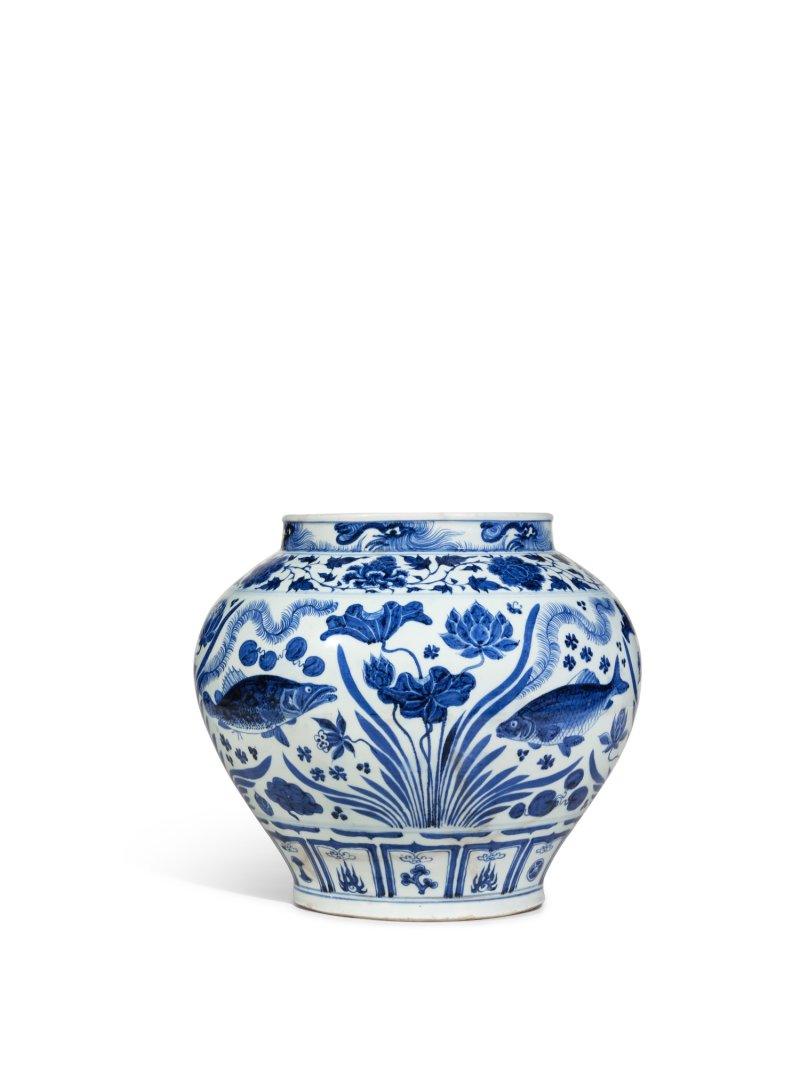

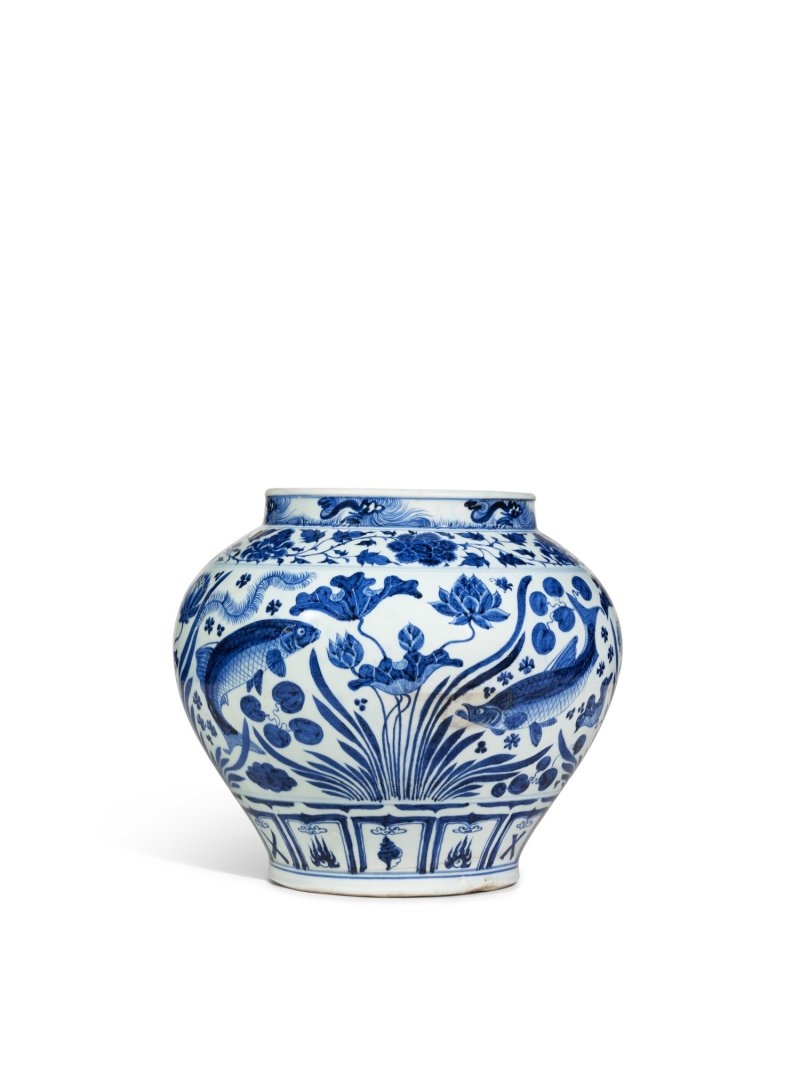

Lot 6017 An important and exceptionally painted blue and white 'fish' jar, guan, Yuan dynasty | 元 青花魚藻紋大罐
落槌价
预展中
成交价
预展中
| 拍卖公司 | 苏富比 |
|---|---|
| 拍卖时间 | 2026年10月30日 |
拍品信息
拍品名称
An important and exceptionally painted blue and white 'fish' jar, guan, Yuan dynasty | 元 青花魚藻紋大罐
起拍价
未知
估值区间
待詢
尺寸
未知
品相
There are two star cracks which have been stabilised: one with a firing line runs horizontally around the luting line near the foot; another near the shoulder, with a fine line extending diagonally from the mouth down to the lower body and a slightly restored impact point. The exterior of the vase with a yellow stain at the central luting line, the interior with associated characteristic crazing. As typical of jars of this period, there is fritting to the mouth rim.
If a condition report is provided to assist you with assessing the condition of the lot, it is for guidance purposes only. Such condition report may not refer to all faults, restoration, alterations, or adaptations because Sotheby's is not a professional conservator or restorer but rather a condition report is a statement of subjective, qualified opinion genuinely held by Sotheby's. For these reasons, any such condition report is not an alternative to taking your own professional advice regarding the condition of the lot. Prospective buyers should also refer to the Guide for Buyers at Auction which includes important notices concerning the type of property in this sale.
If a condition report is provided to assist you with assessing the condition of the lot, it is for guidance purposes only. Such condition report may not refer to all faults, restoration, alterations, or adaptations because Sotheby's is not a professional conservator or restorer but rather a condition report is a statement of subjective, qualified opinion genuinely held by Sotheby's. For these reasons, any such condition report is not an alternative to taking your own professional advice regarding the condition of the lot. Prospective buyers should also refer to the Guide for Buyers at Auction which includes important notices concerning the type of property in this sale.
更多信息
w. 35.3 cm
来源:A European private collection.
Christie’s London, 11th July 2006, lot 111 and back cover.
Eskenazi Ltd, London, 2006.
Collection of Sir Joseph Hotung (1930-2021).
Sotheby's Hong Kong, 8th October 2022, lot 6.
展览:British Museum, London, on loan, 2012.
著录:Rosemary Scott, ‘A Magnificent and Rare 14th Century Fish Jar’, Chinese Ceramics and Works of Art, Including Export Art, Christie’s London, 2006, pp. 108-11.
Huo Jishu (Jessica Harrison-Hall), ‘Yuandai qinghua ci: Da Ying Bowuguan yu Daweide Jijinhui cang pin/Yuan Dynasty Blue-and-White: Collections and Collectors in the British Museum and Sir Percival David Collection’, in Li Zhongmou et al., Youlan shencai. 2012 Shanghai Yuan qinghua guoji xueshu yantaohui lunwenji/Splendors in Smalt. Art of Yuan Blue-and-white Porcelain Proceedings, Shanghai, 2015, vol. 1, p. 389, fig. 23.
Regina Krahl, Early Chinese Blue-and-White Porcelain. The Mingzhitang Collection of Sir Joseph Hotung, Hong Kong, 2022, no. 8.
图录
说明:來源
歐洲私人收藏
倫敦佳士得2006年7月11日,編號111及封底
埃斯卡納齊,倫敦,2006年
何鴻卿爵士(1930-2021年)收藏
香港蘇富比2022年10月8日,編號6
展覽
大英博物館,倫敦,借展,2012年
出版
蘇玫瑰,〈A Magnificent and Rare 14th Century Fish Jar〉,中國瓷器及工藝精品,倫敦佳士得,2006年,頁108-11
霍吉淑,〈元代青花瓷:大英博物館與大維德基金會藏品〉,李仲謀等,《幽藍神采:2012上海元青花國際學術研討會論文集》,上海,2015年,卷1,頁389,圖23
康蕊君,《Early Chinese Blue-and-White Porcelain. The Mingzhitang Collection of Sir Joseph Hotung》,香港,2022年,編號8
Spiritual Freedom in the Yuan Dynasty
Regina Krahl
‘The Pleasures of Fishes’ is the title of a handscroll painting by Zhou Dongqing, a ‘fish painter’ active in the Yuan dynasty, almost six meters long, dated in accordance with 1291, and today in the Metropolitan Museum of Art, New York (Stephen Little with Shawn Eichman, Taoism and the Arts of China, Art Institute of Chicago, Chicago, IL, 2000, no. 7) (fig. 1). Zhou was a native of Jiangxi and his paintings were most likely well known to the porcelain painters of Jingdezhen.
Ink paintings with naturalistic scenes featuring fishes are recorded in China since the 3rd century and were a recognized genre of ink painting at the Song dynasty (960-1279) imperial painting academy. The precise observation of different varieties of fish and their movements under water was considered particularly challenging since observation from nature is difficult, and represented the kind of technical mastery that was admired at court. Liu Cai (active c. 1080-1120) was a court painter, who specialized in paintings of fishes already in the late Northern Song, and in the Southern Song dynasty, Emperor Lizong (r. 1224-64) invited another fish painter, Fan Anren, a native of Zhejiang, to paint for the court.
Fish paintings were, however, not just stupendous exercises of the brush; among China’s literati they were also revered because they carried a deeper meaning. The genre was held in great esteem for its Daoist association, with fish being considered the manifestation of spiritual freedom, one of the eternal ideals of China’s intellectuals. In the Yuan dynasty, the topic was taken over by scholar painters. For the literati-officials loyalist to the deposed Song dynasty, this sentiment must have evoked bitter-sweet associations with their own freedom from the constraints of a government position, under the Mongol-ruled dynasty.
Fish paintings were always associated with a famous passage in the book Zhuangzi by Zhuang Zhou (c. 369-286 BC), Daoism’s leading proponent, and a colophon on Zhou’s painting ‘The pleasures of fishes’ explicitly refers to it. It relates a discussion between Zhuangzi and the Confucian Huizi about the pleasures of fishes. While Zhuangzi claims that freely darting about as they please, is what fish really enjoy, Huizi counters that Zhuangzi, not being a fish, cannot know what fish enjoy. The exchange ends with Zhuangzi, guided by Daoist intuition, winning the argument over the Confucian, who employs formalist reasoning.
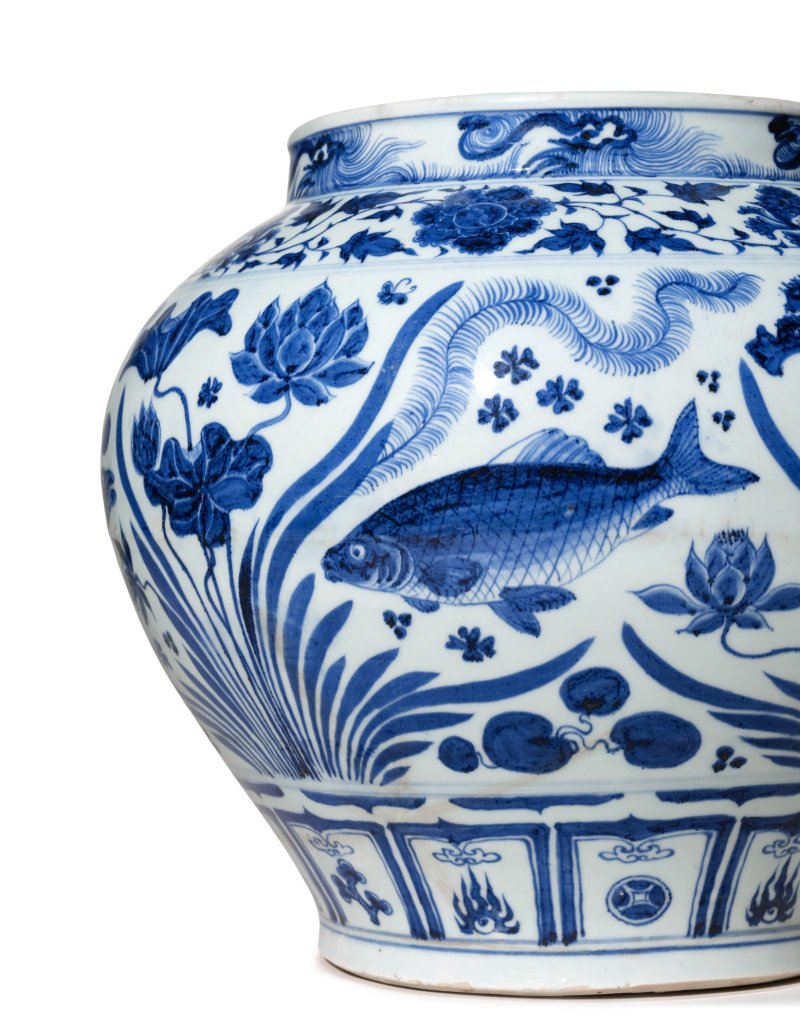
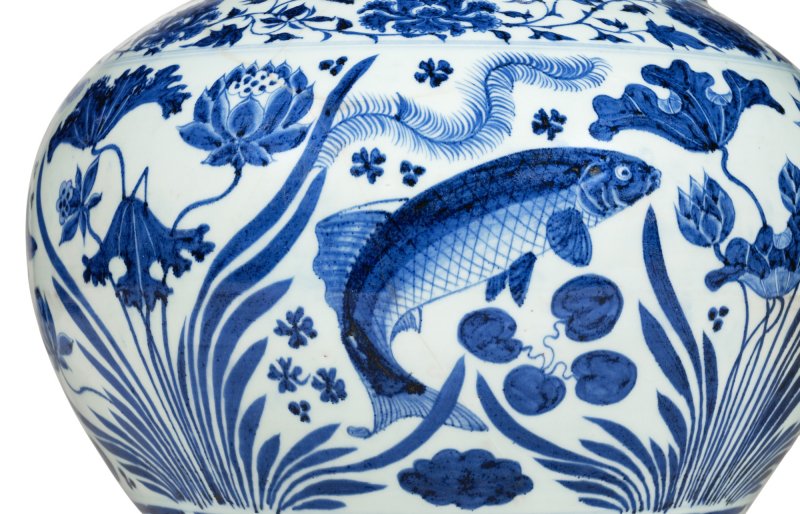
Fish among water plants represent one of the most powerful designs of Yuan blue-and-white porcelain. The porcelain painter responsible for the scene on the present jar admirably rendered the serene state of the four fat fishes, grouped in pairs, silently floating through water plants, seemingly at total ease in their surroundings. Even without the historic philosophical reading of this motif, the scene emanates an air of peace and contentment, transferring the viewer to the idyllic scenery of a lake in the Jiangnan region of south-eastern China, whose still surface is covered with large green lotus leaves and their ravishing white and pink flowers and whose clear waters are teeming with golden-orange and silvery-blue fish.
Grouped in two pairs swimming towards each other, the fishes here depict a mandarin fish, easy to recognize by its strongly patterned – in real life very colourful – skin and round tail fin and three different fish of the carp family. The carp at the end of Zhou’s handscroll is depicted in the leaping pose, also seen on this jar, which evokes the carp turning into a dragon and for China’s scholars embodied the student succeeding at the official examinations that opened the path to a government career. If the ink paintings of this theme may have served the painters as models for the fish, they would not have found samples of the large clumps of lotus there, as water plants on these fish paintings are clearly subordinate to the main subject, the fish. On this jar, the lotus plants are so magnificently painted that they are at least as important for the complete picture as the fishes between them. Naturalistically rendered, we see them in different stages of maturation and decay, with buds turning to fully opened blooms and eventually to pods, and fresh curly leaves juxtaposed with wilting and shrivelled ones with frilly edges, suspended on broken stems. The painter went to great lengths to employ varying tones of cobalt blue like different tones of black ink would be used in paintings on paper or silk. The lively scene, with insects hovering above, is in fact a daring composition, basically showing a vertical cross section through a body of water and the air above it, combining fauna and flora from below and above the water level.
Quite a number of Yuan fish jars are preserved, but they vary greatly in quality. The present piece appears to be the tallest and is among the best painted. While the jar in the Museum of Oriental Ceramics, Osaka, formerly in the Ataka collection, is arguably the most dramatic, with its overly large fish – three singles and a pair – nearly filling out the full height of the design band (Mikami Tsugio, Sekai tōji zenshū/Ceramic Art of the World, vol. 13: Ryō, Kin, Gen/Liao, Chin and Yüan Dynasties, Tokyo, 1981, pl. 56), the present jar is closest overall to a jar with cut-down neck from the collection of Sir Harry Garner, now in the Fuji Art Museum, Tokyo, included in the Mostra d’Arte Cinese/Exhibition of Chinese Art, Palazzo Ducale, Venice, 1954, cat. no. 613 (fig. 2); and one in the Palace Museum, Beijing, with a lotus scroll around the shoulder, in Gugong Bowuyuan cang wenwu zhenpin quanji. Qinghua youlihong/The Complete Collection of Treasures of the Palace Museum. Blue and White Porcelain with Underglazed Red, Shanghai, 2000, vol. 1, no. 5 (fig. 3). In its painting style it is also very similar to two jars that are lacking the borders above and below the pond scene, one in the Brooklyn Museum (Sherman E. Lee and Wai-kam Ho, Chinese Art under the Mongols: The Yüan Dynasty, 1279–1368, Cleveland Museum of Art, Cleveland, 1968, no. 155) and one exhibited at Eskenazi’s (Two Rare Chinese Porcelain Fish Jars of the 14th and 16th Centuries, Eskenazi, London, 2002, no. 1).
Fragments of fish jars have been discovered at the Luomaqiao kiln sites of Jingdezhen, see Weng Yanjun and Li Baoping, New Finds of Yuan Dynasty Blue-and-White Porcelain from the Luomaqiao Kiln Site, Jingdezhen: An Archaeological Approach, London, 2021, pl. 35, figs 4 and 5.
The power of the design proved irresistible even a century later, when potters working at the imperial kilns for the Xuande Emperor (1426-35) copied it, who otherwise rarely took Yuan designs as models. It can be seen quite similarly interpreted, for example, on a deep, lobed bowl of Xuande mark and period, sold in these rooms, 5th April 2017, lot 101 (fig. 4).
神遊大元
康蕊君
元,周東卿,擅畫魚,其《魚樂圖》手卷,近六公尺長,作於1291年,現藏於紐約大都會藝術博物館,見 Stephen Little 及 Shawn Eichman,《Taoism and the Arts of China》,芝加哥藝術學院,芝加哥,2000年,編號7(圖一)。周氏江西人,當朝景德鎮瓷人或亦熟知其畫作。
遊魚暢泳水藻之間,悠然自得,此題材自三世紀已有記載,復盛行於宋代畫院。魚居水中,不便微察細觀,又較其他禽鳥寫生更艱,擅畫魚者,尤得朝廷賞識。北宋宮廷畫師劉寀(活躍於約1080-1120年),即以繪魚聞名,南宋理宗一朝(1224-64年在位),浙江魚繪名家,范安仁,曾任職畫院待詔。
魚樂圖,非僅筆墨之戲,實則寓意深厚;此題材象徵無拘逍遙,相應道家脫離俗世羈絆之追求,深植中國仕人階層。蒙元統治之下,遺宋文人備受壓抑拘束,對於自由之想望,更顯苦澀,魚藻題材遂常見於文人畫。
魚畫多與道家經典《莊子》相關,前述周東卿畫作上題詩「魚樂」更是確認其道學意涵。莊周(公元前約369-286年)與儒者惠子,曾機智對辯,莊子見魚悠游水中,稱魚之樂,惠子反問,「子非魚,安知魚之樂?」,莊子智答「子曰『汝安知魚樂』云者,既已知吾知之而問我,我知之濠上也」作結。
魚藻圖,屬元代青花瓷之經典紋飾,本品繪豐魚四尾,兩兩成對,怡然自在,穿梭水藻之間。即略道學奧義,觀其圖紋之美,也足矣。游魚自得,靜好圓滿,宛若神遊至江南水鄉,美景湖畔,翠綠荷葉亭亭,點綴白粉荷花,相映清澈湖水中金豔、銀藍之游魚。
魚紋成雙,彼此相對,一為鱖魚,鱗色濃麗,尾鰭圓短,相伴三鯉。前述周氏繪畫中,卷尾鯉魚跳躍姿態,亦見於本罐,象徵鯉魚躍龍門,科舉及第,仕途高升。游魚姿態或依據魚藻圖畫作而來,然繪畫中無荷葉花卉,往往僅點綴少許水藻。此罐綴以豐美的荷葉花卉紋,與游魚錯落相間,相互輝映。宛若寫生自然,荷花枝葉姿態各異,含苞、盛放、蓮蓬、新葉、枯枝等,記錄新陳榮衰,生生不息。瓷人運用鈷藍之深淺色調,表現水墨繪於紙或絹上的濃淡變化,構圖生動大方,點綴草蟲於上,增添垂直空間,巧妙結合水上、水面、水下於一器,生意盎然。
傳世元代青花魚藻紋大罐,品質差距甚鉅,本品可謂其中尺寸最高,且畫藝最精者。大阪市立東洋陶磁美術館藏一例,出自安宅典藏,構圖張力十足,魚紋更大,三尾獨魚及一對雙魚,幾乎填滿瓷罐中段,圖見三上次男編,《世界陶磁全集》,卷13:遼、金、元,東京,1981年,圖版56。與本品更相近為迦納爵士舊藏一例,器頸已截,現存於東京富士美術館,錄於《Mostra d’Arte Cinese/Exhibition of Chinese Art》,威尼斯,1954年,編號613(圖二)。另一例為北京故宮博物院藏品,罐肩上綴纏枝蓮紋,出版於《故宮博物院藏文物珍品大系.青花釉裏紅(上)》,上海,2000年,編號5(圖三)。本品紋飾風格,亦與二例相類,其一現存於布魯克林博物館(李雪曼、何惠鑒,《Chinese Art under the Mongols. The Yüan Dynasty (1279-1368)》, 克利夫蘭藝術博物館,克利夫蘭,1968 年,編號155),另一例曾收入埃斯卡納齊展覽(《Two Rare Chinese Porcelain Fish Jars of the 14th and 16th Centuries》,埃斯卡納齊,倫敦,2002年,編號1)。
景德鎮落馬橋遺址曾出土青花魚藻紋罐殘片,見翁彥俊及李寶平,《New Finds of Yuan Dynasty Blue-and-White Porcelain from the Luomaqiao Kiln Site, Jingdezhen: An Archaeological Approach》,倫敦,2021年,圖版35,圖4、5。
青花魚藻紋飾歷久不衰,百年之後,明代宣德御窰,仍有燒製,為極少數延續元風之瓷器,如宣窰青花魚藻紋十棱菱口大盌,2017年4月5日售於香港蘇富比,編號101(圖四)。
常见问题
这件An important and exceptionally painted blue and white 'fish' jar, guan, Yuan dynasty | 元 青花魚藻紋大罐的成交价是多少?
落槌价为 预展中。 成交价为 预展中。
拍品的品相状况如何?
There are two star cracks which have been stabilised: one with a firing line runs horizontally around the luting line near the foot; another near the shoulder, with a fine line extending diagonally from the mouth down to the lower body and a slightly restored impact point. The exterior of the vase with a yellow stain at the central luting line, the interior with associated characteristic crazing. As typical of jars of this period, there is fritting to the mouth rim.
If a condition report is provided to assist you with assessing the condition of the lot, it is for guidance purposes only. Such condition report may not refer to all faults, restoration, alterations, or adaptations because Sotheby's is not a professional conservator or restorer but rather a condition report is a statement of subjective, qualified opinion genuinely held by Sotheby's. For these reasons, any such condition report is not an alternative to taking your own professional advice regarding the condition of the lot. Prospective buyers should also refer to the Guide for Buyers at Auction which includes important notices concerning the type of property in this sale.
If a condition report is provided to assist you with assessing the condition of the lot, it is for guidance purposes only. Such condition report may not refer to all faults, restoration, alterations, or adaptations because Sotheby's is not a professional conservator or restorer but rather a condition report is a statement of subjective, qualified opinion genuinely held by Sotheby's. For these reasons, any such condition report is not an alternative to taking your own professional advice regarding the condition of the lot. Prospective buyers should also refer to the Guide for Buyers at Auction which includes important notices concerning the type of property in this sale.
这件拍品的流传来源是什么?
A European private collection.
Christie’s London, 11th July 2006, lot 111 and back cover.
Eskenazi Ltd, London, 2006.
Collection of Sir Joseph Hotung (1930-2021).
Sotheby's Hong Kong, 8th October 2022, lot 6.
Christie’s London, 11th July 2006, lot 111 and back cover.
Eskenazi Ltd, London, 2006.
Collection of Sir Joseph Hotung (1930-2021).
Sotheby's Hong Kong, 8th October 2022, lot 6.
这件拍品曾在哪些展览中展出过?
British Museum, London, on loan, 2012.
这件拍品被哪些著录书籍记载?
Rosemary Scott, ‘A Magnificent and Rare 14th Century Fish Jar’, Chinese Ceramics and Works of Art, Including Export Art, Christie’s London, 2006, pp. 108-11.
Huo Jishu (Jessica Harrison-Hall), ‘Yuandai qinghua ci: Da Ying Bowuguan yu Daweide Jijinhui cang pin/Yuan Dynasty Blue-and-White: Collections and Collectors in the British Museum and Sir Percival David Collection’, in Li Zhongmou et al., Youlan shencai. 2012 Shanghai Yuan qinghua guoji xueshu yantaohui lunwenji/Splendors in Smalt. Art of Yuan Blue-and-white Porcelain Proceedings, Shanghai, 2015, vol. 1, p. 389, fig. 23.
Regina Krahl, Early Chinese Blue-and-White Porcelain. The Mingzhitang Collection of Sir Joseph Hotung, Hong Kong, 2022, no. 8.
图录