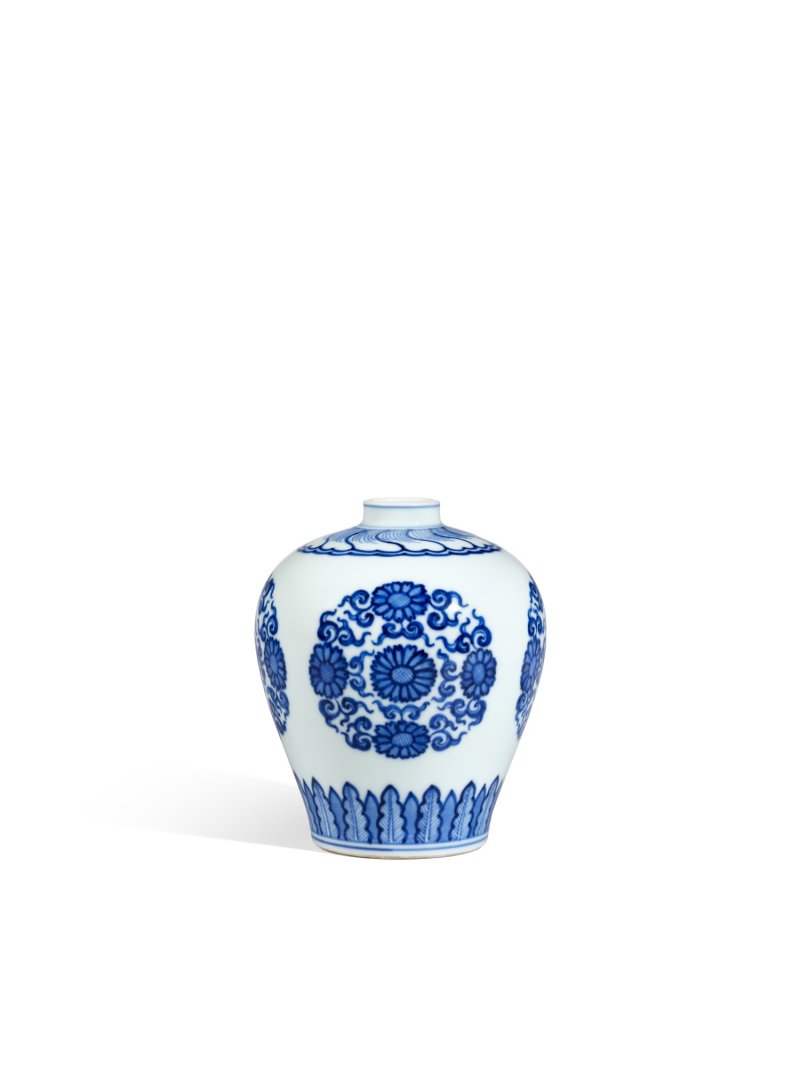

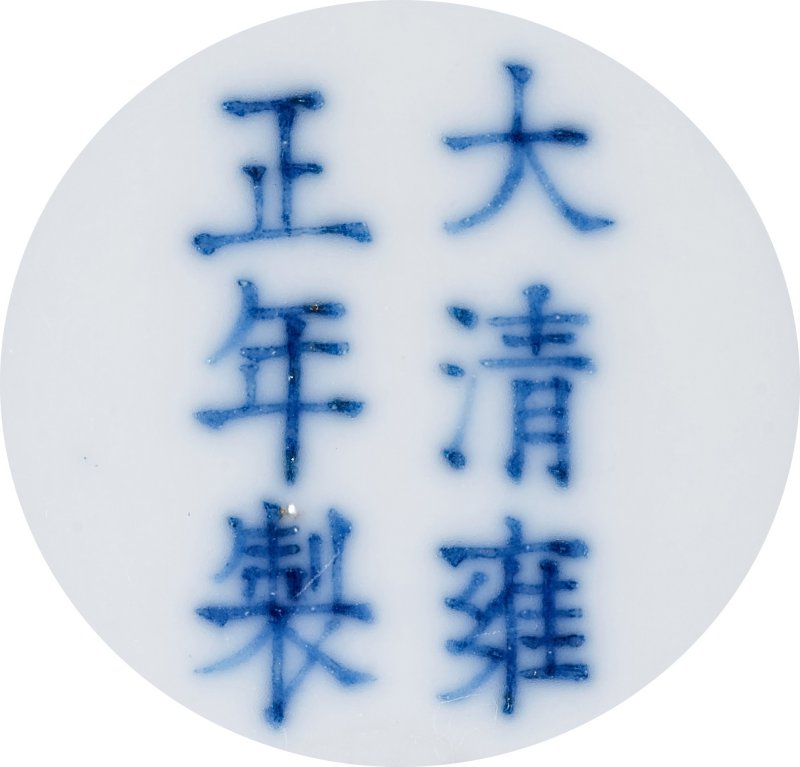
Lot 6020 A fine blue and white 'chrysanthemum medallion' jar, Mark and period of Yongzheng | 清雍正 青花團菊紋罐 《大清雍正年製》款
落槌价
预展中
成交价
预展中
| 拍卖公司 | 苏富比 |
|---|---|
| 拍卖时间 | 2026年10月30日 |
拍品信息
拍品名称
A fine blue and white 'chrysanthemum medallion' jar, Mark and period of Yongzheng | 清雍正 青花團菊紋罐 《大清雍正年製》款
起拍价
HKD 1,000,000
估值区间
1,000,000 - 2,000,000 HKD
尺寸
未知
品相
Good overall condition, with only very minor firing imperfections.
整體品相良好,及窰燒微瑕。
If a condition report is provided to assist you with assessing the condition of the lot, it is for guidance purposes only. Such condition report may not refer to all faults, restoration, alterations, or adaptations because Sotheby's is not a professional conservator or restorer but rather a condition report is a statement of subjective, qualified opinion genuinely held by Sotheby's. For these reasons, any such condition report is not an alternative to taking your own professional advice regarding the condition of the lot. Prospective buyers should also refer to the Guide for Buyers at Auction which includes important notices concerning the type of property in this sale.
更多信息
h. 14 cm
来源:Christie’s New York, 3rd June 1988, lot 272.
Christie’s Hong Kong, 28th April 1997, lot 672.
图录
说明:來源
紐約佳士得1988年6月3日,編號272
紐約佳士得1997年4月28日,編號672
The Yongzheng Emperor (r. 1723-35) is celebrated for his fine artistic taste, his passion for classic porcelain of the Ming dynasty (1368-1644), and the fabulous reproductions of these traditional wares he commissioned. The motifs of the present chrysanthemum jar are reminiscent of Chenghua porcelains, but no exact Chenghua prototype appears to be recorded. Related chrysanthemum roundels are known from Chenghua bowls; see a doucai bowl excavated from the waste heaps of the Ming imperial kilns at Jingdezhen included in Imperial Porcelains from the Reign of Chenghua in the Ming Dynasty: A Comparison of Porcelains from the Imperial Kiln Site at Jingdezhen and Imperial Collection of the Palace Museum, Beijing, 2016, vol. II, pl. 155. The pattern on the shoulders is also similar to those on Chenghua jars; see a doucai covered jar with lotus medallions between bands of petals, preserved in the Palace Museum, Beijing, ibid., vol. I, pl. 139.
A slightly larger jar of this design from the Yongzheng period, with its matching cover, in the Palace Museum, Taipei, was included in Special Exhibition of K'ang-hsi, Yung-cheng and Ch'ien-lung porcelain Ware from the Ch'ing Dynasty in the Palace Museum, Taipei, 1986, cat. no. 28, and again in Good Fortune, Long Life, Health, and Peace: A Special Exhibition of Porcelains with Auspicious Designs, Taipei, 1995, cat. no. 90. Two comparable jars, also without a cover, were sold in these rooms, 5th October 2016, lot 3698, and 8th April 2023, lot 3634.
Jars decorated with chrysanthemum medallions are more commonly known painted in the doucai palette; see for example a Yongzheng covered jar with a wider mouth and painted with medallions of two chrysanthemums separated by floral sprays, illustrated in The Tsui Museum of Art. Chinese Ceramics, vol. IV, Hong Kong, 1995, pl. 145; and another sold twice at Christie's Hong Kong, 1st May 1994, lot 692, and 3rd November 1998, lot 957.
Porcelain jars of this form are believed to be tea vessels, possibly used as tea caddies. Comparable jars, together with other tea vessels, are illustrated in three Qing court paintings of the Qianlong Emperor preserved in the Palace Museum, Beijing; The Complete Collection of Treasures of the Palace Museum. Paintings by the Court Artists of the Qing Court, Hong Kong, 1996, pls 30-31 and 73.
雍正帝善鑑明辨、審美不凡,在位年間所製御器,素以雅緻靈秀著稱。世宗尚古,青睞明代名瓷,詔命仿學復作,成器端莊秀麗。此團菊罐上紋飾慕古,雖無同式明代雛本對照,但圖案近成化遺風。景德鎮珠山御窰遺址出土鬪彩盌殘件,上繪團菊,雖以四朵為一組,但風格相類,可資參考,圖見《明代成化御窰瓷器:景德鎮御窰遺址出土與故宮博物院藏傳世瓷器對比(下)》,北京,2016年,圖版155。此罐肩上花瓣,也可見於傳世成化瓷罐,如北京故宮所藏鬪彩蓋罐,器肩及足上均繪相近花瓣,見《明代成化御窰瓷器(上)》,出處同上,圖版139。
另參考台北故宮博物院藏同式雍正青花團菊蓋罐,尺寸略大於此,錄於《清康雍乾名瓷特展》,台北,1986年,編號28,並見於《福壽康寧:吉祥圖案瓷器特展圖錄》,台北,1995年,編號90。香港蘇富比亦曾拍出兩例同類器物,均無蓋,分別為2016年10月5日,編號3698及2023年4月8日,編號3634。
清代團菊紋罐,較多以鬪彩作飾,例如《徐氏藝術館.陶瓷篇IV.清代》所載清雍正仿明成化蓋罐,雙菊團紋與折枝蓮花相間,罐口較寬(香港,1995年,圖版145)。該式鬪彩團菊紋罐,也有見於拍賣,如香港佳士得兩度售出之例,分別為1994年5月1日,編號692,及1998年11月3日,編號957。
此類罐子,應與茶事相關,或為藏儲茶葉之用。北京故宮博物院藏《乾隆歲朝圖》及兩軸《乾隆雪景行樂圖》中,高宗旁邊木架均放有各式茶具,當中見有相類罐子,圖見《故宮博物院藏文物珍品全集.清代宮廷繪畫》,香港,1996年,圖版30-31及73。
常见问题
这件A fine blue and white 'chrysanthemum medallion' jar, Mark and period of Yongzheng | 清雍正 青花團菊紋罐 《大清雍正年製》款的成交价是多少?
落槌价为 预展中。 成交价为 预展中。
拍品的品相状况如何?
Good overall condition, with only very minor firing imperfections.
整體品相良好,及窰燒微瑕。
If a condition report is provided to assist you with assessing the condition of the lot, it is for guidance purposes only. Such condition report may not refer to all faults, restoration, alterations, or adaptations because Sotheby's is not a professional conservator or restorer but rather a condition report is a statement of subjective, qualified opinion genuinely held by Sotheby's. For these reasons, any such condition report is not an alternative to taking your own professional advice regarding the condition of the lot. Prospective buyers should also refer to the Guide for Buyers at Auction which includes important notices concerning the type of property in this sale.
整體品相良好,及窰燒微瑕。
If a condition report is provided to assist you with assessing the condition of the lot, it is for guidance purposes only. Such condition report may not refer to all faults, restoration, alterations, or adaptations because Sotheby's is not a professional conservator or restorer but rather a condition report is a statement of subjective, qualified opinion genuinely held by Sotheby's. For these reasons, any such condition report is not an alternative to taking your own professional advice regarding the condition of the lot. Prospective buyers should also refer to the Guide for Buyers at Auction which includes important notices concerning the type of property in this sale.
这件拍品的流传来源是什么?
Christie’s New York, 3rd June 1988, lot 272.
Christie’s Hong Kong, 28th April 1997, lot 672.
图录
Christie’s Hong Kong, 28th April 1997, lot 672.
图录