
拍品信息
拍品名称
張靈 白鵝換經圖 設色紙本 鏡心 明代 | ZHANG LING (MING DYNASTY)
年代
Exchanging a White Goose for Calligraphy
起拍价
USD 20,000
估值区间
未知
尺寸
未知
品相
未知
更多信息
Exchanging a White Goose for Calligraphy
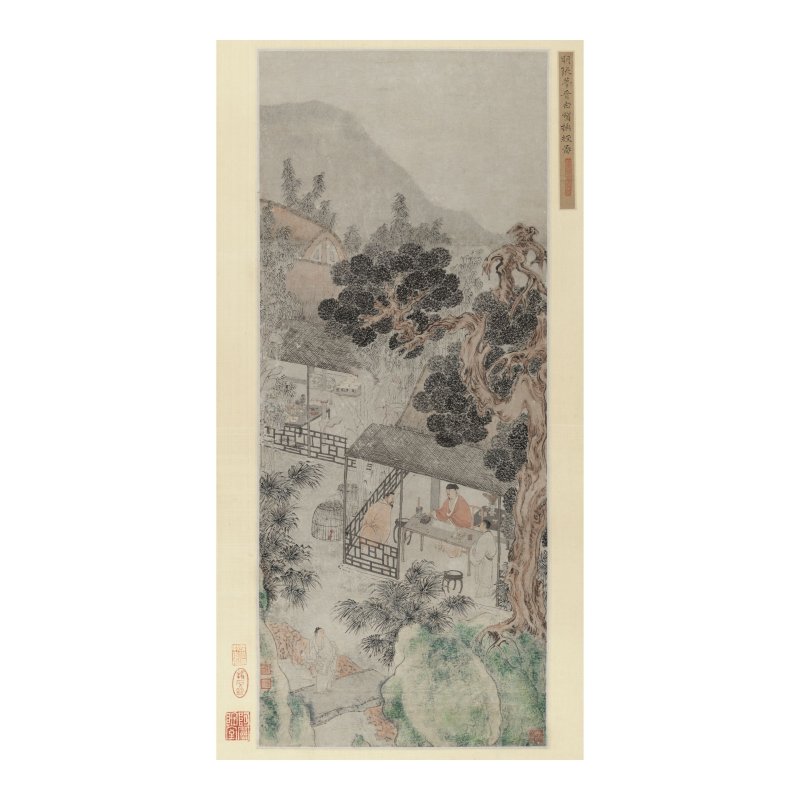
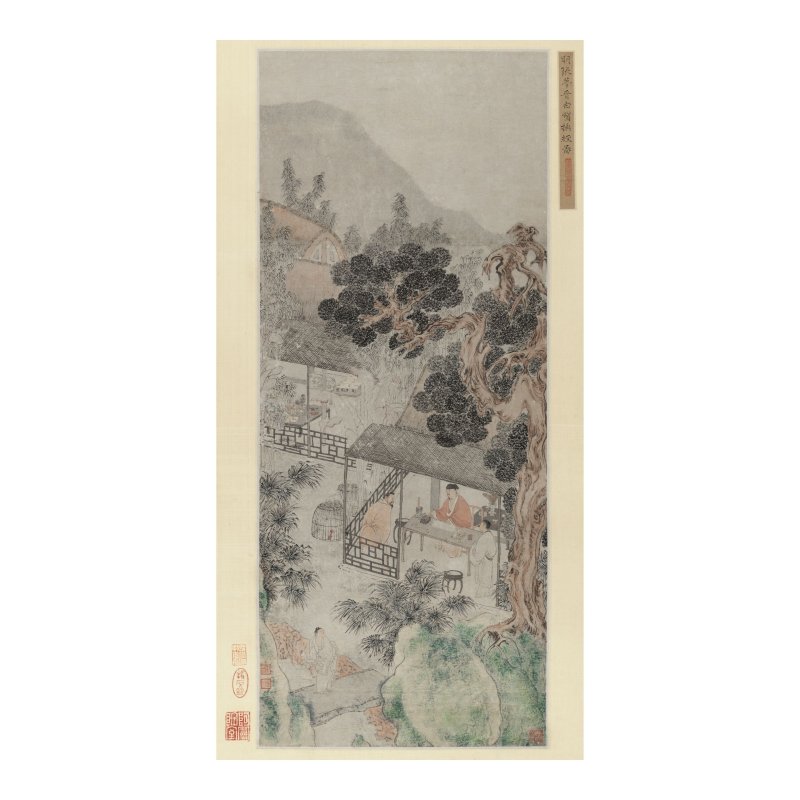
Mounted for framing, ink and color on paper, with two artist's seals and four collector's seals, mounted with a titleslip with a collector's seal of Huang Wengen (1895-1984).
26 x 10 3/4in (65.7 x 27cm)
Footnotes
Provenance:
Collection of Huang Wengen (1895-1984)
Collection of Wang Fangyu (1913-1997)
Zhang Ling, style name Mengjin, was a native of Suzhou. He was born during the Chenghua reign (1465-1487) and died in the early years of the Zhengde reign (1506-1521). He studied painting and calligraphy under Zhu Yunming (1461-1527) and was a childhood friend of Tang Yin (1470-1524). He was described as "naturally sociable and chivalrous in temperament," and "when drunk, would give himself over to wine and behave with wild abandon." Judging from the surviving records of his life, Zhang Ling may have been born a year or two after Tang Yin (1470–1523). Xu Zhenqing (1479-1511)'s Xin Qian Ji contains a poem mourning Zhang's death; since Xu himself died in 1511, when Tang Yin was forty-two, Zhang could have been no more than around forty when he died, a regrettably early end to a gifted life.
Surviving works by Zhang Ling are exceedingly rare, with only a handful presently known in public collections, including the handscroll (Summoning the Immortal), the ink hanging scroll (The Pleasures of Fishing), and the 1051-dated hanging scroll (Scholar in an Autumn Grove), in the collection of the Palace Museum, Beijing, as well as the portrait (The Weaver Maiden) in the Shanghai Museum.
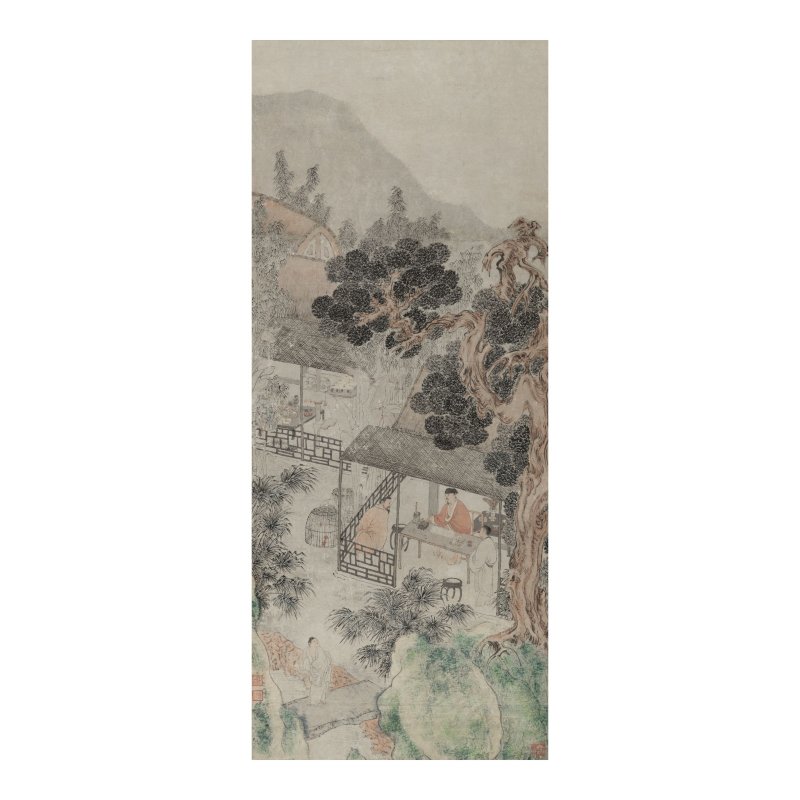
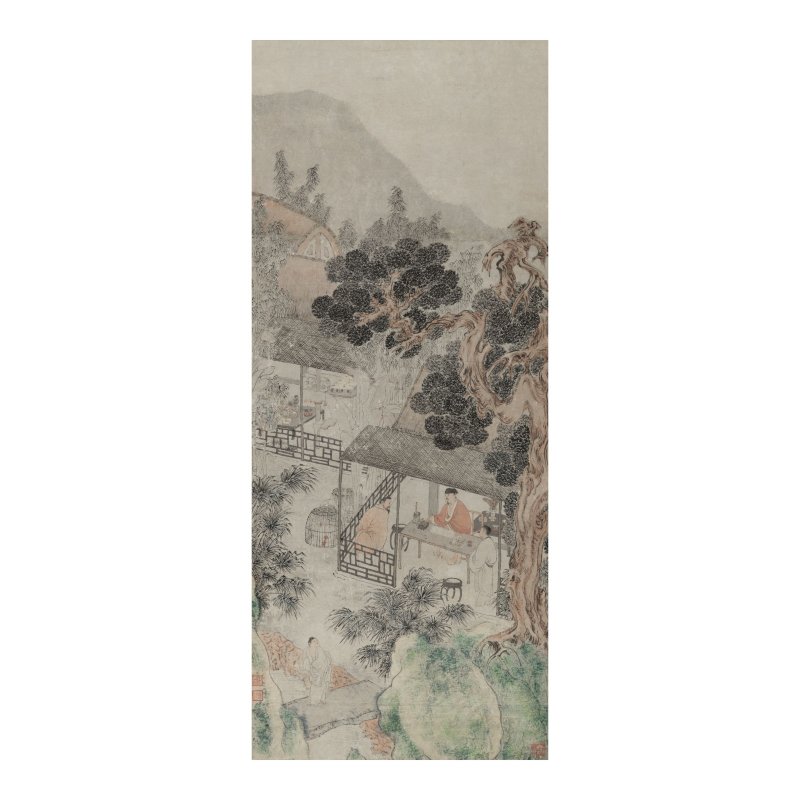
The present lot illustrates the celebrated story of Wang Xizhi (303-361), whose fondness for geese led him to transcribe the "Huangting jing" (Scripture of the Yellow Court) in exchange for a flock of white geese raised by a Daoist priest at Shanyin. Here, the "Sage of Calligraphy" wears a broad smile and appears entirely at ease as he unfurls the paper and dips his brush into the inkstone, while the Daoist stands nearby with his hands clasped behind his back, watching intently in breathless anticipation. The scholar's studio is furnished with refined simplicity. The lacquered table, chair and stools are characteristic of Ming-style furniture, while the scholar's implements and accoutrements, including the brush, ink, paper and inkstone, books, a scepter, incense burners, and a flower vase, are casually arranged across the tables. Delicately colored and rendered with considerable attention to detail, the setting may well represent the artist's ideal vision of a literati studio.
Beyond the studio, distant mountains, pines, cypresses, plantains, bamboo, and scholarly setting in another interior space are all depicted with meticulous care. The brushwork is restrained and elegant, and the coloring fresh and muted, firmly rooted in the orthodox tradition of the Wu School. These qualities accord closely with Wang Zhideng (1535-1612)'s description in the (Records of Painters in Suzhou): "In Zhang Ling's figure paintings, the headdresses and garments possess an archaic character, while the forms and coloring are pure and authentic, entirely free of vulgarity. He occasionally painted landscapes as well. Although he had not acquired his skill through prolonged practice, his brush was lively and his ink vigorous, standing distinctly apart from the commonplace; much in his work is worthy of admiration."
Although the present painting bears no signature and is marked only by two seals, it subsequently passed through the distinguished collections of Huang Wengen (1895-1984) and Wang Fangyu (1913-1997). It may therefore offer valuable new material for further consideration of Zhang Ling's artistic achievement.
Huang Wengen, also named Huang Wen, was a native of Qingyuan, Guangdong Province. He was a friend of Zhu Ruzhen (1870-1943), and in 1939, Huang became the first director of the Qingyuan Civilian Hospital. His collector's in the lower left corner of the silk mount represents his studio name. The name derived from Huang's ownership of Shen Zhou (1427-1509)'s , an ink handscroll of dailily, which was sold at Christie's Hong Kong on 26 November 2007, lot number 851, and most recently appeared at auction at Beijing Zhonghongxin on 15 July 2021, lot number 1215. It bears the same and collector's seals from Huang Wengen found on the present painting. An important collector during the Republican period, he assembled a notable collection of Ming and Qing paintings and calligraphy, fine examples of which continue to appear on the market.
Born in Beijing, Wang Fangyu graduated from the Department of Education at Fu Jen Catholic University in 1936. He traveled to the United States for further study in 1944 and received his master's degree from Columbia University, subsequently teaching at Yale University and Seton Hall University. Wang was internationally recognized as a preeminent authority on Bada Shanren (1626-1705) and one of the artist's most important collectors. His publications include , co-authored with Richard Barnhart, and the bilingual (Chinese/English) of , co-authored with Hsu Kai-yu (1922-1982), both of which have become essential references for scholars and enthusiasts of Chinese painting.
張靈 白鵝換經圖 設色紙本 鏡心 明代
鈐印:張靈、夢晉
藏印:
(黄)懷萱堂、揖石齋、阿曼陀室
順德阿蒙所藏書畫印
題簽:明張夢晉〈白鵝換經圖〉
鈐印:(黃)黃氏懷萱堂藏
黃文根(1895-1984)「懷萱堂」舊藏
王方宇(1913-1997)舊藏
張靈,字夢晉,蘇州人,生於成化年間(1465-1487),約卒於正德(1506-1521)年初。曾執經於祝允明門下,與唐寅為總角之交。徐禎卿《新倩籍》、王穉登《吳郡丹青誌》等記張靈生性「好交遊為俠,醉則使酒作狂」, 他與六如相鄰而居,「氣志雅合,茂才相敵,又俱善畫,以故契深椒蘭。」考其行跡,張靈生年可能晚於唐寅(1470-1523)一兩歲,徐禎卿《新倩籍》有弔張靈詩文,徐氏卒於正統辛未十一年(1511),時唐寅四十二歲,則張靈卒時不過不惑之年,令人扼腕。
張靈傳世作品極罕,王穉登說他「雖瓊枝早折,然一鱗一角,要足為珍」。目前公藏僅有北京故宮〈招仙圖卷〉、〈漁樂圖〉軸、作於弘治十四年(1501)的〈秋林高士圖〉軸及上海博物館〈織女圖〉等數件而已,清末民初《古緣萃錄》及《神州大觀》中,錄〈赤壁後遊圖〉與〈松下安坐圖〉,兩幅皆作於嘉靖十年(1531),與其卒年相去甚遠,或為偽作。
本幅〈白鵝換經圖〉描繪愛鵝成癖的王羲之, 寫〈黃庭經〉以換取山陰道士所養白鵝的故事。畫中「書聖」滿面含笑,神態悠容,正欲伸紙揮毫,道士負手一旁屏息凝視。書齋佈置清雅,髹漆桌墩、圓墩俱為典型明式,筆墨紙硯、書冊如意、香爐花樽等各樣文房清翫散置案頭,淡色描染,頗為寫實,應為畫家理想中文人書房之陳設。屋外近石遠山、松柏蕉竹、屋宇圍欄,處處描摹精微,筆墨淡雅,線條舒緩,敷色清麗,秉承吳門正脈,與《吳郡丹青誌》所記亦相吻合:「靈畫人物,冠服玄古,形色清真,無卑庸之氣。山水間作,雖不由閒習,而筆生墨勁,斬然絕塵,多可尚者。」本幅雖無款署,僅鈐印兩方,然先後經黃文根、王方宇兩大收藏家遞藏,或可為我們研究張靈的藝術成就,提供新的素材。
黃文根,名雯,廣東清遠人。1939年任清遠平民醫院第一任院長,與朱汝珍友善。「懷萱堂」為其堂號,源自其所藏沈周〈懷萱圖〉,該作於2007年11月26日於香港佳士得釋出,拍品編號851;最近一次則於2021年7月15日在北京中鴻信上拍,拍品編號1215。該卷上亦鈐有與本幅相同的「懷萱堂」、「揖石齋」藏印。黃氏為民國時期重要收藏家,所藏明清書畫,頗多佳作,時見散於市場。
王方宇生於北京,1936年畢業於北京輔仁大學教育系,1944年負笈美國,獲哥倫比亞大學碩士學位,先後任教於耶魯大學和西東大學。王氏乃海內外公認研究八大山人的權威及最重要的收藏家,他與班宗華合著《荷園主人-八大山人的生平與藝術(1626-1705)》及與許芥昱合著中英文版《看齊白石畫》乃同好者案頭必備。
Mounted for framing, ink and color on paper, with two artist's seals and four collector's seals, mounted with a titleslip with a collector's seal of Huang Wengen (1895-1984).
26 x 10 3/4in (65.7 x 27cm)
Footnotes
Provenance:
Collection of Huang Wengen (1895-1984)
Collection of Wang Fangyu (1913-1997)
Zhang Ling, style name Mengjin, was a native of Suzhou. He was born during the Chenghua reign (1465-1487) and died in the early years of the Zhengde reign (1506-1521). He studied painting and calligraphy under Zhu Yunming (1461-1527) and was a childhood friend of Tang Yin (1470-1524). He was described as "naturally sociable and chivalrous in temperament," and "when drunk, would give himself over to wine and behave with wild abandon." Judging from the surviving records of his life, Zhang Ling may have been born a year or two after Tang Yin (1470–1523). Xu Zhenqing (1479-1511)'s Xin Qian Ji contains a poem mourning Zhang's death; since Xu himself died in 1511, when Tang Yin was forty-two, Zhang could have been no more than around forty when he died, a regrettably early end to a gifted life.
Surviving works by Zhang Ling are exceedingly rare, with only a handful presently known in public collections, including the handscroll (Summoning the Immortal), the ink hanging scroll (The Pleasures of Fishing), and the 1051-dated hanging scroll (Scholar in an Autumn Grove), in the collection of the Palace Museum, Beijing, as well as the portrait (The Weaver Maiden) in the Shanghai Museum.
The present lot illustrates the celebrated story of Wang Xizhi (303-361), whose fondness for geese led him to transcribe the "Huangting jing" (Scripture of the Yellow Court) in exchange for a flock of white geese raised by a Daoist priest at Shanyin. Here, the "Sage of Calligraphy" wears a broad smile and appears entirely at ease as he unfurls the paper and dips his brush into the inkstone, while the Daoist stands nearby with his hands clasped behind his back, watching intently in breathless anticipation. The scholar's studio is furnished with refined simplicity. The lacquered table, chair and stools are characteristic of Ming-style furniture, while the scholar's implements and accoutrements, including the brush, ink, paper and inkstone, books, a scepter, incense burners, and a flower vase, are casually arranged across the tables. Delicately colored and rendered with considerable attention to detail, the setting may well represent the artist's ideal vision of a literati studio.
Beyond the studio, distant mountains, pines, cypresses, plantains, bamboo, and scholarly setting in another interior space are all depicted with meticulous care. The brushwork is restrained and elegant, and the coloring fresh and muted, firmly rooted in the orthodox tradition of the Wu School. These qualities accord closely with Wang Zhideng (1535-1612)'s description in the (Records of Painters in Suzhou): "In Zhang Ling's figure paintings, the headdresses and garments possess an archaic character, while the forms and coloring are pure and authentic, entirely free of vulgarity. He occasionally painted landscapes as well. Although he had not acquired his skill through prolonged practice, his brush was lively and his ink vigorous, standing distinctly apart from the commonplace; much in his work is worthy of admiration."
Although the present painting bears no signature and is marked only by two seals, it subsequently passed through the distinguished collections of Huang Wengen (1895-1984) and Wang Fangyu (1913-1997). It may therefore offer valuable new material for further consideration of Zhang Ling's artistic achievement.
Huang Wengen, also named Huang Wen, was a native of Qingyuan, Guangdong Province. He was a friend of Zhu Ruzhen (1870-1943), and in 1939, Huang became the first director of the Qingyuan Civilian Hospital. His collector's in the lower left corner of the silk mount represents his studio name. The name derived from Huang's ownership of Shen Zhou (1427-1509)'s , an ink handscroll of dailily, which was sold at Christie's Hong Kong on 26 November 2007, lot number 851, and most recently appeared at auction at Beijing Zhonghongxin on 15 July 2021, lot number 1215. It bears the same and collector's seals from Huang Wengen found on the present painting. An important collector during the Republican period, he assembled a notable collection of Ming and Qing paintings and calligraphy, fine examples of which continue to appear on the market.
Born in Beijing, Wang Fangyu graduated from the Department of Education at Fu Jen Catholic University in 1936. He traveled to the United States for further study in 1944 and received his master's degree from Columbia University, subsequently teaching at Yale University and Seton Hall University. Wang was internationally recognized as a preeminent authority on Bada Shanren (1626-1705) and one of the artist's most important collectors. His publications include , co-authored with Richard Barnhart, and the bilingual (Chinese/English) of , co-authored with Hsu Kai-yu (1922-1982), both of which have become essential references for scholars and enthusiasts of Chinese painting.
張靈 白鵝換經圖 設色紙本 鏡心 明代
鈐印:張靈、夢晉
藏印:
(黄)懷萱堂、揖石齋、阿曼陀室
順德阿蒙所藏書畫印
題簽:明張夢晉〈白鵝換經圖〉
鈐印:(黃)黃氏懷萱堂藏
黃文根(1895-1984)「懷萱堂」舊藏
王方宇(1913-1997)舊藏
張靈,字夢晉,蘇州人,生於成化年間(1465-1487),約卒於正德(1506-1521)年初。曾執經於祝允明門下,與唐寅為總角之交。徐禎卿《新倩籍》、王穉登《吳郡丹青誌》等記張靈生性「好交遊為俠,醉則使酒作狂」, 他與六如相鄰而居,「氣志雅合,茂才相敵,又俱善畫,以故契深椒蘭。」考其行跡,張靈生年可能晚於唐寅(1470-1523)一兩歲,徐禎卿《新倩籍》有弔張靈詩文,徐氏卒於正統辛未十一年(1511),時唐寅四十二歲,則張靈卒時不過不惑之年,令人扼腕。
張靈傳世作品極罕,王穉登說他「雖瓊枝早折,然一鱗一角,要足為珍」。目前公藏僅有北京故宮〈招仙圖卷〉、〈漁樂圖〉軸、作於弘治十四年(1501)的〈秋林高士圖〉軸及上海博物館〈織女圖〉等數件而已,清末民初《古緣萃錄》及《神州大觀》中,錄〈赤壁後遊圖〉與〈松下安坐圖〉,兩幅皆作於嘉靖十年(1531),與其卒年相去甚遠,或為偽作。
本幅〈白鵝換經圖〉描繪愛鵝成癖的王羲之, 寫〈黃庭經〉以換取山陰道士所養白鵝的故事。畫中「書聖」滿面含笑,神態悠容,正欲伸紙揮毫,道士負手一旁屏息凝視。書齋佈置清雅,髹漆桌墩、圓墩俱為典型明式,筆墨紙硯、書冊如意、香爐花樽等各樣文房清翫散置案頭,淡色描染,頗為寫實,應為畫家理想中文人書房之陳設。屋外近石遠山、松柏蕉竹、屋宇圍欄,處處描摹精微,筆墨淡雅,線條舒緩,敷色清麗,秉承吳門正脈,與《吳郡丹青誌》所記亦相吻合:「靈畫人物,冠服玄古,形色清真,無卑庸之氣。山水間作,雖不由閒習,而筆生墨勁,斬然絕塵,多可尚者。」本幅雖無款署,僅鈐印兩方,然先後經黃文根、王方宇兩大收藏家遞藏,或可為我們研究張靈的藝術成就,提供新的素材。
黃文根,名雯,廣東清遠人。1939年任清遠平民醫院第一任院長,與朱汝珍友善。「懷萱堂」為其堂號,源自其所藏沈周〈懷萱圖〉,該作於2007年11月26日於香港佳士得釋出,拍品編號851;最近一次則於2021年7月15日在北京中鴻信上拍,拍品編號1215。該卷上亦鈐有與本幅相同的「懷萱堂」、「揖石齋」藏印。黃氏為民國時期重要收藏家,所藏明清書畫,頗多佳作,時見散於市場。
王方宇生於北京,1936年畢業於北京輔仁大學教育系,1944年負笈美國,獲哥倫比亞大學碩士學位,先後任教於耶魯大學和西東大學。王氏乃海內外公認研究八大山人的權威及最重要的收藏家,他與班宗華合著《荷園主人-八大山人的生平與藝術(1626-1705)》及與許芥昱合著中英文版《看齊白石畫》乃同好者案頭必備。