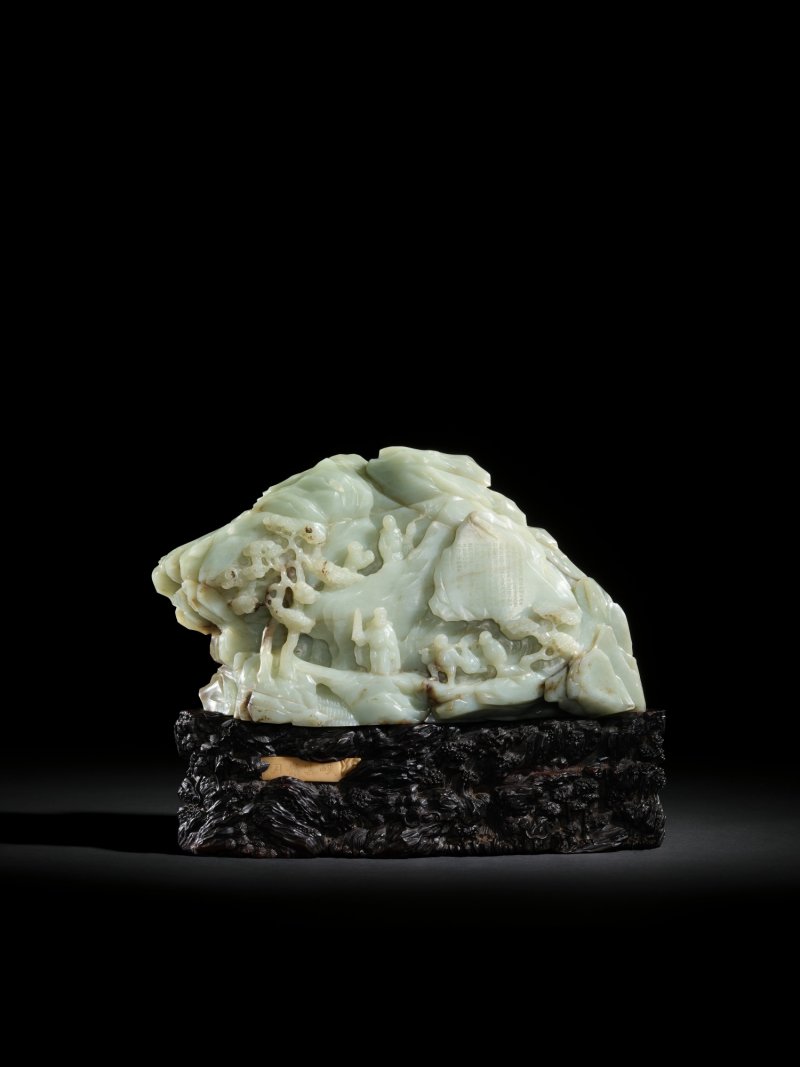
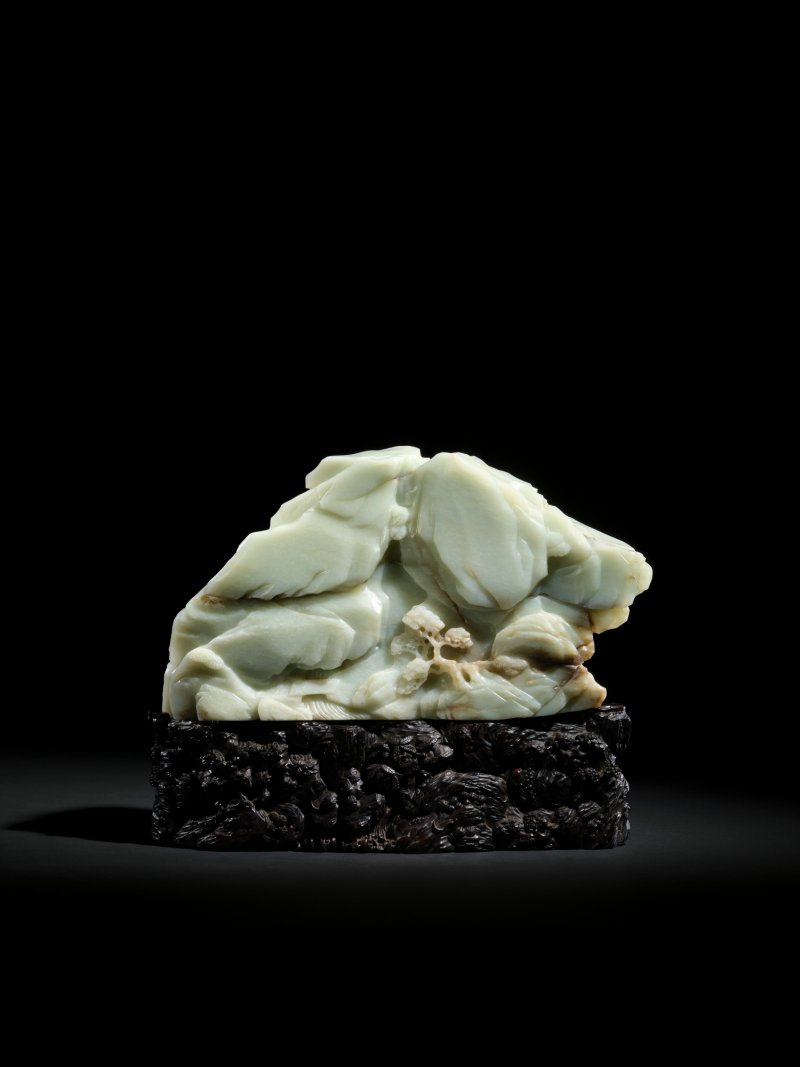
Lot 6037 A large imperially inscribed celadon jade ‘gathering jade ’ boulder Qianlong period, dated to the Jimao year, corresponding to 1759 | 清乾隆 青玉御題詩採玉圖大山子 《乾隆己卯秋御製》款
落槌价
预展中
成交价
预展中
| 拍卖公司 | 苏富比 |
|---|---|
| 拍卖时间 | 2026年10月30日 |
拍品信息
拍品名称
A large imperially inscribed celadon jade ‘gathering jade ’ boulder Qianlong period, dated to the Jimao year, corresponding to 1759 | 清乾隆 青玉御題詩採玉圖大山子 《乾隆己卯秋御製》款
起拍价
HKD 1,500,000
估值区间
1,500,000 - 2,000,000 HKD
尺寸
未知
品相
如欲了解本拍品狀況的更多資訊,請聯絡 Rubie.Fong@sothebys.com
更多信息
wood stand
35 cm
来源:A Hong Kong private collection, acquired from Jade House, Hong Kong, prior to 2000
图录
说明:來源
香港私人收藏,於2000年前購自香港中易公司
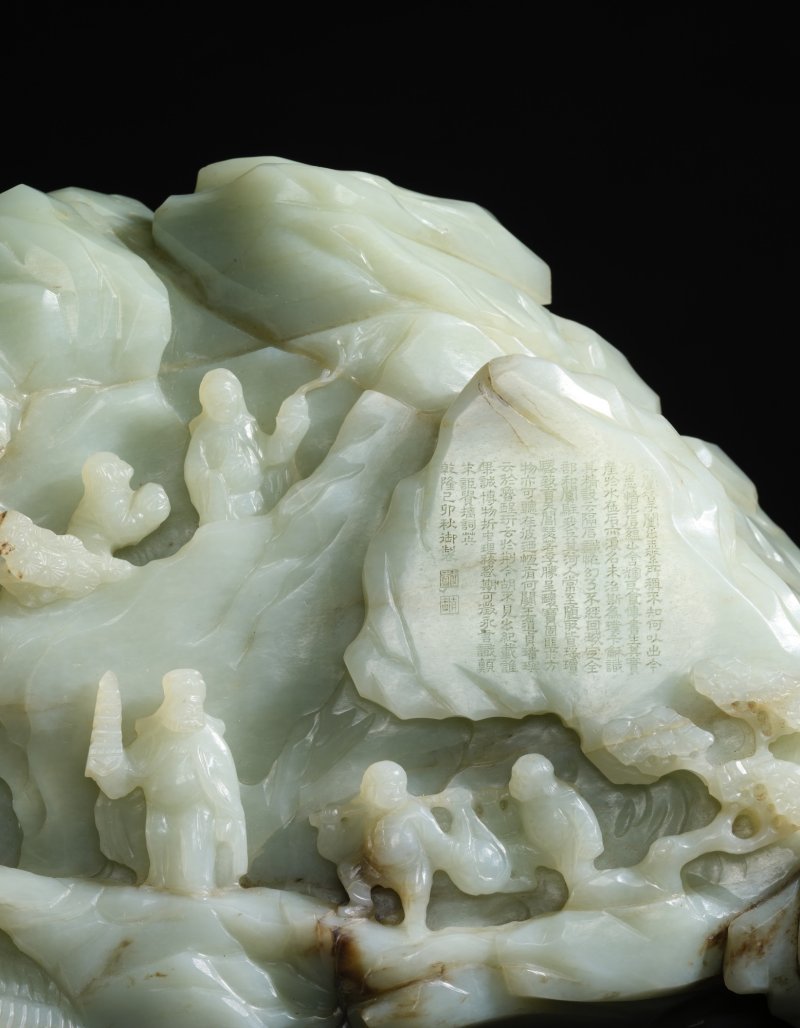
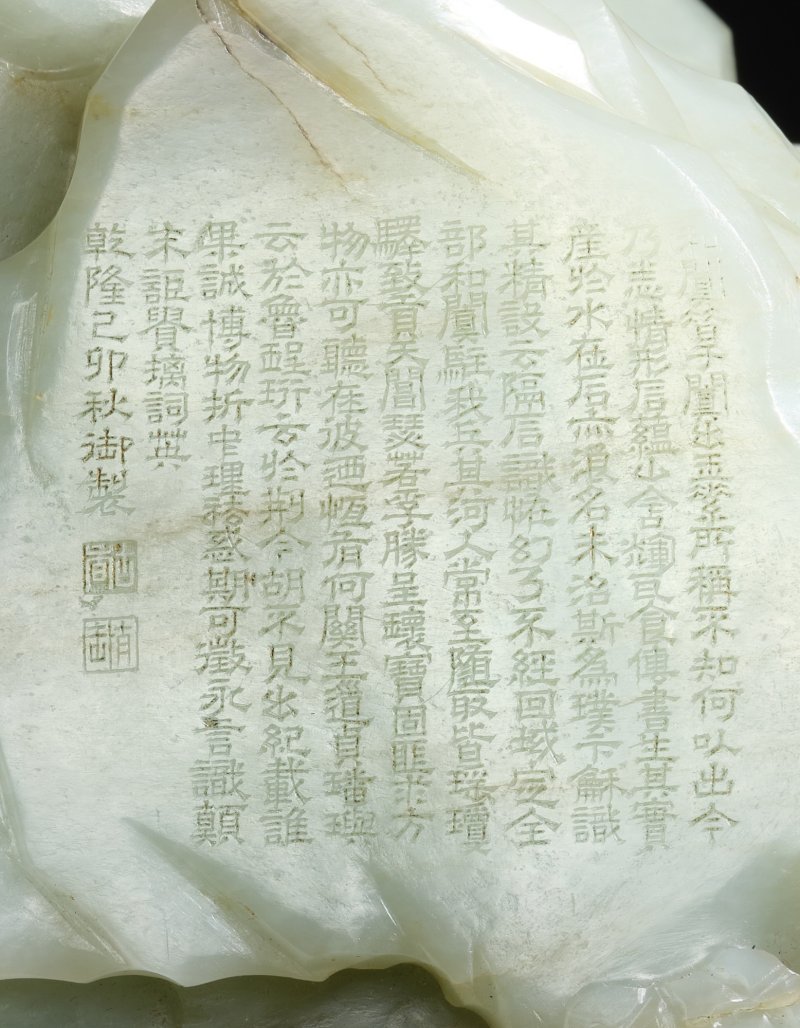
The present magnificent and monumental celadon jade boulder serves as a powerful historical testament to the Qianlong Emperor’s military triumphs and his scholarly, empirical approach to the natural world. Carved in the round to depict a vivid scene of figures gathering jade amidst a rugged, mountainous river landscape, the boulder is prominently inscribed with an imperial poem titled Hetian yu (Hetian Jade). Dated to the jimao year of the Qianlong reign (corresponding to 1759), the poem and the carving together celebrate a pivotal moment in Qing dynasty history.
In 1759, the Qing army successfully pacified the Dzungar and Muslim regions (present-day Xinjiang), officially bringing the jade-rich territory of Hetian (Khotan) under Qing imperial control. This monumental victory secured the 'jade route', allowing raw jade to be sent as tribute to the imperial court in unprecedented quantities. The Qianlong Emperor composed this poem to commemorate the event, boldly declaring his political and military sovereignty.
Beyond its political significance, the poem offers a fascinating insight into the Emperor’s scholarly mindset. For centuries, Chinese literati believed that jade was primarily mined from mountains. Drawing upon newly acquired geographical knowledge and firsthand reports from the region, the Qianlong Emperor uses this poem to correct this historical misconception. He notes that the finest jade is actually “harvested” from the riverbeds, what is known today as 'seed jade' or river pebbles. Furthermore, he dismisses ancient myths, such as the legend of Bian He who was said to be able to recognise jade hidden within a rough stone, advocating instead for an empirical approach.
The full poem carved on the boulder can be translated as follows:
Hetian Jade
Hetian was formerly known as Yutian, long renowned for yielding jade.
We knew not how it was produced, but now the circumstances are fully understood.
'Hidden in stones and glowing in mountains' is mere hearsay passed down by scholars.
In truth, it is produced in water; to say it lies within stone is an unfounded claim.
Before being worked, it is but a rough stone; Bian He recognised its pure essence.
But to claim one can recognise it through the outer stone is absurd and illogical.
With the Muslim region entirely pacified, our troops are stationed in Hetian.
People frequently visit its rivers, gathering precious jade at will.
It is sent via post stations as tribute to the heavenly gates, presented with utmost reverence.
Such rare treasures are not actively sought, yet local tributes can be accepted.
Since it is constantly found there, what does it have to do with the virtue of the ruler's way?
It is said that fanyu jade came from Lu, and chengheng jade from Jing.
Why are they not found today? Who among the ancient records is truly honest?
By studying the nature of things to find the absolute truth, we can dispel myths with verifiable facts.
These words are forever recorded to explain the whole truth, for what value is there in merely flaunting literary brilliance?
Artistically, this boulder is a quintessential masterpiece of Qianlong imperial craftsmanship, seamlessly integrating poetry, calligraphy, painting, and carving. The lapidary has masterfully utilised the natural shape and varying tones of the jade stone to create a three-dimensional landscape painting, bringing the Emperor's words to life.
For a closely related example, compare a green jade 'jade gathering' boulder from the Qing court collection, now preserved in the Palace Museum, Beijing (museum assertion number Gu 93388). The Beijing example is carved with a similar subject matter of figures gathering jade in a mountainous landscape, but is inscribed with a different imperial poem, Yutian cai yu (Gathering Jade in Yutian), dated to the yiyou year (1765). Both boulders perfectly encapsulate the Qianlong Emperor's fascination with jade production and his pride in expanding the empire's frontiers.
此件青玉御題詩採玉圖大山子體量碩大,雕工精絕,不僅是乾隆時期宮廷玉作的巔峰之表,更是一件極具歷史與政治意義的清代重器。山子依玉料原形圓雕崇山峻嶺、古木參天之景,並以高浮雕及透雕技法生動刻畫了於激流河床間採玉的場景。山壁平整處陰刻乾隆帝御作五言詩《和闐玉》,紀年己卯(即乾隆二十四年,1759年),將詩、書、畫、雕完美融為一體,盡顯「乾隆工」之極致追求。
乾隆二十四年(1759年)是清代歷史上的重要轉折點。是年,清軍徹底平定準噶爾及回部,將盛產玉石的新疆和闐(于闐)地區正式納入大清版圖。自此玉路大開,優質玉料得以源源不絕地作為貢品運往內廷。乾隆帝特作此詩以誌其盛,詩中「回域定全部,和闐駐我兵」一句,不僅是地理疆域的確認,更是帝王對國家一統、皇權遠播的霸氣宣示。
除政治意義外,此詩亦深刻展現了乾隆帝重實證的「博物」精神。歷代文人多受古籍所限,誤以為玉石皆蘊藏於深山之中。乾隆帝在詩中親自糾正了這一錯誤認知,明確指出最上乘的和闐玉實則多產自玉龍喀什河等水域之中(即今日所稱之「籽料」)。同時,他對古籍中「卞和隔石識玉」等神話傳說提出質疑,強調「博物折中理,祛惑期可徵」,體現了其試圖以實地考察之事實,來破除歷史迷信與附會的實用主義哲學。
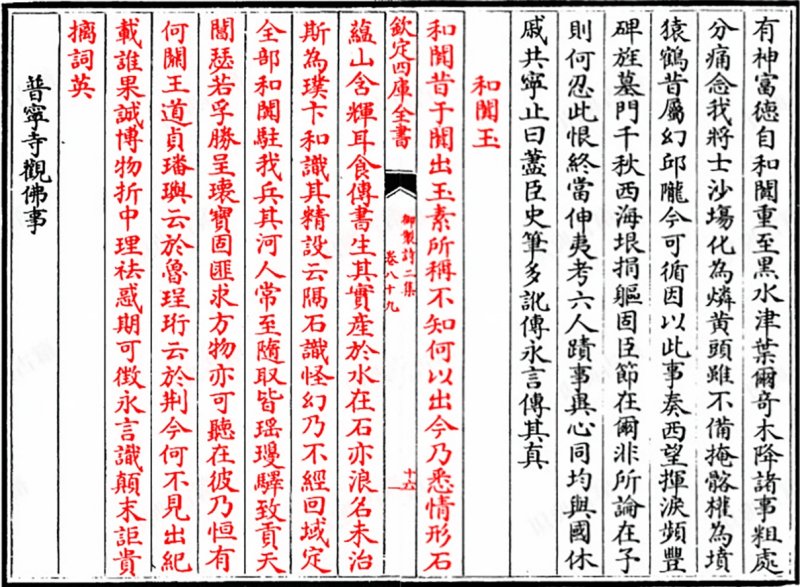
山子上所刻御製詩《和闐玉》收錄於《御製詩二集》卷八十九,全文如下:
和闐昔于闐,出玉素所稱。
不知何以出,今乃悉情形。
石蘊山含輝,耳食傳書生。
其實產於水,在石亦浪名。
未治斯為璞,卞和識其精。
設云隔石識,怪幻乃不經。
回域定全部,和闐駐我兵。
其河人常至,隨取皆瑤瓊。
驛致貢天閶,瑟若孚勝呈。
瓌寶固匪求,方物亦可聽。
在彼乃恆有,何關王道貞。
璠璵云於魯,珵珩云於荊。
今何不見出,紀載誰果誠。
博物折中理,祛惑期可徵。
永言識顛末,詎貴摛詞英。
乾隆己卯秋御製
「古香」、「太璞」印
此類以新疆採玉為題材的御製玉山,在宮廷玉器中佔有極高的地位。可資比較一例為北京故宮博物院蓄藏之清乾隆碧玉採玉圖山子(館藏編號:故93388)。該故宮藏品同樣雕琢回人於山澗採玉之景,然其上所刻為乾隆三十年(1765年)之御題詩《于闐採玉》。兩件山子雖詩文與紀年不同,但皆深刻反映了乾隆帝對新疆玉料開採的高度重視,以及將開疆拓土之絕世偉業銘刻於珍貴玉石之上的帝王情懷。
常见问题
这件A large imperially inscribed celadon jade ‘gathering jade ’ boulder Qianlong period, dated to the Jimao year, corresponding to 1759 | 清乾隆 青玉御題詩採玉圖大山子 《乾隆己卯秋御製》款的成交价是多少?
落槌价为 预展中。 成交价为 预展中。
拍品的品相状况如何?
如欲了解本拍品狀況的更多資訊,請聯絡 Rubie.Fong@sothebys.com
这件拍品的流传来源是什么?
A Hong Kong private collection, acquired from Jade House, Hong Kong, prior to 2000
图录
图录