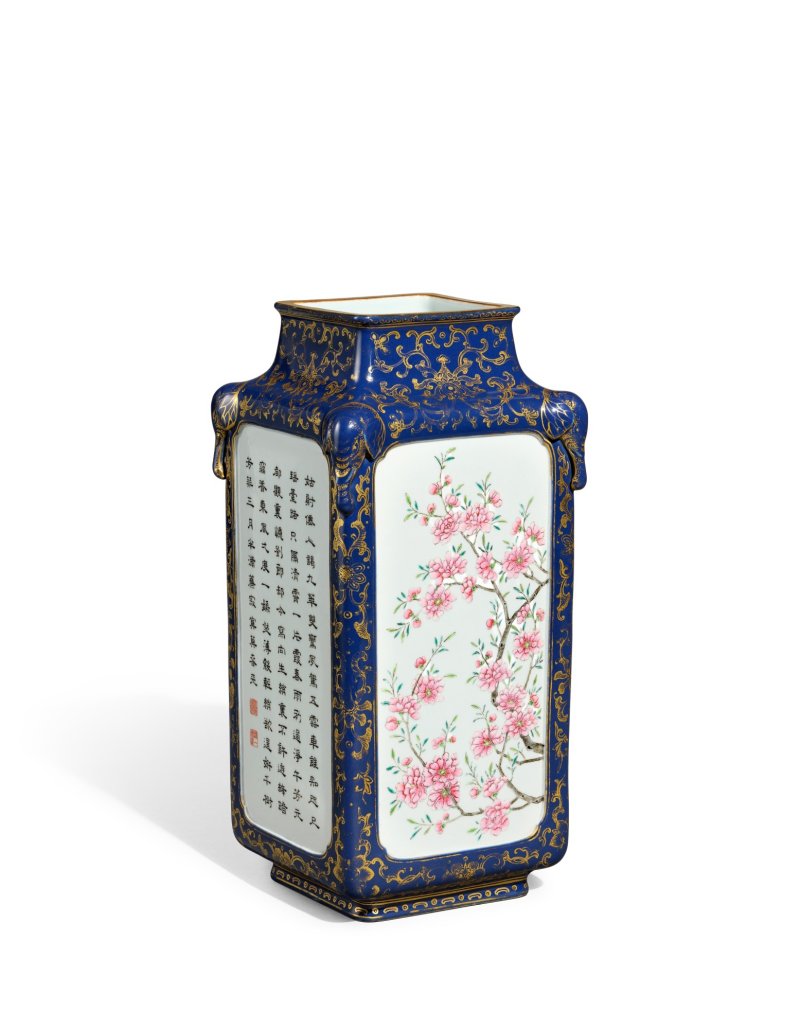

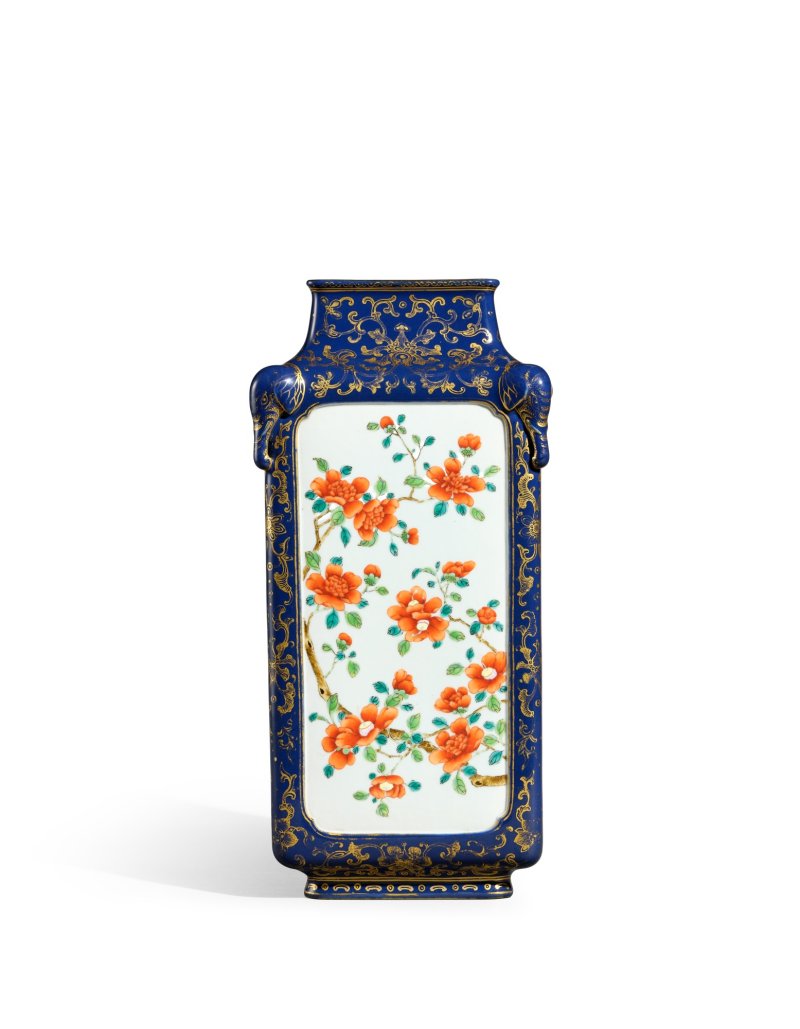
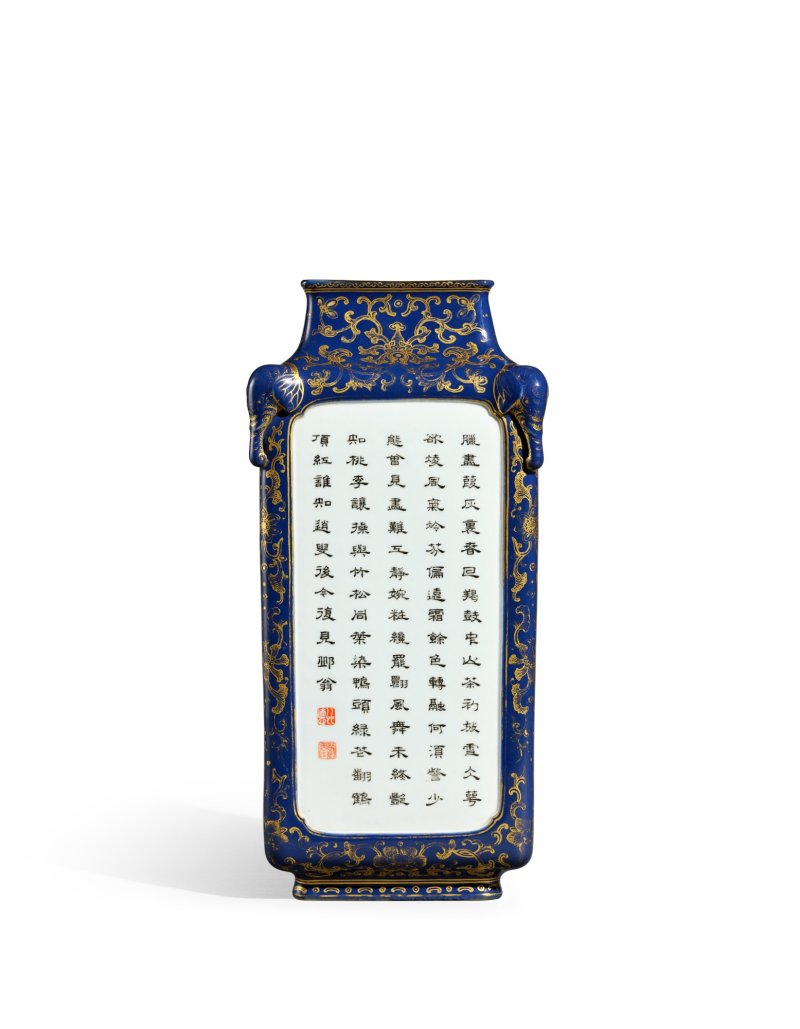
Lot 6035 A fine and rare imperial inscribed blue-ground and gilt-decorated 'floral' square vase, Qing dynasty, Qianlong period | 清乾隆 霽青地描金開光粉彩花卉御製詩鋪象首四方瓶 「乾隆宸翰」、「惟精惟一」、「比德」、「朗潤」印
落槌价
预展中
成交价
预展中
| 拍卖公司 | 苏富比 |
|---|---|
| 拍卖时间 | 2026年10月30日 |
拍品信息
拍品名称
A fine and rare imperial inscribed blue-ground and gilt-decorated 'floral' square vase, Qing dynasty, Qianlong period | 清乾隆 霽青地描金開光粉彩花卉御製詩鋪象首四方瓶 「乾隆宸翰」、「惟精惟一」、「比德」、「朗潤」印
起拍价
HKD 5,000,000
估值区间
5,000,000 - 10,000,000 HKD
尺寸
未知
品相
The vase is in very very good overall condition with just some expected rubbing to the gilded decoration. The enamels are otherwise well preserved.
If a condition report is provided to assist you with assessing the condition of the lot, it is for guidance purposes only. Such condition report may not refer to all faults, restoration, alterations, or adaptations because Sotheby's is not a professional conservator or restorer but rather a condition report is a statement of subjective, qualified opinion genuinely held by Sotheby's. For these reasons, any such condition report is not an alternative to taking your own professional advice regarding the condition of the lot. Prospective buyers should also refer to the Guide for Buyers at Auction which includes important notices concerning the type of property in this sale.
If a condition report is provided to assist you with assessing the condition of the lot, it is for guidance purposes only. Such condition report may not refer to all faults, restoration, alterations, or adaptations because Sotheby's is not a professional conservator or restorer but rather a condition report is a statement of subjective, qualified opinion genuinely held by Sotheby's. For these reasons, any such condition report is not an alternative to taking your own professional advice regarding the condition of the lot. Prospective buyers should also refer to the Guide for Buyers at Auction which includes important notices concerning the type of property in this sale.
更多信息
31.8 cm
来源:Sotheby’s Hong Kong, 8th April 2013, lot 3025.
图录
说明:來源
香港蘇富比2013年4月8日,編號3025
詩題:
「臘盡葭灰裏,春回羯鼓中。山茶初放雪,冰蕊欲凌風。
氣冷芳偏遠,霜餘色轉融。何須訾少態,曾見畫難工。
靜婉粧才罷,翾風舞來終。豔知桃李讓,操與竹松同。
葉染鴨頭綠,花翻鶴頂紅。誰知趙叟後,今復見邱翁。」
「姑射仙人謁九華,雙鸞夙駕五雲車。
誰知咫尺瑤臺路,只隔清霄一片霞。
春雨初過淨午芳,元都觀裏憶劉郎。
卻令寫向生綃裏,不許游蜂暗竊香。
東風一度一嫣然,薄縠輕綃欲遑妍。
千樹芳菲三月半,滿簾寂寞莫春天。」
In Praise of the Camellia – A Magnificent Blue-Ground Famille-Rose Decorated Imperial Vase
Hajni Elias
Finely potted and exquisitely decorated porcelain vases bearing elegant verses, combined with traditional flower decoration, were marvels of the Qianlong period. They tested the artist, who possibly worked under the guidance of China’s most celebrated Superintendent Tang Ying (1682-1756), in many ways. Inspired by scroll paintings, this type of decoration provided the challenge of transferring a two dimensional painting onto a three-dimensional ceramic piece. Much skill and planning went into the placing of the design, the execution of the calligraphy and the completion of the painted decoration in the famille-rose palette, creating a masterpiece designed to give great pleasure to the emperor.
The present piece belongs to a special group of wares created in the Imperial kilns at Jingdezhen, Jiangxi province, where the most highly skilled potters were employed to produce wares for the Qing court. The poems are written in the clerical style of calligraphy known as lishu, with the sepia ink characters neatly and spaciously placed, creating an overall impression of formal serenity. The emperor must have especially favoured the poem titled Yong shancha ('Song for the Camellia'), as it also appears on a famille-rose hexahedral brushpot with a design of flowers with the poem in sepia ink on a panel, from the Qing court collection and now in the Nanjing Museum, illustrated in The Official Kiln Porcelain of the Chinese Qing Dynasty, Shanghai, 2003, p.316; and on a closely comparable octagonal vase decorated with two floral panels and two poems, one of which is the same as that seen here but written in the regular or kaishu script, in the National Palace Museum, Taipei, included in the Special Exhibition of K’ang-his, Yung-cheng and Ch’ien-lung Porcelain Ware from the Ch’ing Dynasty in the National Palace Museum, National Palace Museum, Taipei, 1986, cat. no. 80. The two poems may be translated as follows:
Twelfth month finished in reed ashes,
Spring’s return announced in hourglass drum.
The camellia begins to bloom in the snow,
Ice stamens about to trip lightly on the breeze.
Scent cold, fragrance reaches out to remote distances,
Amidst remains of frost, colours transform and melt.
No need to slight its small stature,
For, once seen, it’s hard to paint well.
A quiet and gentle effect, makeup stops at that,
Fluttering in the breeze its dance comes to an end.
For gorgeousness we know it yields to pear and peach,
But in character it’s ranked with bamboo and pine.
Leaves dyed duck’s head green,
Blossoms more than crane’s crest red,
Who could’ve known that after Old Man Zhao
We’d now again see Old Gentleman Qiu!
Seals: Bide ('compared to virtue') and Langrun ('bright and lustrous')
When the immortal of Mount Guye
pays a visit to Nine Fluorescence Palace
Drawn by paired phoenixes he starts out early
in his Five Clouds Carriage,
But who knows how thin and flimsy
that Jasper Terrace Highway is,
For it’s just a stretch of rosy red cloud
on the far side of clear sky.
A spring rain has just past through
cleansing midday fragrant blossoms,
Here at the Mysterious Metropolis Abbey,
reminding me of Young Man Liu.
Now I’ll order this scene
be sketched on fine silk,
So wandering bees won’t be allowed
slyly to steal their fragrance.
With each advent of the east wind,
she’s a year more sweet and charming,
In thin crepes and light silks
eager to display her beauty.
It may be the fragrant glory of a thousand trees
half way through third month,
Yet on this day at the end of spring
loneliness fills her curtains.
Seals: Qianlong chen han ('Emperor Qianlong’s Own mark') and Weijing weiyi ('Be Precise, Be Undivided')
The poems celebrate the arrival of spring, a season associated with change and renewal for both nature and mankind. One of the poems praise the beauty of the camellia, a winter and spring flower that brings a vivid splash of colour when little else is in bloom. He often ordered poems to be inscribed on decorative objects. It is not clear whether the Qianlong Emperor actually wrote these poems himself or simply chose to use verses composed by someone else.
The paintings of camellias and peach blossoms against a white ground, decorating this vase, are attractively framed by the stylized gilt painted scroll motif against a dark blue ground, as if the beauty of nature is revealed through a window. The sharp contrast between the scholarly decoration of the flowers and calligraphy against the luxurious gilt decoration is attractive and visibly reflects Qianlong’s taste in art, his fondness for the traditional and the opulent. This vase represents his personal taste, which gravitated towards porcelain designs that were artistically complex pieces and showed his appreciation for scholarship expressed in his writings and poems.
For examples of vessels decorated in a related fashion, bearing an imperial poem and floral designs in panels on a gilt-decorated blue-ground, see a wall vase included in the exhibition The Life of Emperor Qianlong, the Macao Museum of Art, Macao, 2002, cat. no. 63.7; and a globular vase, the main body of the vessel treated as an illustrated album with a panel of poetry followed by a panel of illustration, the neck and foot decorated with floral scroll design in gold against a blue-ground, published in Chuimei Ho and Bennet Bronson, Splendors of China’s Forbidden City. The Glorious Reign of Emperor Qianlong, Chicago, 2004, pl. 294.
詠山茶:霽青描金開光粉彩花卉紋四方瓶
Hajni Elias
此瓶形態端莊規整,上繪傳統花卉及墨書麗辭佳句,粉彩畫工生動自然,書法筆意婉約簡靜,屬乾隆一朝洋彩大觀中精妙之作,應為供清高宗親賞鑑玩而作。受啟於詩意圖及題畫詩,藝匠妙將卷軸書畫,轉移至立體瓷作之上,詩畫並飾,相輔相成。藝匠書畫及造瓷技藝精鍊,心思縝密,或隸屬著名的景德鎮御窰廠督陶官唐英(1682-1756年)旗下。
瓷瓶燒造於江西景德鎮御窰,由當地藝技卓絕之匠人巧製。瓶身外壁墨書隸體詩句,流麗工整,佈局舒展,整體氣度端莊寧靜。一詩題為《詠山茶》,應屬清高宗最喜愛的詩之一,帶有此詩之相類作例,參考一粉彩題詩六方筆筒,飾花卉紋,一面墨書《詠山茶》,出自清宮舊藏,現存南京博物院,錄於《中國清代官窰瓷器》,上海,2003年,頁316。另有乾隆年款八方瓶,兩面飾開光花卉圖,亦墨書詩句兩首,其中一首內容與此瓶御詩相同,但以楷書為體,現藏台北故宮博物院,與本品近似,可資對比,載於《清康雍乾名瓷》,故宮博物院,台北,1986年,編號 80。
詩句頌揚春天來臨,萬象更新。其中一詩,稱讚山茶之美,山茶每於冬至、初春季節轉換開花,當其他花木還在半睡未醒之際,清風吹過,已聞得山茶芬馥,花色鮮麗嬌媚,仿佛令人看見了春日的柔美輕盈。清高宗命人將詩句飾於藝品珍藏之上。然此瓶上詩文,是否出自弘曆之手,或只是世宗借用前人之句,尚未可知。
瓶壁四方開光,兩面分別繪白地桃枝山茶,群葩吐豔,開光以外通體鈷藍地,加繪描金番蓮,宛若推窗外探,芳菲撲臉。書畫兼備的文人傳統,與細緻描金的奢華品味,形成強烈對比,繁密中見雅尚,展現高宗對墨客騷人的尊崇,以及複雜瓷作的偏好,突顯他獨特的個人品味。
參考一相類瓶例,同帶花卉紋飾,並書御製詩,開光外蓋施藍地描金,錄於《乾隆皇帝文化生活藝術展》,澳門藝術博物館,澳門,2002年,編號63.7。另有瓶例,器身開光墨書詩句,另有開光內繪花卉紋飾,頸足飾藍地描金花卉紋,載於何翠媚及 Bennet Bronson,《Splendors of China’s Forbidden City. The Glorious Reign of Emperor Qianlong》,芝加哥,2004年,圖版294。
常见问题
这件A fine and rare imperial inscribed blue-ground and gilt-decorated 'floral' square vase, Qing dynasty, Qianlong period | 清乾隆 霽青地描金開光粉彩花卉御製詩鋪象首四方瓶 「乾隆宸翰」、「惟精惟一」、「比德」、「朗潤」印的成交价是多少?
落槌价为 预展中。 成交价为 预展中。
拍品的品相状况如何?
The vase is in very very good overall condition with just some expected rubbing to the gilded decoration. The enamels are otherwise well preserved.
If a condition report is provided to assist you with assessing the condition of the lot, it is for guidance purposes only. Such condition report may not refer to all faults, restoration, alterations, or adaptations because Sotheby's is not a professional conservator or restorer but rather a condition report is a statement of subjective, qualified opinion genuinely held by Sotheby's. For these reasons, any such condition report is not an alternative to taking your own professional advice regarding the condition of the lot. Prospective buyers should also refer to the Guide for Buyers at Auction which includes important notices concerning the type of property in this sale.
If a condition report is provided to assist you with assessing the condition of the lot, it is for guidance purposes only. Such condition report may not refer to all faults, restoration, alterations, or adaptations because Sotheby's is not a professional conservator or restorer but rather a condition report is a statement of subjective, qualified opinion genuinely held by Sotheby's. For these reasons, any such condition report is not an alternative to taking your own professional advice regarding the condition of the lot. Prospective buyers should also refer to the Guide for Buyers at Auction which includes important notices concerning the type of property in this sale.
这件拍品的流传来源是什么?
Sotheby’s Hong Kong, 8th April 2013, lot 3025.
图录
图录