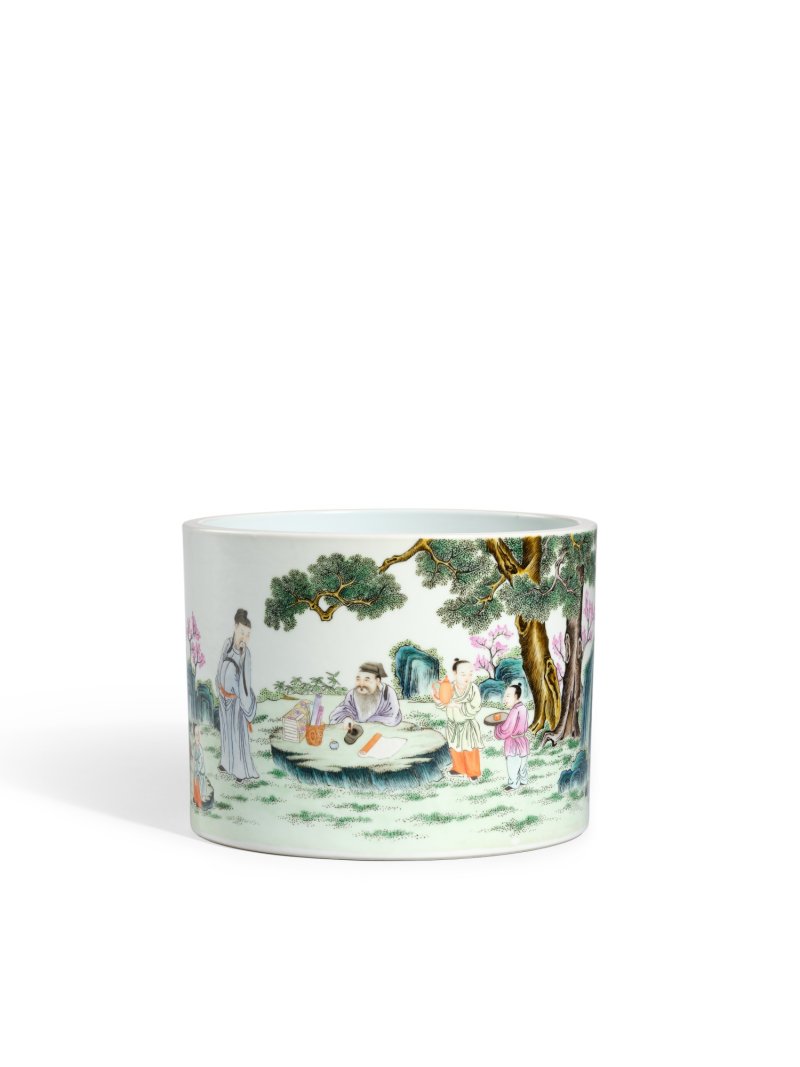
Lot 6043 A fine and inscribed famille-rose ‘Su Shi and Mi Fu’ brushpot, signed Tang Ying, Qing dynasty, 19th century | 清十九世紀 粉彩東坡玩硯圖題詩筆筒 《瀋陽唐英》款
落槌价
预展中
成交价
预展中
| 拍卖公司 | 苏富比 |
|---|---|
| 拍卖时间 | 2026年10月30日 |
拍品信息
拍品名称
A fine and inscribed famille-rose ‘Su Shi and Mi Fu’ brushpot, signed Tang Ying, Qing dynasty, 19th century | 清十九世紀 粉彩東坡玩硯圖題詩筆筒 《瀋陽唐英》款
起拍价
HKD 650,000
估值区间
650,000 - 1,300,000 HKD
尺寸
未知
品相
Fine overall condition, with the enamels generally very well preserved. Minor firing imperfections include a few iron spots inside and several pinholes on the rim and base.
整體品相佳。釉彩保存良好。偶見輕微窰燒瑕疵,如器內數點鏽斑,口沿及底部數點棕眼。
If a condition report is provided to assist you with assessing the condition of the lot, it is for guidance purposes only. Such condition report may not refer to all faults, restoration, alterations, or adaptations because Sotheby's is not a professional conservator or restorer but rather a condition report is a statement of subjective, qualified opinion genuinely held by Sotheby's. For these reasons, any such condition report is not an alternative to taking your own professional advice regarding the condition of the lot. Prospective buyers should also refer to the Guide for Buyers at Auction which includes important notices concerning the type of property in this sale.
更多信息
d. 21.5 cm
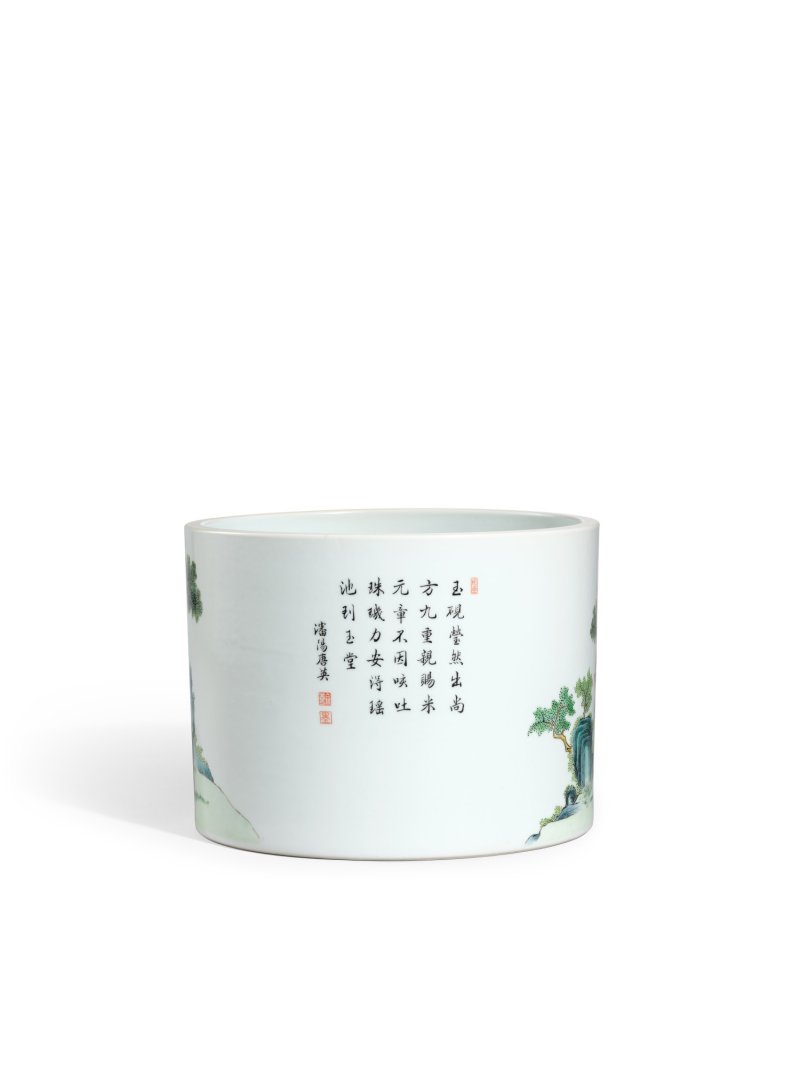
詩文:
玉硯瑩然出尚方,九重親賜米元章。
不因啖吐珠璣力,安得瑤池到玉堂。
——出自《東坡詩話》
来源:Collection of the Idemitsu Museum of Arts, Tokyo.
Sotheby’s Hong Kong, 8th April 2013, lot 3023.
展览:Chūgoku Bijutsu-ten Series 5: Min Shin no Bijutsu [Chinese Art Exhibition Series: The Art of the Ming and Qing Dynasties], Osaka Municipal Museum of Art, Osaka, 1980.
著录:Toji taikei [Compendium of Ceramics], vol. 46, Tokyo, 1973, fig. 29.
Idemitsu Bijutsukan zōhin zuroku. Chūgoku tōji / Chinese Ceramics in the Idemitsu Collection, Tokyo, 1987, col. pl. 231.
图录
说明:來源
出光美術館,東京
香港蘇富比2013年4月8日,編號3023
展覽
《中国美術展シリーズ5:明清の美術》,大阪市立美術館,大阪,1980年
出版
《陶磁大系》,卷46,東京,1973年,圖29
《出光美術館藏中國陶磁》,東京,1987年,彩圖231
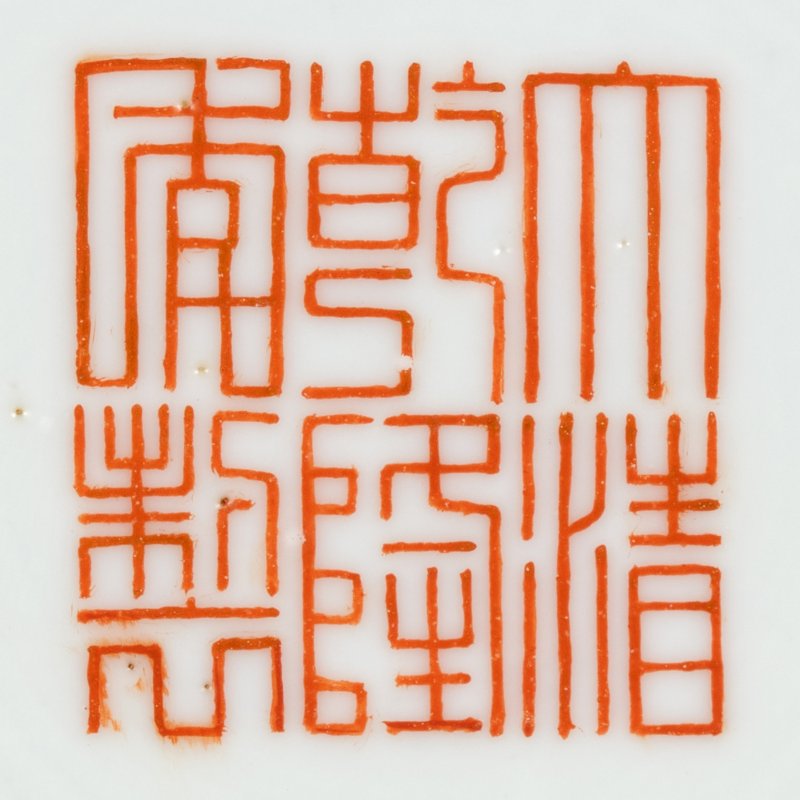
The present finely painted brushpot has an illustrious provenance, having been treasured in Japan for a long period of time. It was included in the Osaka Municipal Museum of Art exhibition Arts of the Ming and Qing Dynasties, Osaka, 1980, and is also illustrated in Toji taikei, vol. 46, Tokyo, 1973, fig. 29, and in Chinese Ceramics in the Idemitsu Collection, Tokyo, 1987, col. pl. 231. It is based on a near identical brushpot in the Shanghai Museum, of the same dimensions and closely related decoration, but with a four-character ‘Qianlong nianzhi’ reign mark in red enamel on the base instead of the six-character mark seen on this piece. It is illustrated in a number of publications including, Zhongguo taoci quanji [The complete works of Chinese ceramics], vol. 15, Shanghai, 2000, pl. 22, and also in Wenwu 1978, vol 7, pp. 83–84.
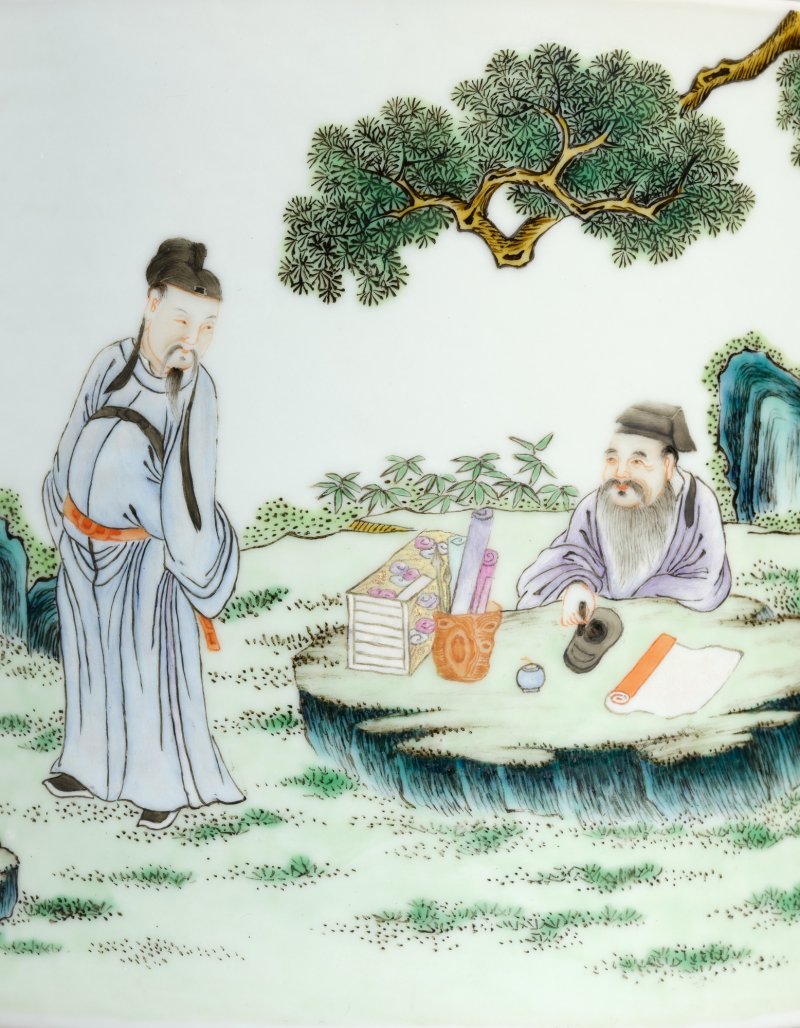
The figural scene on the brushpot, titled ‘Painting of Old Mi Examining His Inkstone’, depicts the Song painter, poet and calligrapher Mi Fu (1051-1107), standing in his garden eyeing his friend Su Shi (1037-1101) seated at a rock table before an inkstone. The poem accompanying this scene reveals the story behind the painting. It may be found with a passage in the Dongpo shihua (Poetry Talks Related to Dongpo [Su Shi]), attributed to Mi Fu’s contemporary, Su Shi, later edited by Chen Xiuming and reprinted in Lin Li, ed., Zhongguo lidai zhenxi xiaoshuo [Rare and Important Anecdotes from China throughout the Ages], Beijing, 1998, p. 398.
According to the passage, Mi Fu was once presented an inkstone named ‘Jasper Pond’2 by the Song emperor Huizong (r. 1100-1126). Every time he brought it out for a look, he bowed twice toward it before appreciating but he never dared actually use it. One day, his close friend Su Shi asked to see his much treasured ‘Jasper Pond’ inkstone. Mi Fu ordered Su Shi to bow toward it twice and only then brought it out to show him. Su Shi said, ‘Although this inkstone seems very fine, we don’t know yet what the ink from it is like.’ He noticed an ink stick on the desk, spat into the inkstone and ground some ink with it. Mi Fu was outraged and scolded him saying, ‘You old bandit, you’ve ruined my inkstone!’ And then he tried to give the inkstone to Su Shi, who said, ‘How can you ever give a gift from the Emperor to someone else?’ Mi Fu replied, ‘How can such a soiled inkstone ever be used again?’ Su Shi laughed and, taking the inkstone, composed a poem in reply. The poem may be translated as follows:
This jade inkstone, shimmering and glossy
came from the Imperial Manufactory,
A personal gift from the Ninth Layer of Heaven3
to Mi Yuanzhang.
If it weren’t for the power to cough up and spit out
jades and pearls,
How could this ‘Jasper Pond’ ever have reached
the Jade Hall?4
1Jasper Pond is located in the land of the Immortals.
2“Ninth Layer of Heaven” is the abode of the emperor.
3The third line may be interpreted as follows: ‘If Su Shi had not spat onto the inkstone, and if his writings were not praised as brilliant as jade and pearl, the inkstone would not have come to him, a Hanlin academician.’ ‘Jade Hall’ refers to the Hanlin Academy.
本品為日本名家珍藏,曾於1980年大阪市立美術館《明清の美術》展出,又出版於《陶磁大系》以及《出光美術館藏中國陶磁》。此器應以上海博物館藏粉彩筆筒為範,該品之尺寸、紋飾與此幾近一樣,惟底書礬紅彩「乾隆年製」四字款,而本品則帶六字款,載於《中國陶瓷全集》,卷15,上海,2000年,圖版22,亦見於《文物》, 1989年,卷7,頁83–84。
圖中見宋人蘇軾(1037-1101年)安坐園林,怡然賞玩墨硯寶物,會心微笑,宋代書畫家、詩人米芾(1051-1107年)站於一旁觀看。此景及畫後題詩皆出自傳蘇軾(1037-1011年)著《東坡詩話》,經民國陳秀明編輯,錄於林鯉等編,《中國歷代珍稀小說》,北京,1998年,頁398。
米芾,字符章,天性好潔。御賜一硯,名曰瑤池。每出觀,必再拜而淡玩,不敢擅用也。東坡一日請觀瑤池硯,元章命之再拜,而後出示之。東坡曰:「此硯雖好,未知發墨何如?」因見案上有墨,坡遂以唾磨之。元章罵曰:「鬍子壞吾硯矣。」遂以硯與東坡。東坡曰:「御賜豈可與人。」元章曰:「污硯豈可複用。」坡笑持硯而回詩曰:「玉硯瑩然出尚方,九重親賜米元章。不因啖吐珠璣力,安得瑤池到玉堂。」
唐英(1682–1756年)字俊公,號蝸居老人,祖籍遼寧瀋陽,棣漢軍正白旗,祖先為清帝家奴。十六歲始事於清宮造辦處,康熙年間進養心殿,學詩文、書畫、戲曲等。職於紫禁城時,已兼顧御瓷樣式事宜,雍正四年(1726年)獲派往景德鎮,初為輔助年希堯,後擢督陶官,負責御窰廠整體運作達二十五年,成就輝煌,乾隆二十一年(1756年)以七十五歲高齡得乾隆帝見於圓明園,賜「奉宸苑卿」銜,後不久離世。
常见问题
这件A fine and inscribed famille-rose ‘Su Shi and Mi Fu’ brushpot, signed Tang Ying, Qing dynasty, 19th century | 清十九世紀 粉彩東坡玩硯圖題詩筆筒 《瀋陽唐英》款的成交价是多少?
落槌价为 预展中。 成交价为 预展中。
拍品的品相状况如何?
Fine overall condition, with the enamels generally very well preserved. Minor firing imperfections include a few iron spots inside and several pinholes on the rim and base.
整體品相佳。釉彩保存良好。偶見輕微窰燒瑕疵,如器內數點鏽斑,口沿及底部數點棕眼。
If a condition report is provided to assist you with assessing the condition of the lot, it is for guidance purposes only. Such condition report may not refer to all faults, restoration, alterations, or adaptations because Sotheby's is not a professional conservator or restorer but rather a condition report is a statement of subjective, qualified opinion genuinely held by Sotheby's. For these reasons, any such condition report is not an alternative to taking your own professional advice regarding the condition of the lot. Prospective buyers should also refer to the Guide for Buyers at Auction which includes important notices concerning the type of property in this sale.
整體品相佳。釉彩保存良好。偶見輕微窰燒瑕疵,如器內數點鏽斑,口沿及底部數點棕眼。
If a condition report is provided to assist you with assessing the condition of the lot, it is for guidance purposes only. Such condition report may not refer to all faults, restoration, alterations, or adaptations because Sotheby's is not a professional conservator or restorer but rather a condition report is a statement of subjective, qualified opinion genuinely held by Sotheby's. For these reasons, any such condition report is not an alternative to taking your own professional advice regarding the condition of the lot. Prospective buyers should also refer to the Guide for Buyers at Auction which includes important notices concerning the type of property in this sale.
这件拍品的流传来源是什么?
Collection of the Idemitsu Museum of Arts, Tokyo.
Sotheby’s Hong Kong, 8th April 2013, lot 3023.
Sotheby’s Hong Kong, 8th April 2013, lot 3023.
这件拍品曾在哪些展览中展出过?
Chūgoku Bijutsu-ten Series 5: Min Shin no Bijutsu [Chinese Art Exhibition Series: The Art of the Ming and Qing Dynasties], Osaka Municipal Museum of Art, Osaka, 1980.
这件拍品被哪些著录书籍记载?
Toji taikei [Compendium of Ceramics], vol. 46, Tokyo, 1973, fig. 29.
Idemitsu Bijutsukan zōhin zuroku. Chūgoku tōji / Chinese Ceramics in the Idemitsu Collection, Tokyo, 1987, col. pl. 231.
图录
Idemitsu Bijutsukan zōhin zuroku. Chūgoku tōji / Chinese Ceramics in the Idemitsu Collection, Tokyo, 1987, col. pl. 231.
图录