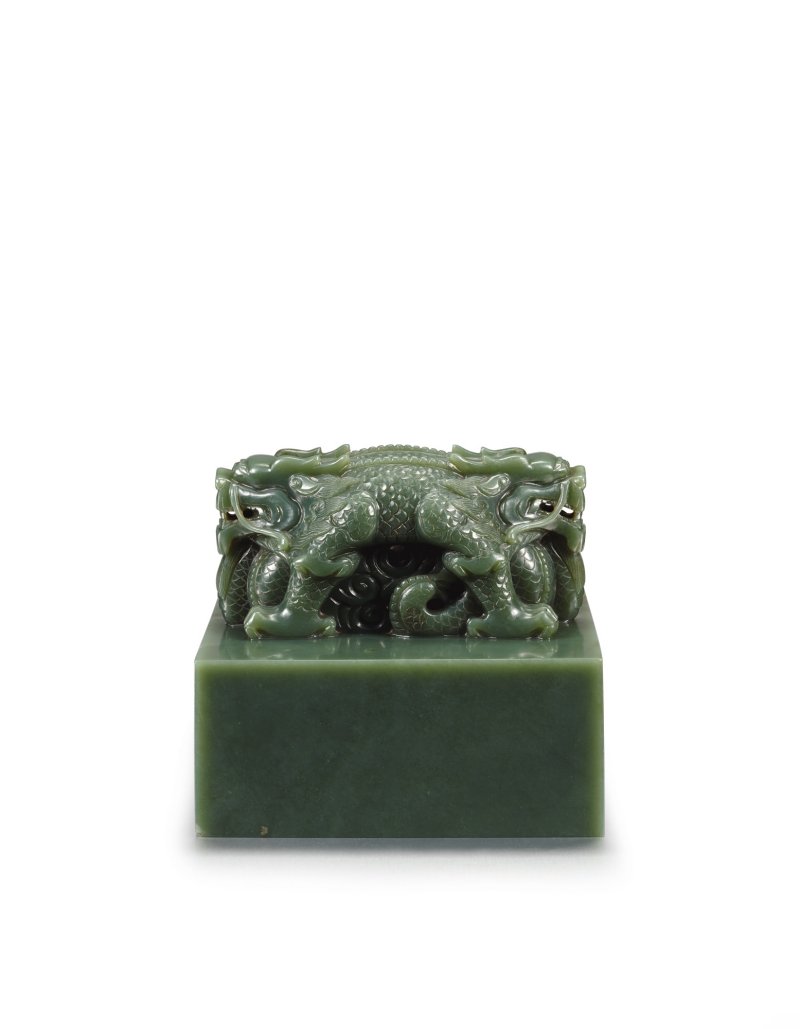

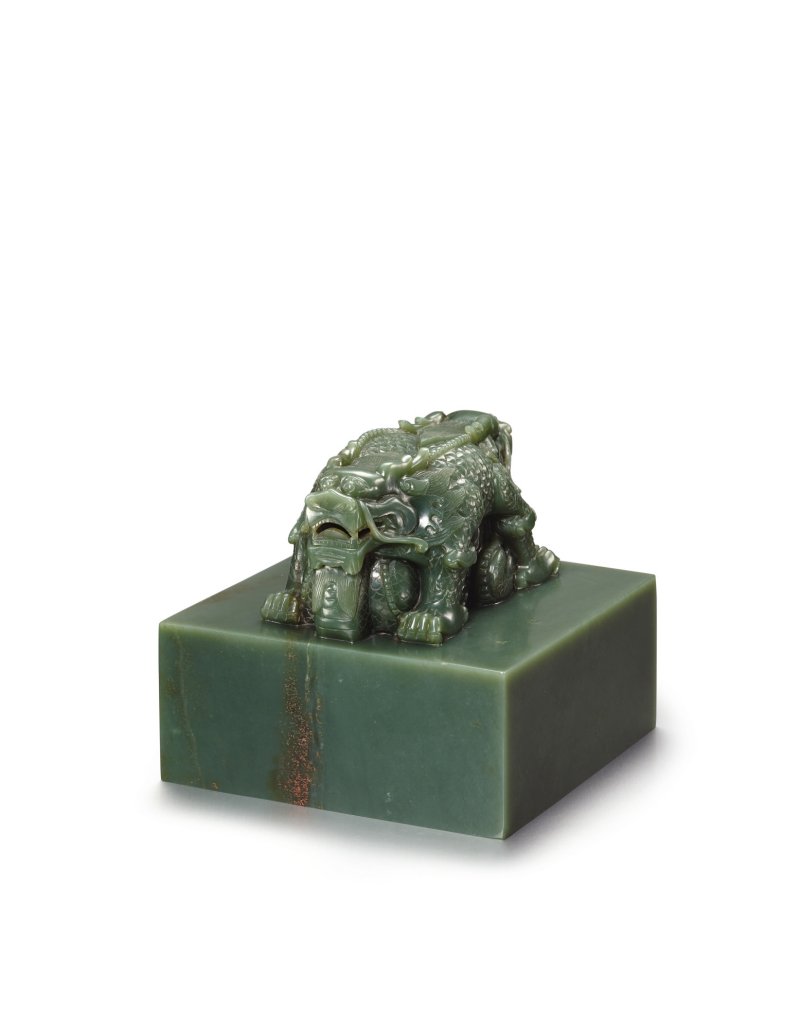
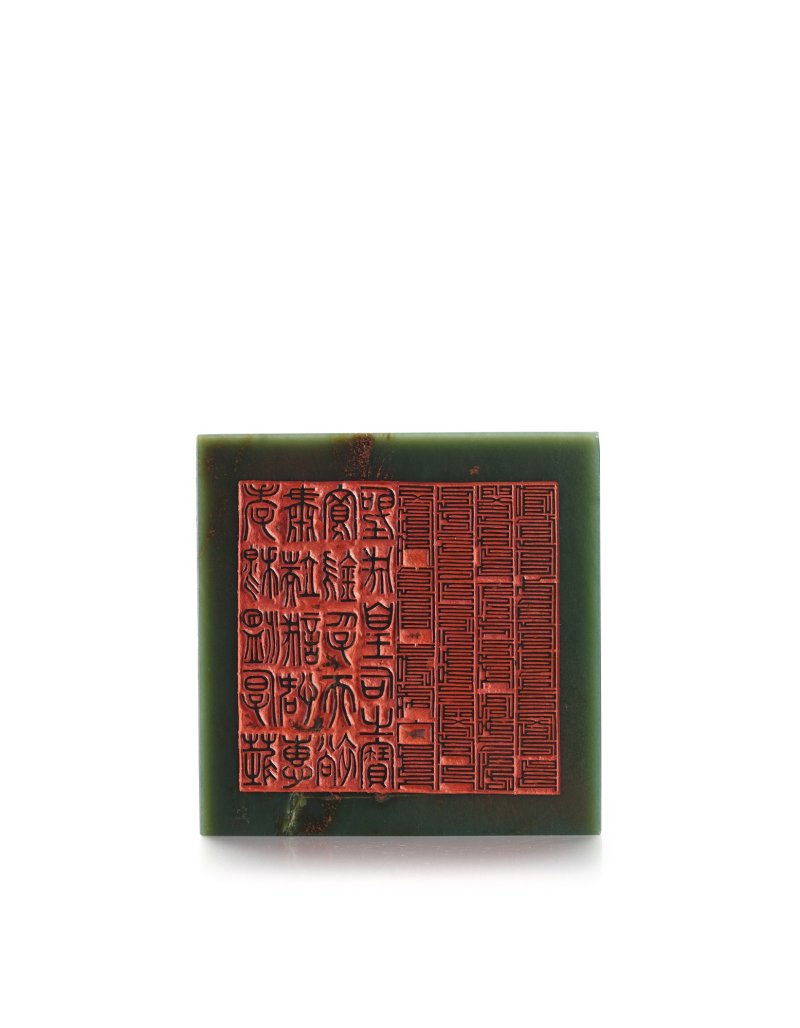
Lot 6075 A large spinach-green jade 'dragon' seal with Manchu and Chinese inscriptions, Qing dynasty, Guangxu period | 清光緒 碧玉交龍鈕滿漢文孝穆成皇后尊謚寶璽 印文:孝穆溫厚莊肅端誠恪惠寬欽孚天裕聖成皇后之寶
落槌价
预展中
成交价
预展中
| 拍卖公司 | 苏富比 |
|---|---|
| 拍卖时间 | 2026年10月30日 |
拍品信息
拍品名称
A large spinach-green jade 'dragon' seal with Manchu and Chinese inscriptions, Qing dynasty, Guangxu period | 清光緒 碧玉交龍鈕滿漢文孝穆成皇后尊謚寶璽 印文:孝穆溫厚莊肅端誠恪惠寬欽孚天裕聖成皇后之寶
起拍价
HKD 1,000,000
估值区间
1,000,000 - 2,000,000 HKD
尺寸
未知
品相
Good overall condition, with expected occasional minor bruising and pitting, as well as minute nicks to the extremities, including the tips of the dragons’ scales and manes and the edges of the seal.
整體品相良好。邊沿有輕磕及撞痕,包括龍鱗及毛髮邊沿,實屬正常。
If a condition report is provided to assist you with assessing the condition of the lot, it is for guidance purposes only. Such condition report may not refer to all faults, restoration, alterations, or adaptations because Sotheby's is not a professional conservator or restorer but rather a condition report is a statement of subjective, qualified opinion genuinely held by Sotheby's. For these reasons, any such condition report is not an alternative to taking your own professional advice regarding the condition of the lot. Prospective buyers should also refer to the Guide for Buyers at Auction which includes important notices concerning the type of property in this sale.
更多信息
13 by 13 cm
来源:Collection of Mrs. Christian Holmes, New York.
Collection of Alan and Simone Hartman.
展览:Chinese Jades through the Centuries: From Private and Museum Collections, China House Gallery, China Institute in America, New York, 1968, cat. no. 63.
著录:Robert Kleiner, Chinese Jades from the Collection of Alan and Simone Hartman, Hong Kong, 1996, cat. no. 150.
图录
说明:來源
Christian Holmes 夫人收藏,紐約
哈特曼伉儷收藏
展覽
《Chinese Jades through the Centuries: From Private and Museum Collections》,華美協進社藝廊,紐約,1968年,編號63
Robert Kleiner,《Chinese Jades from the Collection of Alan and Simone Hartman》,香港,1996年,編號150
This seal belongs to a special group of seals known as yibao, or posthumous seals. Such seals were not created to be used during the lifetimes of emperors and empresses but rather were produced after their deaths as part of the system of ancestral temples and posthumous naming in China. The present was created in the Guangxu period, most likely in the first year (1875), to commemorate the first wife of his grandfather, the Daoguang Emperor, Empress Xiaomou Cheng (1781-1808), who passed away at the age of 28, before her husband ascended the throne.
In Chinese history, the worship and posthumous naming of emperors and empresses were an important component of court rules governed by explicit and strict regulations. Posthumous imperial seals were an essential category of artefacts created to be included in these rituals. In general, a posthumous title contained ten laudatory terms for a total of twenty Chinese characters. Usually twelve characters in length initially, an empress’s posthumous title typically begins with xiao [filialness], continues with a series of eulogising phrases, and ends with the temple name of her emperor. An emperor newly ascended to the throne was to add one or two laudatory phrases to the previous emperors and empresses. Seeing the potential for these titles to become unwieldy and confusing, the Qianlong emperor issued an edict upon ascending the throne that additions were only to be made within reason. By the Jiaqing reign, it was decided that titles would not be further lengthened, and the meanings and lengths of imperial posthumous titles were standardised.
In the 45th year of the Qianlong reign (1780), the Emperor decreed that a new set of posthumous imperial jade seals be made and dedicated at the Ancestral Temple in Beijing, and that the old ones would be dedicated at the Ancestral Temple in Shengjing. The old posthumous imperial seals had been made on an ad hoc basis and thus were of different colours and qualities; thus the new set would be of the same size and form, with finials in the shape of dragons and crafted uniformly from Khotan jade. By 1782, these sixteen new seals were completed and dedicated by the Qianlong Emperor at the Ancestral Temple. The following year, he ordered Yonglang, Prince Yi, and others to send the sixteen old jade albums and seals to the Ancestral Temple in Shengjing, thereby beginning the practice of maintaining two sets of imperial jade albums and seals between the former and current capitals. When a new emperor added to his predecessors’ posthumous titles, officials and craftspeople would be tasked with recarving.
It is recorded that in the 1st year of the Guangxu period, the Emperor added to the existing posthumous title for his late grandmother and decreed her to be named Empress Xiaomu Wenhou Zhuangsu Duancheng Kehui Kuanqin Futian Yusheng Cheng, the exact title inscribed on the present seal.
此方寶璽屬於一類特殊的印璽,即「諡寶」。此類寶璽並非供帝后生前使用,而是於其駕崩後,配合中國傳統宗廟與上諡制度而特製。本品製於光緒年間,極可能為光緒元年(1875年),乃為紀念光緒帝祖父道光帝之元配孝穆成皇后(1781-1808年)而製。孝穆成皇后於其夫登基前逝世,年僅二十八歲。
在中國歷史上,帝后之祭祀與上諡乃宮廷禮制之重要組成部分,有著明確且嚴格的規定。而帝后諡寶更是此類典儀中不可或缺之重器。一般而言,完整之諡號包含十個讚美之詞,共計二十字。皇后之諡號初上時通常為十二字,以「孝」字起首,繼以一系列美諡,最後以其夫(皇帝)之帝號(或廟號)作結。新帝登基時,通常會為先帝及先后尊加一至兩詞(兩至四字)之徽號。有鑑於諡號不斷疊加易致冗長繁雜,乾隆帝於登基時下詔,規定尊加字數應有定制。至嘉慶朝,遂定下不再增加字數之規,帝后諡號之含義與字數長度遂成定制。
乾隆四十五年(1780年),高宗下旨重新琢製一套全新之玉製諡寶,供奉於北京太廟,而舊有之諡寶則移送盛京太廟供奉。舊有之諡寶乃歷代陸續隨時添造,故玉色參差、質地不一;新造之諡寶則要求尺寸形制劃一,皆作交龍鈕,並統一採用和闐玉雕琢。至乾隆四十七年(1782年),十六方新造玉寶告竣,由乾隆帝親自供奉於太廟。翌年,高宗命儀親王永琅等人將十六份舊玉冊、玉寶送往盛京太廟尊藏,自此開啟了兩京太廟各供奉一套帝后玉冊玉寶之定制。當新帝為先帝后尊加諡號時,便會交由臣工匠人將寶璽進行磨洗改刻。
據記載,光緒元年,皇帝為其已故祖母尊加上諡,定其諡號為「孝穆溫厚莊肅端誠恪惠寬欽孚天裕聖成皇后」,正與本方寶璽之印文完全吻合。
常见问题
这件A large spinach-green jade 'dragon' seal with Manchu and Chinese inscriptions, Qing dynasty, Guangxu period | 清光緒 碧玉交龍鈕滿漢文孝穆成皇后尊謚寶璽 印文:孝穆溫厚莊肅端誠恪惠寬欽孚天裕聖成皇后之寶的成交价是多少?
落槌价为 预展中。 成交价为 预展中。
拍品的品相状况如何?
Good overall condition, with expected occasional minor bruising and pitting, as well as minute nicks to the extremities, including the tips of the dragons’ scales and manes and the edges of the seal.
整體品相良好。邊沿有輕磕及撞痕,包括龍鱗及毛髮邊沿,實屬正常。
If a condition report is provided to assist you with assessing the condition of the lot, it is for guidance purposes only. Such condition report may not refer to all faults, restoration, alterations, or adaptations because Sotheby's is not a professional conservator or restorer but rather a condition report is a statement of subjective, qualified opinion genuinely held by Sotheby's. For these reasons, any such condition report is not an alternative to taking your own professional advice regarding the condition of the lot. Prospective buyers should also refer to the Guide for Buyers at Auction which includes important notices concerning the type of property in this sale.
整體品相良好。邊沿有輕磕及撞痕,包括龍鱗及毛髮邊沿,實屬正常。
If a condition report is provided to assist you with assessing the condition of the lot, it is for guidance purposes only. Such condition report may not refer to all faults, restoration, alterations, or adaptations because Sotheby's is not a professional conservator or restorer but rather a condition report is a statement of subjective, qualified opinion genuinely held by Sotheby's. For these reasons, any such condition report is not an alternative to taking your own professional advice regarding the condition of the lot. Prospective buyers should also refer to the Guide for Buyers at Auction which includes important notices concerning the type of property in this sale.
这件拍品的流传来源是什么?
Collection of Mrs. Christian Holmes, New York.
Collection of Alan and Simone Hartman.
Collection of Alan and Simone Hartman.
这件拍品曾在哪些展览中展出过?
Chinese Jades through the Centuries: From Private and Museum Collections, China House Gallery, China Institute in America, New York, 1968, cat. no. 63.
这件拍品被哪些著录书籍记载?
Robert Kleiner, Chinese Jades from the Collection of Alan and Simone Hartman, Hong Kong, 1996, cat. no. 150.
图录
图录